Why 60% of HVAC Businesses Fail in Year 1 (And How to Beat the Odds)
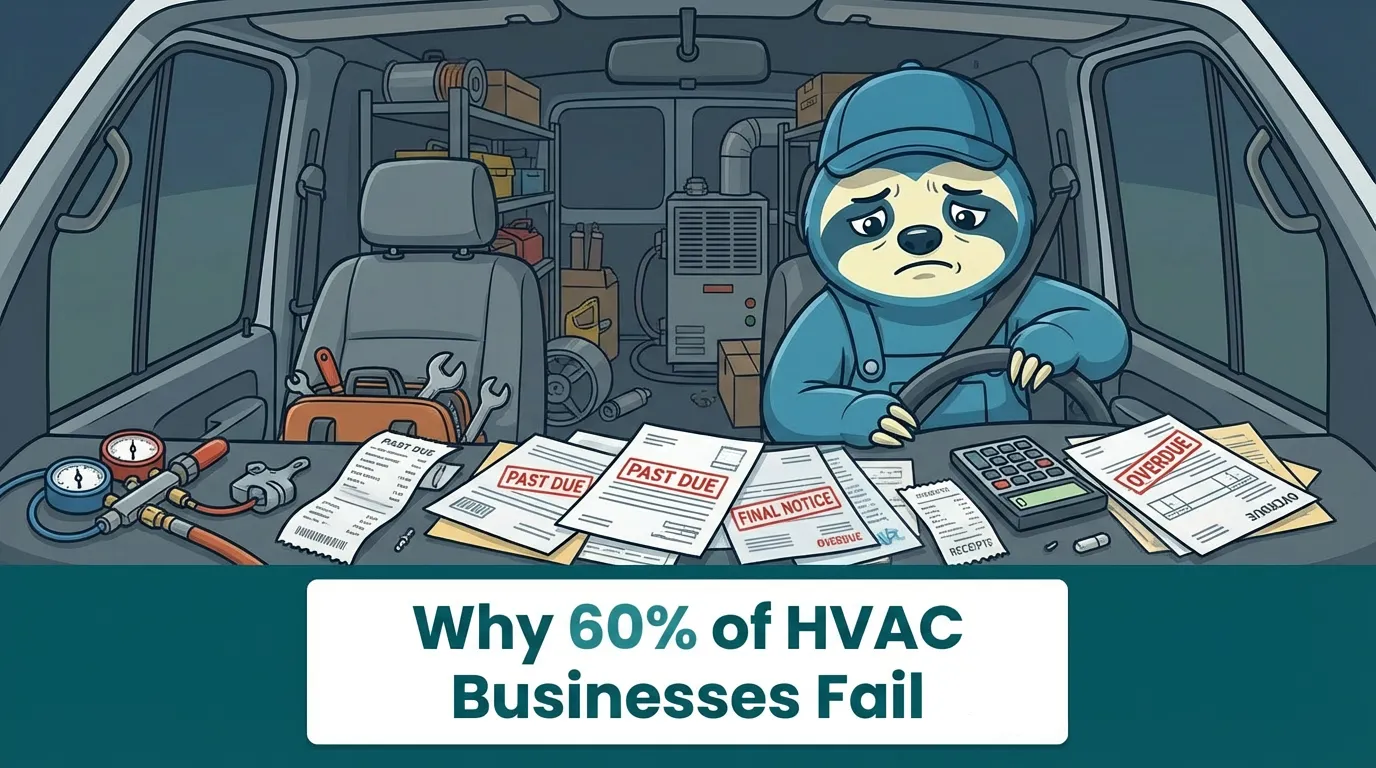
The HVAC industry is booming. Climate change, aging infrastructure, and new efficiency regulations mean demand has never been higher. So why do most new HVAC businesses fail within their first year?
The uncomfortable truth is that technical skill has almost nothing to do with it. The best technician in town can still run a failing business, while someone with average skills but solid business sense thrives.
After talking to contractors who've been in the trenches - both those who made it and those who didn't - we've identified the seven deadly mistakes that kill promising HVAC businesses. More importantly, we'll show you how to avoid them.
The Brutal Reality: HVAC Failure Statistics
Let's not sugarcoat this. Industry data paints a sobering picture:
- 60%+ of new HVAC businesses fail within their first year
- 80% don't make it past year five
- The average failed HVAC business loses $50,000-$100,000 before closing
- Most failures happen not from lack of work but from lack of profit
The cruel irony? Many of these businesses were busy. They had jobs lined up. Phones were ringing. But busy doesn't mean profitable, and revenue doesn't mean survival.
Here's what actually kills them.
Mistake #1: Underpricing to "Win" Jobs
This is the silent killer. It feels logical - charge less than competitors, win more jobs, make it up on volume. Except it doesn't work that way.
The math that bankrupts HVAC businesses:
Most new owners calculate their price like this:
- "My old employer charged $85/hour"
- "I'll charge $65 to be competitive"
- "I'll get more jobs and make more money"
What they forget to include:
- Insurance ($5,000-$15,000/year)
- Vehicle costs ($8,000-$12,000/year)
- Tools and equipment replacement
- Licensing and continuing education
- Callbacks and warranty work
- Unbillable time (estimates, travel, admin)
- Taxes (self-employment is 15.3% right off the top)
When you add it all up, that $65/hour might actually cost you $70 to deliver. You're literally paying clients to let you work.
The "busy but broke" trap:
You'll be exhausted. Working 60-hour weeks. Phone always ringing. But at the end of the month, there's nothing left. You can't figure out where the money went because technically you made $15,000 in revenue. What you don't see is you spent $16,000 to make it.
The fix: Calculate your true hourly cost before you quote a single job. Include everything. Then add 25-35% profit margin. Yes, you might lose some price-shoppers. Good - they weren't profitable anyway.
Mistake #2: No Emergency Fund
Seasonality is brutal in HVAC. Summer is slammed. Winter has its moments. Spring and fall? Crickets.
New business owners often launch in peak season. June starts great. July is insane. August you're turning down work. You feel invincible.
Then October hits. The phone slows down. But your bills don't.
What drains your cash when you're not expecting it:
- Slow seasons (every year, predictable but still painful)
- Equipment breakdowns (your van's transmission doesn't care about your cash flow)
- Slow-paying clients (that $3,000 invoice sitting at 60 days)
- Unexpected repairs on jobs (misquoted, discovered issues)
- Insurance renewals and tax payments
The rule that saves businesses: Keep 3-6 months of operating expenses in reserve. Not revenue - expenses. If it costs you $8,000/month to keep the lights on, you need $24,000-$48,000 sitting in a separate account.
Yes, that's a lot. Build it slowly. Take 10-15% of every payment and move it to savings. Don't touch it unless the business literally cannot operate otherwise.
Mistake #3: Trying to Do Everything Yourself
You started this business for freedom. Instead, you've created a job where you're the technician, the dispatcher, the bookkeeper, the marketer, the estimator, and the customer service rep.
The typical day of a solo HVAC owner:
- 5:30 AM: Answer emails, schedule the day
- 7:00 AM: First job
- 12:00 PM: Eat lunch in the van while driving to the next job
- 6:00 PM: Finish last job
- 7:00 PM: Write up invoices, return calls you missed
- 9:00 PM: Finally home, too tired to think about marketing
- Repeat until burnout
The burnout timeline:
Months 1-3: Adrenaline carries you. This is exciting. Months 4-6: Getting tired but pushing through. Months 7-9: Exhaustion sets in. Quality slips. Clients notice. Months 10-12: Full burnout. Mistakes happen. You resent the business.
The fix: Outsource or automate before you think you can afford it. A bookkeeper costs $200-$400/month but saves you 5+ hours and prevents expensive mistakes. Answering services cost $100-$300/month but capture leads you'd otherwise miss. Job management software costs $50-$150/month but saves hours of scheduling chaos.
The math works. A bookkeeper at $300/month frees up time worth $500+ in billable work you could do instead.
Mistake #4: Ignoring the Business Side
Being a great technician and being a great business owner are completely different skills. The industry is full of mediocre technicians running successful businesses and master craftsmen going bankrupt.
What happens when you ignore the business:
- Invoices go out late (or not at all)
- You have no idea which jobs are profitable
- Tax time is a nightmare of shoeboxes and panic
- You can't answer basic questions: "What's your profit margin?" "What's your average job value?" "What's your close rate on estimates?"
The business basics you must master:
- Bookkeeping: Know your numbers weekly, not yearly
- Job costing: Track actual time and materials vs. estimate on every job
- Cash flow forecasting: Know what's coming in and going out 30-60 days ahead
- Pricing reviews: Adjust prices at least annually based on actual costs
You don't need an MBA. You need a simple system and the discipline to use it. Thirty minutes every Sunday reviewing your numbers will do more for your business than another certification.
Mistake #5: Poor Lead Management
Every missed call is money walking out the door. Every slow response is a job going to your competitor.
The numbers that should scare you:
- 85% of callers won't leave a voicemail - they just call the next company
- Responding in 5 minutes vs. 30 minutes increases conversion by 400%
- The average HVAC lead is worth $300-$800 in revenue
- Missing just 2 calls per week = $30,000-$80,000 in lost annual revenue
What poor lead management looks like:
- Calls going to voicemail while you're on a job
- Returning calls at 7 PM when the client has already booked someone else
- No system to track where leads come from
- No follow-up on estimates that didn't close
- No idea what your actual conversion rate is
The fix: Answer every call or have someone who can. Use a dedicated business line with an answering service for overflow. Track every lead - where it came from, what happened to it, why it did or didn't close. Follow up on open estimates within 48 hours.
The contractors who win aren't always the best technicians. They're the ones who answer the phone.
Mistake #6: No Marketing Strategy
"I'll just do good work and word of mouth will take care of the rest."
This is the most common marketing strategy for new HVAC businesses. It's also why most fail.
Word of mouth is real and powerful, but it's slow. It takes 2-3 years to build meaningful referral momentum. Most new businesses don't have 2-3 years of runway to wait.
What actually works for new HVAC businesses:
-
Google Business Profile (free): This is non-negotiable. Claim it, optimize it, get reviews on it. When someone searches "HVAC repair near me," you need to show up.
-
Reviews strategy: Ask every satisfied client for a review. Make it easy - send them a direct link. Respond to every review, positive or negative.
-
Local networking: Real estate agents, property managers, home inspectors, other contractors. One property manager relationship can be worth $50,000+/year.
-
Basic website: Doesn't need to be fancy. Needs to load fast, work on mobile, have your phone number visible, and show up in local searches.
-
Social proof: Before/after photos, testimonials, certifications displayed. People buy from businesses they trust.
What doesn't work: Waiting for the phone to ring. Posting randomly on Facebook. Paying for leads you can't afford. Hoping your cousin will refer you business.
Mistake #7: Wrong Customers, Wrong Jobs
In the first year, desperation leads to bad decisions. You take every job because you need the work. But some jobs cost you money. Some clients cost you sanity.
Jobs that kill new HVAC businesses:
- Lowball jobs where you underpriced to "get your foot in the door"
- Nightmare clients who haggle, complain, and pay late
- Jobs outside your expertise where you spend 3x the estimated time
- Work for friends and family at "discount" rates that become free
- Jobs too far away where drive time eats all your margin
How to identify problem clients early:
- They haggle aggressively on the first call
- They badmouth their previous contractor (you're next)
- They want detailed estimates for simple jobs (they're shopping you)
- They're rude to your staff
- They have a history of disputes (check reviews they've left for others)
The fix: It's okay to say no. Actually, it's essential. Every hour spent on a bad job is an hour you can't spend on a good one. Fire problem clients before they fire you.
Define your ideal job: What service? What ticket size? What type of client? Then build your business around attracting more of exactly that.
How Successful HVAC Businesses Beat the Odds
The 40% that survive - and the smaller percentage that actually thrive - share common traits:
1. Systems from day one
They don't wing it. They have processes for everything: how jobs are scheduled, how estimates are written, how invoices are sent, how follow-up happens. The system runs the business so the business doesn't run them.
2. Pricing for profit, not volume
They know their numbers. They price for 25-35% net margins. They lose some price-shoppers and don't care. They'd rather do 100 jobs at $400 profit each than 150 jobs at $100 profit each.
3. They invest in tools that save time
Job management software, accounting software, answering services, automated scheduling. Every dollar spent on efficiency returns multiples in time saved and leads captured.
4. Recurring revenue through maintenance contracts
The holy grail of HVAC. Maintenance agreements provide predictable monthly revenue, keep clients loyal, and fill the slow season schedule. Top HVAC businesses get 30-50% of revenue from maintenance contracts.
5. They treat it like a business, not a job
They spend time working on the business, not just in it. Marketing. Systems. Strategy. Even if it's just 2 hours on Sunday morning reviewing numbers and planning the week.
The First-Year Survival Checklist
Before you take another job, make sure you have these foundations in place:
Financial:
- True hourly cost calculated (include everything)
- Prices set with 25-35% margin built in
- Separate business bank account
- Emergency fund started (goal: 3 months expenses)
- Bookkeeping system in place (even if it's just spreadsheets)
Operations:
- Business phone number (not your personal cell)
- System for capturing every lead
- Process for responding within 5 minutes
- Job tracking method (software or manual)
- Invoicing system that sends invoices same-day
Legal/Insurance:
- Proper licensing for your state/province
- General liability insurance
- Vehicle insurance (commercial)
- Workers comp (if required)
Marketing:
- Google Business Profile claimed and optimized
- Basic website with phone number prominent
- Review request process for completed jobs
- List of 10 potential referral partners to contact
The Path Forward
Starting an HVAC business is hard. The statistics are brutal. But they're not destiny.
The businesses that fail aren't failing because the market is bad or competition is too fierce. They're failing because of avoidable mistakes - mistakes you now know to avoid.
The HVAC industry needs more skilled, professional contractors. Clients are desperate for reliable service. The opportunity is real.
But opportunity alone doesn't build a successful business. Systems do. Discipline does. Treating every job like it matters and every dollar like it's precious - that's what separates the 40% who make it from the 60% who don't.
The demand is there. The margin is there. The question is: will you build the business to capture it?
Running an HVAC business means juggling a hundred things at once. WorkZen helps contractors stay organized with job scheduling, client management, and lead tracking - so you can focus on the work that actually makes money. See how it works.
Frequently Asked Questions
Ready to transform your field service business?
Start using WorkZen today - it's free to get started!