The Seasonal Slowdown Survival Guide for Service Businesses
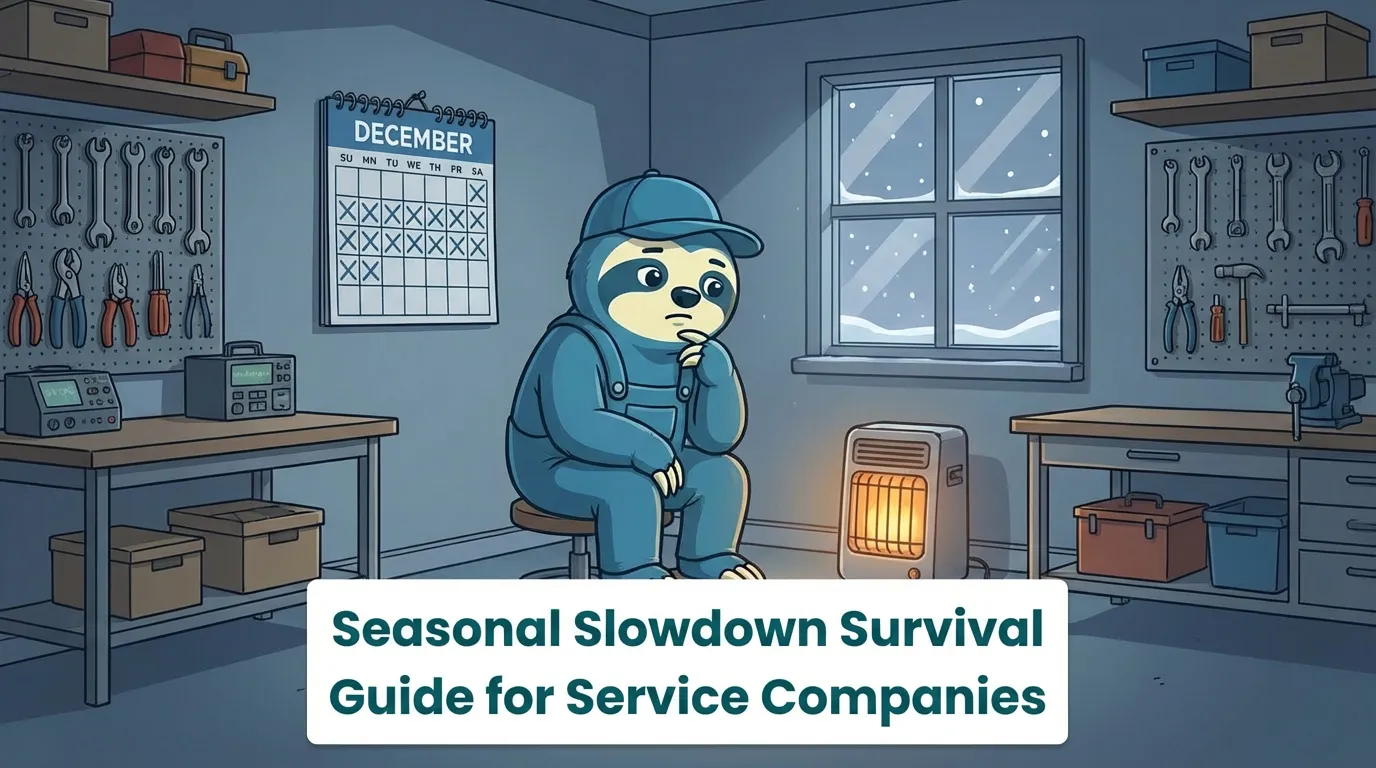
January hits and suddenly the phone stops ringing. Your crews are sitting idle. Bills keep coming but revenue doesn't.
Sound familiar?
Seasonality is the silent killer of service businesses. The contractors who thrive aren't just better at the busy season - they've figured out how to survive (and even profit from) the slow months.
This guide is your playbook for doing exactly that.
The Seasonality Reality Check
Let's be honest about what we're dealing with. Every service trade has a seasonal pattern, but some get hit harder than others.
The hardest-hit trades:
- Landscaping and lawn care - In most Canadian provinces, outdoor work drops to nearly zero from November through March. That's almost half the year with minimal revenue.
- Roofing - Rain, snow, and freezing temperatures shut down most roofing work for 3 to 5 months depending on your region.
- Exterior painting - You can't paint in freezing weather or rain, making winter a dead zone for exterior work.
- Pool services - In Canada, pool season is brutally short. You might have 5 active months if you're lucky.
The more stable trades:
- Plumbing - Pipes burst in winter, bathrooms get renovated year-round. Still sees dips, but less dramatic.
- Electrical - Indoor work available year-round, though new construction slows in winter.
- HVAC - Actually has two peaks (summer cooling and winter heating) but the shoulder seasons between them can be painfully slow. We covered this in depth in our guide on why HVAC businesses fail - seasonality is one of the top killers.
- Junk removal - Stays relatively steady but peaks around moving season and spring cleaning.
Here's the real problem with seasonality: it's not just the slow months that hurt you. It's the compound effect. During slow season you burn through cash reserves. When busy season returns, you're behind on bills. You take on every job - even underpriced ones - just to catch up. You work yourself into the ground during peak months, then hit the slow season exhausted and broke. Repeat.
That cycle destroys businesses. Breaking it requires strategy, not just hard work.
Know Your Numbers: Forecasting the Slowdown
Before you can fight seasonality, you need to understand your specific pattern. Not what you think it looks like - what the data actually says.
Pull your numbers from the last 2 to 3 years:
- Monthly revenue
- Monthly expenses (fixed and variable)
- Number of jobs per month
- Average ticket size per month
- Cash balance at the end of each month
Plot these on a simple chart. You'll likely see a clear pattern. Maybe your slowdown isn't when you thought it was. Maybe it's worse than you realized. Maybe it's actually not that bad, and your cash flow problems come from overspending during the boom.
Calculate your monthly burn rate:
Add up everything you spend in a typical slow month. Rent or mortgage. Vehicle payments. Insurance. Fuel. Phone and internet. Software subscriptions. Minimum payroll. This is your monthly burn rate - the absolute minimum you need to keep the doors open and the lights on.
The runway calculation:
Take your current cash reserves and divide by your monthly burn rate. That's how many months you can survive with zero revenue. If the answer makes you uncomfortable, good. That discomfort is going to drive you to fix it.
Most financial advisors recommend 3 to 6 months of operating expenses in reserve. If your slow season typically lasts 4 months, you want at least 4 to 5 months of runway before it hits.
Strategy #1: Build Your War Chest
This is the foundation everything else builds on. Without cash reserves, you're one slow month away from crisis.
The discipline of saving during boom time:
When jobs are rolling in and the money is flowing, it's tempting to upgrade the truck, buy new equipment, or finally take that vacation. And some of that spending is justified. But before you spend a dollar on wants, make sure your war chest is funded.
A good target is setting aside 15 to 20 percent of every invoice during your peak months specifically for slow season reserves. Treat it like a tax - it comes off the top before you spend on anything else.
Separate accounts for separate purposes:
Open a dedicated savings account just for your slow season fund. Don't mix it with your operating account. The psychological barrier of having to transfer money out of a savings account makes it harder to spend on impulse.
Some contractors go further and set up three accounts:
- Operating account - Day-to-day expenses
- Tax account - HST/GST and income tax set-asides
- Reserve account - Slow season and emergency fund
When a payment comes in, split it immediately. Operating gets what you need for current expenses, tax account gets 25 to 30 percent (adjust for your bracket), and the reserve gets 15 to 20 percent. What's left is your actual profit.
Resist the feast-mode mentality:
The busiest contractors often live job to job, spending everything they earn because more work is always coming. Until it isn't. The ones who survive long-term are the ones who live like it's slow season all year round - modest overhead, controlled spending, and steady saving.
Strategy #2: Maintenance Contracts and Recurring Revenue
If the war chest is your defense, maintenance contracts are your offense. They're the single most powerful weapon against seasonal revenue drops.
Why maintenance contracts change everything:
A maintenance agreement is a commitment from a client to pay you a regular fee - monthly, quarterly, or annually - in exchange for scheduled preventive service. The beauty is threefold:
- Predictable revenue - You know exactly how much is coming in, regardless of season.
- Scheduled work - You control when the work happens. Schedule it during your slow months.
- Client retention - Clients on maintenance contracts are 5 to 8 times more likely to call you for additional work. They're locked in.
Designing your maintenance program:
The specifics depend on your trade, but the principles are universal:
- HVAC - Seasonal tune-ups (furnace in fall, AC in spring), filter changes, efficiency checks. Price at $150 to $300 per year for residential.
- Plumbing - Annual drain inspections, water heater flushes, fixture checks. Price at $100 to $200 per year.
- Electrical - Panel inspections, surge protector checks, safety audits. Price at $100 to $175 per year.
- Landscaping - Year-round contracts covering mowing, fall cleanup, spring prep, and snow removal. Monthly pricing keeps revenue steady.
- General contractors - Annual property inspections for homeowners, seasonal maintenance checklists.
Pricing for profit:
Don't underprice maintenance contracts just to get sign-ups. The contract price should cover your labor, travel time, and materials, plus a reasonable margin. You're not discounting your services - you're providing peace of mind and priority scheduling.
Many contractors offer a small discount (10 to 15 percent) on the annual price compared to booking services individually, along with priority scheduling during busy season. That's a fair trade for guaranteed recurring revenue.
Selling contracts to existing clients:
Your current client list is a gold mine. Every person you've done work for in the last 2 years is a potential maintenance contract client. After completing a job, offer the maintenance agreement before you leave. "We just fixed your furnace. Want to make sure this doesn't happen again? Our annual maintenance plan includes a full inspection and tune-up, and you get priority scheduling if anything does go wrong."
Time the outreach strategically. Late summer is perfect for selling heating maintenance contracts. Late winter is ideal for AC tune-up agreements. Match the pitch to what's top of mind.
The math that matters:
Let's say you sign 100 residential maintenance contracts at $200 per year. That's $20,000 in guaranteed annual revenue. Schedule all of that work during your slow months (January through March, for example) and you've just filled your calendar and covered a significant chunk of your overhead during the worst time of year.
Now scale that to 200 contracts. Or 500. Top contractors in the HVAC space get 30 to 50 percent of their total revenue from maintenance agreements. That's the kind of stability that lets you sleep at night in February.
Strategy #3: Diversify Your Services
If your revenue depends on a single service that stops when the weather changes, you're building on a shaky foundation. Smart diversification means adding services that fill the gap when your primary work slows down.
Complementary services by trade:
- HVAC - Add duct cleaning, insulation installation, indoor air quality testing, dryer vent cleaning, and humidifier/dehumidifier installation. All indoor work that can happen year-round.
- Plumbing - Add drain cleaning programs, water heater replacements (people don't wait for spring when their hot water dies), bathroom renovations, and water treatment systems.
- Landscaping - Snow removal and salting is the obvious one. Also consider holiday light installation (November through January is prime time), winter pruning, and indoor plant maintenance for commercial clients.
- Roofing - Gutter cleaning and repair, attic insulation, siding installation, and interior renovations. Some roofers pivot to ice dam removal in winter, which can be extremely profitable.
- Painting - Interior painting is the natural counter-seasonal complement. While exterior work stops in winter, interior repaints and renovations pick up as people spend more time inside.
The key to smart diversification:
Don't chase random services just because they make money. Add services that:
- Use your existing skills and equipment
- Serve your existing client base
- Fill your specific slow months
- Don't require massive new investment in training or tools
A plumber adding drain cleaning makes sense. A plumber adding landscaping does not. Stay in your lane, but widen it.
Counter-seasonal thinking:
The most powerful diversification is finding a service that peaks exactly when your primary service dips. Landscaping plus snow removal is the classic example - when one drops off, the other picks up. If you can find that combination for your trade, you've essentially eliminated your slow season entirely.
Strategy #4: Target Different Client Segments
Residential work tends to be the most seasonal. Homeowners think about their properties in spring and summer, then hunker down for winter. But other client segments operate on different timelines.
Commercial and property management:
Property managers need maintenance year-round. Office buildings, apartment complexes, retail spaces, and industrial properties don't shut down for winter. Building a relationship with even 3 to 5 property management companies can provide steady work through your slow months.
The key to landing property management work is reliability and responsiveness. They don't want the cheapest contractor. They want the one who answers the phone, shows up on time, and gets it done right the first time. Sound familiar? That's exactly what you should already be doing.
Institutional and government contracts:
Schools, hospitals, government buildings, and municipal facilities have maintenance budgets that get spent on a fiscal year cycle, not a weather cycle. Many government contracts are actually awarded in fall and winter. Getting on your municipality's approved contractor list takes some paperwork, but the work tends to be steady and well-paying.
Insurance restoration work:
Water damage, fire damage, and storm damage don't follow seasonal patterns. Insurance restoration work is available year-round and often urgent, meaning higher margins. Getting certified through programs like IICRC (Institute of Inspection, Cleaning and Restoration Certification) and building relationships with insurance adjusters can create a steady stream of off-season work.
New construction vs. service:
If you primarily do service calls, consider taking on small renovation or new construction projects during slow months. If you primarily do construction, flip the script and market service and maintenance when building slows down.
Strategy #5: Marketing for the Slow Season
Most contractors stop marketing when they get busy and start marketing when they get slow. This is backwards. The time to market is before you need the work.
Pre-season and "beat the rush" campaigns:
Start marketing your spring and summer services in late winter. "Book your spring AC tune-up now and skip the 3-week wait in June." Clients love the idea of getting ahead of the rush, and you love filling your slow season calendar with booked appointments.
Offer a genuine incentive - maybe 10 percent off for booking before a certain date, or a free filter change included with early booking. The discount is worth it if it moves revenue from a month you're overbooked into a month you're starving.
Mine your existing client database:
Your past clients are your warmest leads. A simple email or text message can bring back work you'd never have gotten otherwise. "Hi Sarah, it's been a year since we serviced your furnace. Want us to schedule your annual checkup?"
This kind of outreach costs almost nothing and has conversion rates that paid advertising can't touch. If you need help building a lead follow-up system, check out our guide on how to get more leads as a contractor - it covers mining past clients in detail.
Invest in SEO during the slow season:
Here's a move that pays dividends: use your slow season to invest in your online presence. Update your website, optimize your Google Business Profile, write blog posts about your services, and collect reviews from recent clients. SEO takes time to build, so work you do in January will start paying off by spring and summer when search volume peaks.
We put together a complete SEO guide specifically for contractors if you want to dig into this properly. The slow season is the perfect time to implement it.
Referral programs:
Launch or re-launch a referral program at the start of slow season. "Refer a friend who books a service and you both get $50 off your next job." Existing clients are your best salespeople, and a small incentive can motivate them to spread the word.
Strategic promotions - with caution:
Discounting can be a slippery slope. You don't want to train your market to expect lower prices. But strategic, time-limited promotions can move the needle during slow months. The key is framing them as limited opportunities, not desperation.
"Winter plumbing inspection - $89 (regular $129) - January only" works. "50% off everything because we're desperate" does not.
Strategy #6: Use the Downtime Productively
The slow season doesn't have to be wasted time. In fact, some of the most valuable work you can do for your business happens when you're not on job sites.
Training and certifications:
Send your team (or yourself) to get additional certifications. HVAC technicians can get indoor air quality certifications. Plumbers can get backflow prevention certification. Electricians can pursue master electrician status. These credentials open up new service lines and justify higher pricing.
Many provinces offer grant programs for skilled trades training. Check with your provincial apprenticeship authority - you might be able to get training subsidized.
Process improvement:
When you're running full speed during busy season, you don't have time to fix the inefficiencies you notice. Slow season is when you build the systems that make busy season run smoother.
Review your job workflow from first call to final invoice. Where are the bottlenecks? Where do things fall through the cracks? Where are you wasting time on manual tasks that could be automated?
This is also the time to evaluate your software tools. Are you still tracking jobs on paper or spreadsheets? Still manually following up on unpaid invoices? Still missing calls because you're on a job site? The right field service management tools can solve these problems, but you need time to set them up properly - and slow season gives you that time.
Equipment maintenance:
Your tools and vehicles take a beating during busy season. Use slow months to service vehicles, repair or replace worn tools, restock supplies, and organize your shop. A truck breakdown during your busiest week in July costs you far more than the time you spend servicing it in February.
Strategic planning:
When was the last time you sat down and actually planned? Not just reacted to whatever job came in, but intentionally decided where your business is going?
Slow season is the time to:
- Review your pricing (are your margins actually where you think they are?)
- Analyze profitability by service type (you might be losing money on certain jobs and not know it)
- Set revenue goals for next year
- Plan your hiring timeline
- Decide which new services to add
- Create a marketing calendar for the coming year
Two or three days of focused planning can change the entire trajectory of your business.
Managing Cash Flow Through the Slowdown
Even with all the strategies above, most service businesses will still experience some revenue reduction during slow months. Managing cash flow during this period is critical.
Invoice immediately and follow up relentlessly:
During slow season, you can't afford to have money sitting in unpaid invoices. Send invoices the same day work is completed, not at the end of the week. Follow up at 7 days, 14 days, and 30 days. Be polite but persistent.
If you're still sending paper invoices or manually chasing payments, this is the problem to solve first. Automated invoicing and payment reminders can cut your average collection time dramatically.
Negotiate payment terms with suppliers:
Talk to your suppliers before slow season hits. Many will extend net-60 or net-90 terms if you have a good payment history and ask in advance. This keeps cash in your account longer without damaging relationships.
Get your line of credit before you need it:
Banks love lending money to people who don't need it and hate lending to people who do. Apply for a business line of credit during your busiest, most profitable months. Having $25,000 to $50,000 available on a line of credit gives you breathing room during slow months without the pressure of needing to qualify when you're already cash-strapped.
Use it as a safety net, not a lifestyle. Draw on it when needed, pay it back as soon as revenue picks up.
Reduce variable overhead strategically:
Look for expenses you can scale down during slow months without damaging your ability to ramp back up. Some examples:
- Pause or reduce paid advertising (shift to free channels like social media and email)
- Reduce inventory orders
- Postpone non-essential equipment purchases
- Negotiate seasonal rates for any subcontractors
What NOT to cut:
- Insurance (this is non-negotiable)
- Your core team (replacing them is far more expensive than carrying them)
- Your phone and communication tools (missing calls during slow season is fatal)
- Your online presence (website, Google Business Profile, software subscriptions)
Cutting these things saves a few hundred dollars and costs you thousands in the long run.
Keeping Good Employees Through Slow Season
This might be the most important section in this entire guide. Losing skilled workers to slow season layoffs is one of the most expensive mistakes a service business can make.
The true cost of turnover:
When you lay off a trained technician, you're not just saving their salary. You're also losing:
- The $5,000 to $15,000 you spent recruiting and training them
- The institutional knowledge they carry
- The client relationships they've built
- The 3 to 6 months of reduced productivity while their replacement gets up to speed
- The risk that they find a better job and don't come back
In a skilled trades labor market that's already tight, losing good workers is a wound that takes months to heal.
Alternatives to layoffs:
- Reduced hours - Going from 40 to 30 hours per week is better than going to zero. Many workers will accept temporary reduced hours if they know the busy season is coming and their job is secure.
- Cross-training - Use slow time to train workers on new skills. An HVAC technician who can also do basic plumbing or electrical is more valuable and more billable.
- Internal projects - Shop organization, vehicle maintenance, inventory management, warehouse cleanup. There's always work to be done.
- Training and certification - Send workers to courses. They come back more skilled, more certified, and more loyal.
- Flexible scheduling - Some workers would love to take unpaid time off in winter for travel or personal projects. Ask before assuming everyone wants full-time hours year-round.
EI workshare programs:
In Canada, the Employment Insurance Work-Sharing program lets you reduce employee hours during slow periods while EI covers a portion of their lost wages. Your team stays employed, they keep most of their income, and you keep your skilled workers. It requires some paperwork with Service Canada, but it's specifically designed for seasonal slowdowns. Look into it well before your slow season starts - the application process takes time.
Communication is everything:
Be honest with your team about seasonal patterns. Share the plan. "Here's what our slow season looks like. Here's what we're doing to manage it. Here's what I need from you." Workers who understand the situation and trust the plan are far more likely to stick around than workers who feel blindsided by sudden hour cuts.
Planning Your Year Around Seasonality
The ultimate goal isn't just surviving slow season. It's building a business that accounts for seasonality in every decision, all year long.
The annual rhythm:
Map out your year in four phases:
- Pre-season (1-2 months before peak) - Ramp up marketing, hire seasonal help, restock supplies, schedule pre-booked work.
- Peak season (your busiest months) - Execute, save, build the war chest. This is where you earn the money that funds the rest of the year.
- Wind-down (1-2 months after peak) - Collect remaining payments, evaluate performance, begin slow season marketing.
- Slow season - Execute maintenance contracts, pursue diversified services, invest in the business, train the team.
Budget for the cycle:
Stop budgeting as if every month will be the same. Build a monthly budget that reflects reality. If July brings in $80,000 and January brings in $20,000, your spending plan needs to account for that. Big purchases and investments should happen during peak months. Slow months should be lean by design, not by accident.
Staffing decisions:
Decide your staffing model in advance. Will you maintain a core team year-round and add seasonal workers during peak? Will you keep everyone full-time and manage hours during slow months? There's no single right answer, but having a plan beats making panicked decisions in November.
Equipment purchase timing:
Buy equipment in your slow season. Dealers often offer better pricing in winter when demand drops. You'll have time to set up and learn new equipment before the rush. And paying for big purchases during slow months is easier if you've built your war chest during peak.
When the Phone Isn't Ringing: Mindset
Let's talk about the mental side of slow season, because it's real and it matters.
When January rolls around and the phone goes quiet, anxiety takes over. You start questioning your pricing, your marketing, your entire business model. You consider taking jobs at a loss just to keep busy. You lose sleep.
This is normal. But it's also dangerous, because anxiety leads to bad decisions.
Slow season anxiety vs. slow season crisis:
There's a difference between a predictable seasonal dip and an actual business crisis. If your slow season looks like last year's slow season, you're fine. It's expected. It's planned for. If your slow season is dramatically worse than historical patterns, then investigate - but don't panic at normal fluctuations.
Productive vs. busy work:
When things are slow, resist the urge to create busywork just to feel productive. Reorganizing your tool shed for the third time isn't productive. Building a referral program is. Scrolling industry forums isn't productive. Getting a new certification is.
Ask yourself: "Will this activity directly contribute to revenue in the next 6 months?" If the answer is no, it's busywork.
The perspective shift:
The most successful contractors don't see slow season as a problem to endure. They see it as a strategic advantage. It's the time when they build the systems, skills, and relationships that make the next busy season their best ever.
Your competitors are sitting at home stressed out. You're building maintenance contract programs, getting new certifications, updating your online presence, and reaching out to property managers. When spring comes, who do you think is better positioned?
The Seasonal Slowdown Action Plan
Here's your playbook, organized by when to do what:
During Peak Season (Do This NOW if You're Busy):
- Set aside 15-20% of every invoice into your reserve account
- Pitch maintenance contracts to every client after completing a job
- Build your email list of past clients
- Apply for a business line of credit while your numbers look great
- Identify 2-3 complementary services you could offer in slow months
Pre-Slow Season (1-2 Months Before the Dip):
- Calculate your monthly burn rate and confirm your runway
- Launch "beat the rush" pre-season campaigns
- Reach out to property managers and commercial contacts
- Plan internal projects for the team (equipment maintenance, training)
- Schedule all maintenance contract work for slow months
During Slow Season:
- Execute maintenance contracts and diversified services
- Send outreach emails to past clients
- Invest in SEO and online presence
- Complete training and certification programs
- Review pricing and profitability
- Plan the next year's calendar and budget
Coming Out of Slow Season:
- Ramp up marketing for peak season
- Hire and train seasonal workers if needed
- Restock supplies and service equipment
- Review what worked and what didn't during slow season
- Adjust your war chest target based on what you learned
Seasonality Is Manageable
Every service business faces seasonal ups and downs. That's not going to change. What can change is how prepared you are for it.
The contractors who go under during slow season aren't the ones who face the worst winters. They're the ones who spent everything during the boom, didn't build systems for recurring revenue, and treated slow season as something that happens to them instead of something they plan for.
You don't need to eliminate seasonality. You need to manage it. Build your war chest during the good months. Create recurring revenue through maintenance contracts. Diversify strategically. Market before you're desperate. Keep your team intact. Use the downtime to build a better business.
Do that consistently, and slow season stops being a crisis. It becomes the part of the year when you invest in next year's growth.
The phone will ring again. Make sure you're ready when it does.
Seasonal slowdowns don't have to mean seasonal chaos. WorkZen helps service businesses stay organized year-round with job scheduling, automated invoicing, and client management - so you can focus on building revenue instead of chasing paperwork. See how it works.
Frequently Asked Questions
Ready to transform your field service business?
Start using WorkZen today - it's free to get started!