Why Service Businesses Plateau at $500K (And How to Break Through)
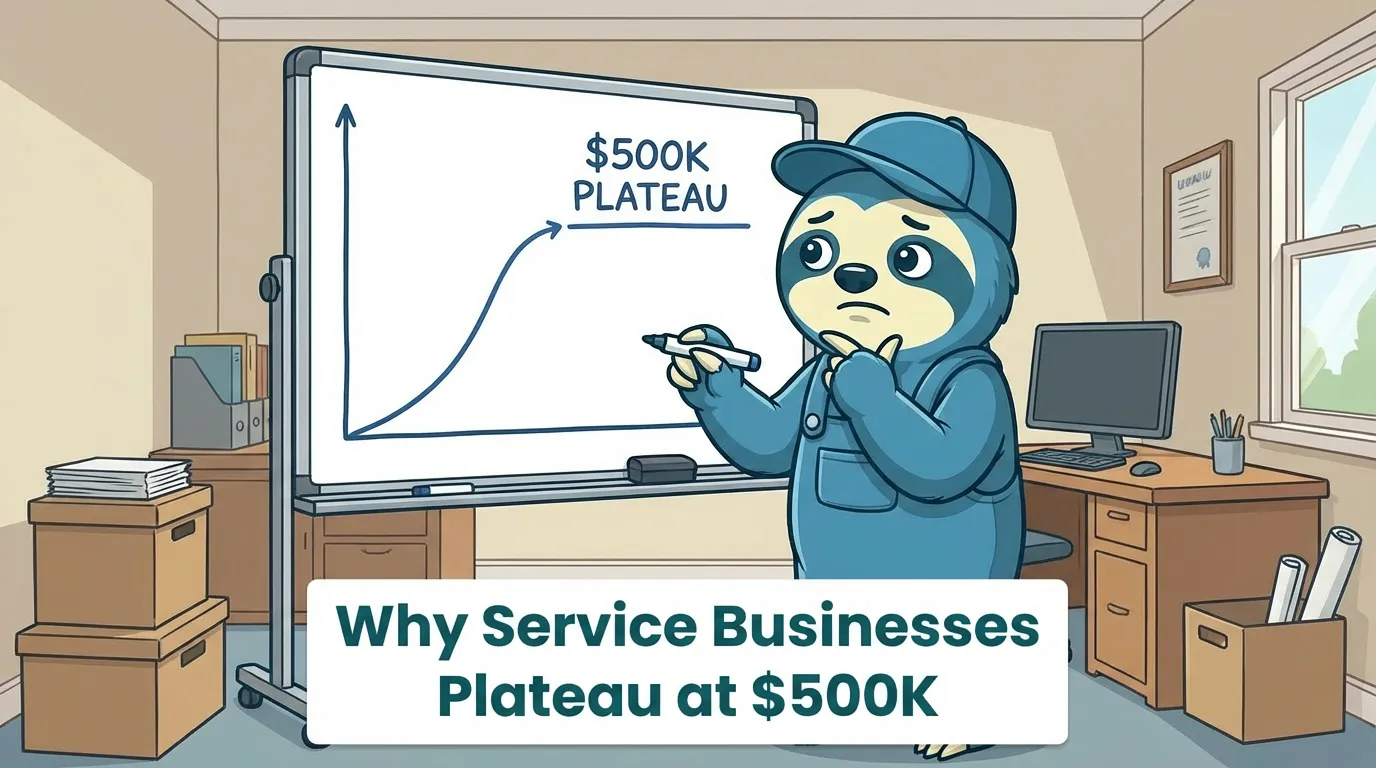
You've built something real. A few hundred thousand in revenue. A small team. Steady work. Clients who trust you. A reputation in your community.
But for the last two or three years? Same revenue. Same profit margins. Same headaches. Maybe you've even worked harder each year, put in longer hours, taken on more jobs - and somehow ended up in the exact same place.
You've hit the plateau.
The $500K ceiling is one of the most common and frustrating stages in the life of a service business. It's big enough to feel like real success - you're not scraping by, you're employing people, you're doing meaningful work. But it's small enough that the owner is still doing everything, and there's no clear path to the next level.
The good news? The plateau isn't permanent. It's a stage. And thousands of service business owners have broken through it. The bad news? Breaking through requires changing almost everything about how you run your business.
The $500K Ceiling: Why It Exists
This number isn't random. Around $500K in annual revenue is where a service business typically has 3-8 employees, the owner is still in the field at least part-time, and the company's entire operation depends on one person's brain.
Think of it like this: from $0 to $500K, you grew by being excellent at your trade and working really hard. You were the best plumber, the fastest electrician, the most reliable HVAC technician. Hustle and skill got you here.
But hustle and skill have a ceiling. There are only so many hours in a day, and you're using all of them. The strategies that got you to $500K - doing everything yourself, keeping costs low by wearing every hat, relying on your personal reputation - are the exact same strategies keeping you stuck.
The Canadian Federation of Independent Business reports that the majority of small businesses in Canada never grow past their first few employees. It's not because the market isn't there. It's because the business model that works at $200K simply breaks at $700K.
Growing past $500K requires a fundamentally different business. Not a bigger version of what you have - a different one entirely.
Sign #1: You ARE the Business
If you got hit by a bus tomorrow - let's be less dramatic, let's say you broke your leg on a ski trip in Whistler - what would happen to your business?
If the honest answer is "it would fall apart within a week," you don't have a business. You have a job. A stressful, all-consuming job where you happen to also handle invoicing, hiring, marketing, and client complaints.
Here's what this looks like in practice:
- You can't take a real vacation. The last time you went away, you spent half the trip on your phone putting out fires. Your family has stopped believing you when you say "I'll be offline."
- Your phone never stops. Clients call you directly. Employees text you questions at 9 PM. You're the dispatcher, the customer service rep, and the quality control department.
- Nothing happens without your approval. Your team waits for you to make decisions about scheduling, pricing, materials, and even which route to take to a job site.
- You're the only one who knows the full picture. Client preferences, pricing history, vendor relationships, that one tricky valve at Mrs. Thompson's house - it's all stored in your head.
This is the owner bottleneck, and it's the single biggest reason service businesses plateau. You've become the constraint on your own growth. The business literally cannot get bigger than your personal capacity to manage it.
Sign #2: Hiring Feels Impossible
You know you need help. You've probably tried hiring. And it probably went poorly.
The hiring trap at the $500K level looks something like this:
- You can't afford to pay top dollar, so you hire someone less experienced
- You don't have time to train them properly, so they make mistakes
- Mistakes cost money and upset clients, so you start doing the work yourself again
- You're right back where you started, except now you're also paying someone's wages
The deeper problem is the "nobody works as hard as me" mindset. And you're right - nobody will care about your business the way you do. That's normal. But you're not hiring a clone of yourself. You're hiring someone to do a specific job, within a system you've built, to a standard you've defined.
Most owners at this stage hire for tasks instead of outcomes. They want someone to "help out" rather than someone who owns a result. There's a massive difference between hiring someone to answer the phone and hiring someone who's responsible for making sure every lead gets a response within five minutes and a follow-up within 24 hours. If you're at the point where you're ready to bring someone on, our guide on how to hire your first technician covers the full process from writing the job post to onboarding.
Sign #3: No Real Systems
Ask yourself: if you hired someone brand new tomorrow, could you hand them a manual and have them deliver the same quality your clients expect?
For most service businesses at $500K, the answer is a hard no. Everything is tribal knowledge. The "system" is whatever's in the owner's head. Quality is inconsistent because it depends on who's doing the work and how they feel that day.
This shows up everywhere:
- Job quoting varies depending on the owner's mood and how busy they are that week
- Client communication is sporadic - some clients get updates, others hear nothing until the invoice arrives
- Scheduling is a whiteboard, a spreadsheet, or a stack of Post-it notes on the dashboard
- Invoicing happens whenever someone remembers, often weeks after the job is done
- Follow-up on leads is hit or miss, with half of them falling through the cracks
Without systems, you can't delegate. Without delegation, you can't grow. Without growth, you're stuck on the plateau.
The irony is that most owners know they need systems. They just don't have time to build them because they're too busy fighting fires - fires that exist because they don't have systems.
Sign #4: Pricing Hasn't Changed in Years
Pull up your price list from three years ago. Now compare it to today's. If the numbers are the same - or close - you've been giving yourself a pay cut every single year.
Since 2020, the cost of doing business in Canada has risen substantially. Fuel, insurance premiums, materials, vehicle costs, labour - everything is more expensive. If your prices haven't kept pace, your margins have been quietly shrinking.
Here's what usually happens:
- You set your prices based on what competitors were charging years ago
- You haven't recalculated your true cost per job since you started
- You're afraid that raising prices will drive clients away
- You're busy, so it feels like the pricing must be working
But busy and profitable are very different things. A lot of service businesses at the $500K plateau are working 60-hour weeks to earn less per hour than their employees make. They're subsidizing their clients' low prices with their own exhaustion. We covered this pricing trap in detail in our post about why HVAC businesses fail - and the same mistakes apply to every trade.
A practical test: Calculate your effective hourly rate. Take your net profit (after all expenses, including your own reasonable salary), divide by the hours you actually worked. If that number is below $30-40/hour, you have a pricing problem. You could probably earn more working for someone else - without the stress, the risk, or the 2 AM emergency calls.
Sign #5: Marketing Is Whatever Comes In
"We get most of our work through word of mouth."
That sentence is both a badge of honour and a warning sign. Word of mouth means your work quality is strong - that's great. But relying exclusively on word of mouth means you have zero control over your lead flow.
The feast-or-famine cycle is brutal:
- Feast: Three weeks booked solid, turning down jobs, rushed scheduling, quality slipping because everyone's overworked
- Famine: Phone stops ringing, cash flow tightens, you start discounting to fill the calendar, team morale drops
This cycle is exhausting, and it makes growth planning impossible. How do you hire when you don't know if you'll have enough work next month? How do you invest in equipment when revenue is unpredictable?
Most service businesses at the plateau have no idea where their leads actually come from, which marketing efforts work, or what their cost per acquired client is. They're spending money on a truck wrap, a website they built five years ago, and a prayer.
Breaking Through: The Mindset Shift
Before we get into tactics, let's address the real barrier: your identity.
You started this business because you're great at your trade. You're a plumber, an electrician, a landscaper, a cleaner. That identity is core to who you are.
But at $500K, your job title needs to change. You need to stop being the best technician in your company and start being the CEO. Not the fancy corner-office CEO - the kind who makes the business work without being in the field every day.
Michael Gerber wrote about this decades ago in The E-Myth: most small businesses are started by technicians who had an entrepreneurial seizure. They're great at the work but never learned to build the machine that does the work.
The shift looks like this:
- From: "I need to do this job right" To: "I need to build a system so anyone can do this job right"
- From: "Nobody does it as well as me" To: "I need to train people and accept 80% of my quality is good enough"
- From: "I can't afford to step back" To: "I can't afford not to step back"
This is uncomfortable. It means watching someone do work differently than you would. It means investing time and money in systems that don't generate revenue today. It means trusting other people with your reputation.
But it's the only way through.
The First Breakthrough: Systematize Everything
Systems aren't fancy software or complicated workflows. A system is just a documented, repeatable way of doing something.
Start with the processes you do most often:
Lead handling: What happens when the phone rings? Who answers? What information do they collect? How fast do they respond to online inquiries? What's the follow-up cadence?
Write it down. A simple checklist: "Answer within 3 rings. Get the client's name, address, phone number, and description of the problem. Offer the next available appointment slot. Send a confirmation text within 5 minutes."
Job execution: What does a standard service call look like from arrival to departure? What does the technician check? What do they communicate to the client? How do they document the work?
Create a checklist for each common job type. Not a novel - a one-page checklist that ensures consistency.
Client communication: When do clients hear from you? Appointment confirmation, day-of reminder, on-the-way notification, job completion summary, follow-up for feedback. Automate what you can, template the rest.
Financial tracking: Every job gets costed. Revenue minus materials, labour, and overhead equals profit. If you don't know the margin on each service you offer, you're flying blind.
The best part about building systems is that it forces you to think about your business in a way you never have before. You'll find inefficiencies you didn't know existed. You'll discover that some of your most popular services are barely profitable while others have margins you could grow into.
The Second Breakthrough: Hire Right
Your first strategic hire isn't another technician. It's someone to take the non-revenue work off your plate.
For most service businesses, the highest-impact first hire is an office administrator or dispatcher. This one person can handle:
- Answering phones and responding to leads
- Scheduling and dispatching
- Sending invoices and following up on payments
- Client communication and follow-ups
- Basic bookkeeping
This hire typically costs $35,000-$50,000/year in Canada. It feels expensive when you're used to doing everything yourself. But consider this: if freeing up 20 hours a week lets you take on just 5 more jobs per month at $500 average profit, that's $30,000/year in additional profit - and you got your life back.
Hire for where you're going, not where you are. If your goal is $1M in two years, hire someone who can handle a $1M operation's administrative load. You'll grow into their capacity instead of outgrowing someone who was barely adequate from day one.
Invest in training. The two weeks you spend training someone properly saves you six months of fixing their mistakes. Document your systems first (see above), then train against those documents. This also means when that person leaves - and people do leave - you're not starting from scratch.
Let go of control. This is the hardest part. Your new hire will do things differently than you. They might answer the phone with a slightly different greeting. They might organize the schedule in a way you wouldn't. If the outcome is right and the client is happy, it doesn't matter. Micromanaging defeats the purpose of hiring.
The Third Breakthrough: Price for Profit
Raising prices is one of the fastest ways to break through the plateau, and it's the thing owners resist most.
Here's what typically happens when service businesses raise prices by 15-20%:
- 5-10% of clients leave. These are almost always your least profitable, most demanding clients. The ones who haggle on every invoice and call at 11 PM on a Saturday. Let them go.
- Revenue stays flat or increases. Fewer jobs at higher margins often equals more profit than more jobs at thin margins.
- Stress decreases. You're less busy but making more money. You have breathing room to think strategically.
- Client quality improves. Clients who value quality over price are easier to work with, more loyal, and more likely to refer others like them.
The math is simple: If you have 100 clients at $500 average and raise prices 20% to $600, even if you lose 15 clients, your revenue goes from $50,000 to $51,000. But you're serving 15 fewer clients, which means less labour, less fuel, less truck wear, and fewer headaches. Your profit probably jumped 30-40%.
How to raise prices without losing sleep:
- Grandfather existing clients for 60-90 days. "Starting April 1st, our rates will reflect updated costs."
- Lead with value. Don't apologize for the increase. Communicate what clients get - reliability, quality, guarantees, professionalism.
- Start with new clients. Quote every new job at your updated rates. You'll quickly see that most people don't flinch.
- Review annually. Make price reviews a yearly habit, not a once-a-decade crisis.
The Fourth Breakthrough: Predictable Lead Generation
Word of mouth is a great foundation. But a foundation isn't a house.
Building predictable lead generation means creating multiple channels that bring in work consistently, whether or not someone happened to recommend you at a barbecue last weekend.
The high-ROI playbook for service businesses:
- Google Business Profile: This is your single most important marketing asset. Complete profile, regular posts, photos of your work, and - critically - reviews. Businesses with 50+ reviews and a 4.5+ rating dominate local search results.
- Review generation system: After every completed job, send a text with a direct link to leave a Google review. Make it easy. Make it automatic. Aim for 5+ new reviews per month.
- Website that converts: Your website doesn't need to be fancy. It needs your phone number visible on every page, a clear description of your services, your service area, and a way to request a quote. If your website is more than 3 years old, it's probably hurting you.
- Referral program: Offer existing clients a meaningful incentive for referrals - a discount on their next service, a gift card, or a charitable donation in their name. Make it easy for them to refer and track it.
- Targeted online ads: Even $500-$1,000/month in Google Ads can generate consistent leads if targeted properly. Focus on high-intent keywords in your service area. Track cost per lead religiously.
The key is measurement. Know exactly how many leads each channel produces, what each lead costs, and what percentage convert to paying clients. Without this data, you're guessing - and guessing is what got you to the plateau. For a deeper dive into building a lead pipeline that doesn't depend on paid ads, check out our guide on how to get more leads as a contractor.
The Fifth Breakthrough: Financial Clarity
Most service business owners can tell you their revenue. Far fewer can tell you their net profit margin, their cost per job, or their most profitable service line.
Financial clarity isn't about becoming an accountant. It's about knowing the numbers that drive your business so you can make informed decisions instead of gut-feel guesses.
The numbers you need to know:
- Gross profit margin by service type. You might discover that your most popular service has a 15% margin while a less common service has a 45% margin. That changes your marketing strategy.
- Cost per lead and cost per acquired client. If a lead costs you $50 and you close 30% of leads, your cost per client is about $167. Is that worth it for a $500 job? Absolutely. For a $150 job? Maybe not.
- Revenue per employee. A healthy service business generates $100,000-$150,000+ in revenue per employee. If you're below that, you either have too many people or not enough revenue.
- Cash flow forecast. Know what's coming in and going out for the next 90 days. This prevents the panic decisions that happen when the bank account looks thin.
- Job costing. After every significant job, compare actual costs to your estimate. Were you accurate? Where did you lose money? This feedback loop makes your quoting better over time.
A practical step: Set a recurring 30-minute appointment with yourself every Monday morning to review your numbers. Revenue last week, jobs completed, average ticket size, outstanding invoices, leads received. It takes half an hour, and it's the most valuable half hour of your week.
The Owner's New Role
At $500K, you're probably spending your time something like this:
- 40% doing field work
- 25% handling admin and scheduling
- 20% dealing with client issues
- 10% sales and estimates
- 5% actually running the business
To break through, that allocation needs to flip:
- 30% sales, estimates, and client relationships
- 25% team management and development
- 20% business development and marketing
- 15% financial management and planning
- 10% or less in the field (only for complex or high-value jobs)
Your job isn't to be the best technician anymore. Your job is to build a team of capable technicians, feed them steady work, give them systems to follow, and make sure the money side works.
This doesn't happen overnight. It's a gradual transition. Start by picking one thing you do daily that someone else could do with proper training. Delegate it. Get comfortable. Then pick the next thing.
The work only you can do at this stage:
- Setting the vision and direction for the company
- Building relationships with key clients and referral partners
- Making pricing and financial decisions
- Hiring and developing your team
- Identifying new opportunities and markets
Everything else should eventually be handled by someone else or automated by software.
The Path from $500K to $1M+
Here's a realistic timeline for a service business making the changes we've discussed:
Months 1-3: Foundation
- Document your core processes
- Implement basic job tracking and scheduling software
- Calculate your true costs and adjust pricing
- Hire or begin searching for your first admin/dispatcher
Months 4-8: Build
- New hire is trained and handling daily operations
- You're spending less time on admin and more on sales
- Lead generation systems are in place and producing results
- Financial tracking is a weekly habit
Months 9-18: Scale
- Add another technician or crew
- Revenue starts climbing as you have capacity and lead flow
- Systems are handling routine operations without your constant input
- You're working fewer hours but the business is producing more
Months 18-36: Breakthrough
- Revenue crosses $750K, then $1M
- You're managing the business, not doing the work
- Multiple lead sources provide steady, predictable work
- Your team handles 90% of daily operations independently
The timeline varies. Some businesses do it faster, especially in high-demand markets or trades with strong margins. Others take longer, particularly if the owner struggles with delegation or the market is competitive.
But the pattern is consistent: systems first, then people, then growth. Skip a step, and you'll end up back on the plateau - just more exhausted than before.
It's a Different Business, Not a Bigger One
The most important thing to understand about growing past $500K is that you're not just scaling up what you have. You're building a different kind of business.
A $500K business is an owner with helpers. A $1M business is an organization with a leader.
The skills that made you successful as a tradesperson - attention to detail, work ethic, technical excellence - are still valuable. But they're no longer sufficient. You need new skills: hiring, training, delegating, financial management, marketing, and strategic thinking.
That can feel overwhelming. But here's the thing: you've already proven you can learn hard things. You mastered a trade. You built a business from nothing to half a million dollars. Learning to be a CEO is just the next skill set.
The plateau isn't a ceiling. It's a doorway. The business you want - the one that runs without you in the field every day, that provides real income and real freedom - is on the other side.
The question isn't whether it's possible. Thousands of service business owners in Canada and beyond have done exactly this. The question is whether you're willing to change how you work to get there.
The answer is in your hands. Or, more accurately, it's in the systems, people, and processes you choose to build next.
Breaking through the revenue plateau starts with getting your operations under control. WorkZen gives service businesses the tools to systematize scheduling, track leads, manage clients, and stay on top of finances - without the complexity or cost of enterprise software. Explore our features or see our pricing to find the right fit for your business.
Frequently Asked Questions
Ready to transform your field service business?
Start using WorkZen today - it's free to get started!