7 Lead Sources Every Contractor Should Be Using (Most Only Use 2)
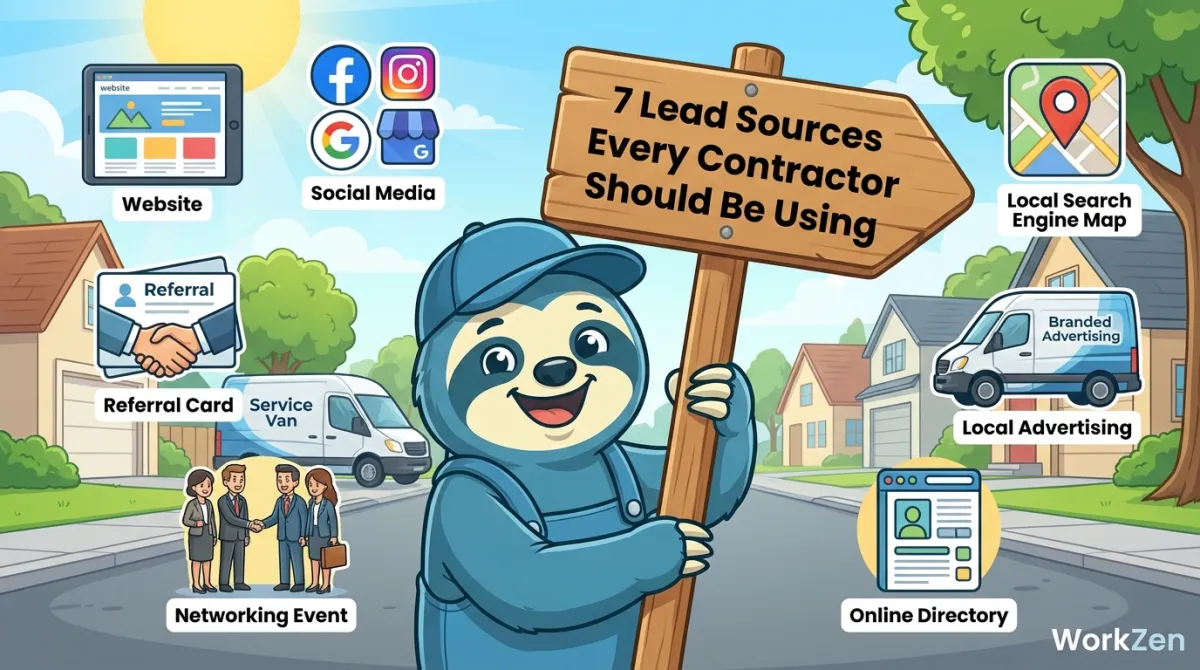
Ask any contractor where their leads come from and you'll hear the same two answers: word of mouth and "I guess Google." Push a little harder and you'll get a shrug. Maybe a vague mention of Angi or a yard sign they put out three years ago.
Here's the problem with that. Word of mouth is wonderful. It's also completely unpredictable. You can't control when someone mentions your name at a barbecue. You can't scale a business on "my neighbor's cousin might call you next week."
And yet, the average contractor relies on just one or two lead sources while leaving five or six perfectly good ones untouched. That's not a marketing strategy. That's a hope strategy. And hope, as they say, makes a terrible business plan.
The contractors who stay consistently booked - even during slow seasons - aren't necessarily better at their trade. They're better at filling their pipeline from multiple directions. When one source dips, another picks up the slack. When referrals slow down in January, Google Ads keep the phone ringing. When ad costs spike in spring, partnerships and social media carry the load.
This guide breaks down the seven lead sources every contractor should be using, ranked by cost, quality, and effort. You don't need all seven running tomorrow. But if you're only using two, you're leaving serious money on the table.
Why Diversifying Lead Sources Actually Matters
Before we dive into the seven sources, let's talk about why this matters beyond the obvious "more leads = more money" equation.
Different sources attract different client types. A referral from a property manager is a different animal than someone clicking your Google ad at midnight with a flooded basement. Both are valuable. Both have different expectations, budgets, and lifetime value. A healthy business needs a mix.
Single-source dependency is dangerous. Contractors who build their entire business on one lead platform learn this the hard way when that platform changes its algorithm, raises prices, or goes through a rough patch. If 80% of your leads come from Thumbtack and Thumbtack decides to double its fees tomorrow, what's your plan?
Compounding effects are real. Google reviews help your Google Business Profile ranking, which helps your SEO, which drives more website traffic, which generates more leads, which creates more happy clients, which generates more reviews. Multiple lead sources don't just add up - they multiply.
Think of it like job diversification. You wouldn't want all your revenue coming from one client. Your lead sources deserve the same logic.
1. Google Business Profile
Cost: Free | Lead Quality: 9/10 | Effort: Medium
If you only do one thing from this entire article, let it be this. Your Google Business Profile (GBP) is the single most underutilized lead source in the contracting world - and it's completely free.
When someone searches "plumber near me" or "HVAC repair in Phoenix," Google shows the Map Pack - three local businesses with reviews, photos, and contact info - right at the top of the page, above everything else. That's your GBP at work. And those searchers have the highest intent of any lead source on this list. They need help now and they're ready to call.
Why most contractors underutilize it:
They set it up once, maybe added a phone number and a blurry logo, and never touched it again. That's like building a storefront and leaving the lights off.
How to actually optimize it:
- Complete every single field. Businesses with complete profiles get 7x more clicks than incomplete ones. Every. Single. Field.
- Choose specific categories. "HVAC Contractor" beats "Contractor." "Emergency Plumber" beats "Plumber."
- Add 15-20+ photos. Your team in uniform, your branded vehicles, before-and-after project shots, your equipment. Google says businesses with photos get 42% more direction requests.
- Post weekly updates. GBP has a "Posts" feature most contractors ignore. Share completed projects, seasonal tips, or promotions. It signals to Google that your business is active.
- Collect reviews relentlessly. This is the ranking multiplier. More reviews (especially recent ones) push you higher in local results. Ask every satisfied client. Make it one tap with a direct link.
- Respond to every review. Positive or negative. It shows engagement and adds keyword-rich content to your profile.
The bottom line: GBP is the closest thing to free advertising that actually works. If your profile is incomplete or stale, fix it this week. The ROI is absurd.
For a deeper dive on optimizing your Google presence, check out our complete SEO guide for contractors.
2. Referral Programs
Cost: Low | Lead Quality: 10/10 | Effort: Low
Word of mouth is the lead source every contractor loves. Referral programs are what word of mouth looks like when you actually treat it like a system instead of a lottery.
Here's the difference: word of mouth is passive. You do good work, hope people talk about it, and occasionally get a call from someone's brother-in-law. A referral program is active. You ask for referrals, make it easy, incentivize it, and track it.
The quality advantage is unmatched. Referred leads close at 2-4x the rate of cold leads. They already trust you because someone they trust vouched for you. They're less price-sensitive, more loyal, and more likely to refer others. It's the lead generation gift that keeps on giving.
How to build a real referral system:
- Ask at the right moment. The best time is right after job completion when satisfaction peaks. "We really appreciate your business. If you know anyone who could use our services, we'd love to take care of them too."
- Offer a meaningful incentive. A $50 gift card, a service credit, or a discount on their next job. Nothing crazy, but enough to nudge someone from "I should mention them" to "Let me text my neighbor right now."
- Make it stupid easy. Send a follow-up text 2-3 days after the job with a simple message: "Thanks again for choosing us! Know someone who could use [your service]? Send them our way and we'll give you $50 off your next service."
- Track everything. Log who referred whom. Thank referrers promptly - ideally within 24 hours of the new lead booking. This reinforcement loop encourages repeat referrals.
- Don't forget past clients. Send a semi-annual email or text to your client list reminding them about your referral program. People forget. Gentle reminders work.
Pro tip: The best referral programs feel natural, not salesy. You're not asking clients to sell for you. You're asking them to help someone they know find a contractor they can trust. Frame it that way and it never feels awkward.
Using a CRM like WorkZen's lead management tools makes tracking referral sources automatic - every lead gets tagged with where it came from, so you know exactly which clients are your best advocates.
3. Local Partnerships
Cost: Free | Lead Quality: 8/10 | Effort: Medium
This one is criminally underused. Local partnerships are free, high-quality, and - once established - practically run themselves.
The concept is simple: find people who serve the same clients as you but don't compete with you, then send each other work.
Who makes a great referral partner:
- Real estate agents need reliable contractors for pre-sale repairs, inspections, and new homeowner recommendations. One good agent relationship can generate 5-10 leads per month.
- Property managers have a constant need for maintenance and repair contractors. This is recurring, predictable work.
- Other trades who don't overlap with yours. If you're an electrician, partner with plumbers and HVAC techs. When they're on a job and the homeowner mentions an electrical issue, your name comes up.
- Insurance adjusters need reliable contractors for restoration and repair claims. These jobs tend to be larger and well-funded.
- Interior designers and home stagers frequently need painters, electricians, and handymen for their projects.
- Home inspectors find problems for a living but don't fix them. Perfect partner for any repair trade.
How to approach them:
Don't lead with "send me leads." Lead with value. "I'd love to refer my clients to you when they need [their service]. Would you be open to doing the same?" Start by referring them business first. Generosity creates reciprocity.
Making it stick:
- Meet for coffee once a quarter to stay top of mind
- Send them a thank-you note (or gift card) every time they send you a lead that converts
- Share their business cards at your job sites and ask them to share yours
- Create a simple one-page sheet about your services they can hand to their clients
The compounding effect: Once you have 3-5 solid referral partners sending you even 2 leads each per month, that's 6-10 high-quality leads with zero marketing spend. And because they come pre-vetted, they close at a higher rate than almost any paid channel.
4. Door-to-Door, Yard Signs, and Community Presence
Cost: Low | Lead Quality: 7/10 | Effort: High
Old school? Sure. Effective? Absolutely - when done right and in the right situations.
This category is all about physical presence in the neighborhoods where you work. It's not glamorous and it takes more effort than digital channels, but it builds the kind of local name recognition that compounds over years.
Yard signs - the silent salesperson:
After every completed job, ask if you can leave a yard sign for a week or two. This is the most cost-effective physical marketing a contractor can do. Your neighbor sees your sign in a yard they trust, and suddenly you're not a random company - you're "the people who did the Johnsons' deck."
- Use bold, readable designs with your name, service, and phone number
- Include a QR code linking to your Google reviews or website
- Offer a small discount ($25 off next service) to clients who let you place a sign for two weeks
- Collect and reuse signs - they're a one-time cost
Door hangers and neighborhood drops:
The day you finish a job is the perfect day to canvas the surrounding houses. You're already in the neighborhood, your truck is parked there, and you can say "We just finished work on your neighbor's house." That context transforms a cold knock into a warm introduction.
- Focus on the 10-15 closest houses to your job site
- Use a simple door hanger: "We just completed [service] for your neighbor at [address]. Need anything similar? Here's a $25 new neighbor discount."
- Don't be pushy. Drop the hanger and move on. The people who need you will call.
Community involvement:
Sponsoring a little league team, setting up a booth at a local home show, or joining the chamber of commerce won't generate leads overnight. But it builds the kind of reputation that makes every other lead source work better. When someone sees your Google ad AND recognizes your name from the community fair, they're far more likely to call.
When this works best: Neighborhood-dense areas, residential services, trades with visible work (roofing, landscaping, painting, fencing). Less effective for commercial or emergency-only services.
5. Social Media and Content Marketing
Cost: Free to Low | Lead Quality: 6/10 | Effort: Medium
Social media for contractors is a weird space. Half the advice out there tells you to post daily on seven platforms and become an "influencer." The other half says social media is a waste of time for trades. The truth is somewhere in between.
What actually works:
Before-and-after posts. This is the contractor's secret weapon on social media. People love transformations. A grimy duct system turned spotless, a demolished bathroom reborn as a spa, a tangled electrical panel rewired into organized perfection. These posts get shared, saved, and talked about. They're also the easiest content to create - you're already doing the work, just take photos.
Educational content. Short tips that solve real problems: "3 signs your water heater is about to fail," "Why your AC runs but doesn't cool," "What that weird noise in your wall actually means." This positions you as the expert and builds trust with people who aren't ready to buy yet but will remember you when they are.
Local Facebook groups. This is the highest-ROI social media tactic for contractors, and almost nobody talks about it. Join every local community Facebook group in your service area. When someone posts "Does anyone know a good electrician?" - you want to be the name that gets mentioned. Contribute helpful answers (without being salesy) and your reputation grows organically.
Which platforms to focus on:
| Platform | Worth It? | Why |
|---|---|---|
| Yes | Local groups, community presence, 35+ demographic | |
| Yes | Before/after photos, visual portfolio | |
| YouTube | Maybe | Long-form tutorials, great for SEO, big time investment |
| TikTok | Maybe | Quick tips can go viral, younger demographic |
| Rarely | Only useful for commercial/B2B services | |
| X (Twitter) | No | Not where homeowners look for contractors |
The honest truth about social media leads: They're slower to convert. Someone who follows you on Instagram for three months before calling is a different timeline than someone Googling "emergency plumber." Social media builds awareness and trust that makes your other lead sources more effective. Think of it as the assist, not the goal scorer.
Time investment tip: Batch your content. Spend one hour per week taking photos on job sites and writing 3-4 posts. Schedule them out. Don't doom-scroll or obsess over metrics. Post consistently and move on.
6. Google Ads and Local Service Ads
Cost: Medium to High | Lead Quality: 8/10 | Effort: Low
When you're ready to pour fuel on the fire, paid search is where the money goes. Google Ads put you directly in front of people actively searching for your services right now. That's intent you can't get from social media or yard signs.
But there's an important distinction most contractors miss: Google Ads and Local Service Ads (LSAs) are two different things, and for most contractors, LSAs are the better bet.
Local Service Ads (the "Google Guaranteed" badge):
- You pay per lead, not per click. Someone has to actually contact you before you pay.
- Your ad appears above regular Google Ads - the very top of the page.
- You get a "Google Guaranteed" badge that builds instant trust.
- Google handles the ad placement. You set a weekly budget and your service area.
- Typical cost: $25-$75 per lead depending on your trade and market.
- You can dispute invalid leads and get credits.
Regular Google Ads (pay-per-click):
- You pay every time someone clicks, whether they call you or not.
- More control over targeting, keywords, and ad copy.
- Appears below LSAs but above organic results.
- Requires more management and optimization.
- Typical cost: $5-$50 per click, with 5-15% of clicks converting to leads.
- Better for contractors who want granular control or target niche services.
When to start with paid ads:
- You've already optimized your free channels (GBP, referrals)
- You can handle more work and need to fill gaps in your schedule
- You have at least $500-$1,000/month to test with
- You have a system to track which ads generate actual revenue, not just calls
The ROI math that matters:
Don't measure success by cost per lead alone. Measure cost per acquired client. If you spend $50 per lead and close 1 in 4, your cost per client is $200. If your average job is $2,000, that's a 10:1 return. That's excellent. But if you're closing 1 in 10, that same $50 lead costs $500 per client - and suddenly the math gets tighter.
Track everything. Use unique phone numbers for your ads, log every lead in your CRM, and calculate your actual cost per booked job. Most contractors who say "Google Ads don't work" simply weren't tracking well enough to know if they did.
7. Lead Generation Platforms
Cost: High | Lead Quality: 5/10 | Effort: Low
Angi (formerly Angie's List), Thumbtack, HomeAdvisor, Bark, Houzz - the lead generation platforms. Let's be honest about what these are and when they make sense.
The business model: These platforms collect homeowner service requests and sell them to contractors. Some sell each lead to multiple contractors (shared leads), which means you're competing for the same client against 3-5 other businesses the moment the lead arrives. Others offer exclusive leads at a premium.
The honest assessment:
Pros:
- Instant lead flow. You can sign up today and get leads tomorrow.
- Zero marketing effort on your part. They do the advertising.
- Useful for new businesses that need to build a client base quickly.
- Some platforms offer pay-per-lead models that cap your risk.
Cons:
- Shared leads mean you're in a bidding war. Speed of response matters more than quality of service.
- Lead quality varies wildly. Tire-kickers, price shoppers, and people who submitted a form by accident are all mixed in.
- Costs add up fast. $25-$150+ per lead, with many leads going nowhere.
- You're building someone else's brand, not your own. Clients remember "I found them on Thumbtack," not your business name.
- Platform dependency. If they raise prices or change rules, you eat it.
When they make sense:
- You just started and need clients immediately to build your portfolio and reviews
- You have spare capacity and want to fill gaps in your schedule
- You use them strategically alongside your own lead generation, not as your only source
- Your trade has high average ticket values that justify the cost per lead
When they don't:
- Your close rate on platform leads is below 15%
- Your cost per acquired client exceeds 15% of average job value
- You're spending more time chasing bad leads than doing actual work
- You have better-converting channels that could use the same budget
The math you need to run:
Take your last 20 platform leads. How many became paying clients? Multiply the number of leads by the cost per lead to get total spend. Divide total spend by the number of clients acquired. That's your real cost per client. Now compare that number to what you'd spend getting the same client through Google Ads or referrals. The answer might surprise you.
Pro tip: If you use lead platforms, respond within 60 seconds. On shared-lead platforms, the first contractor to respond wins the job over 50% of the time. Set up instant notifications and have a response template ready. Speed beats everything else on these platforms.
The Complete Comparison
Here's how all seven lead sources stack up side by side:
| Lead Source | Cost | Lead Quality | Effort | Best For | Time to Results |
|---|---|---|---|---|---|
| Google Business Profile | Free | 9/10 | Medium | Every contractor, every stage | 2-8 weeks |
| Referral Programs | Low ($25-$75 per referral reward) | 10/10 | Low | Every contractor, every stage | 1-4 weeks |
| Local Partnerships | Free | 8/10 | Medium | Established contractors with a network | 1-3 months |
| Door-to-Door / Yard Signs | Low ($200-$500 for signs/materials) | 7/10 | High | Residential, visible trades | Immediate to 1 month |
| Social Media & Content | Free to Low | 6/10 | Medium | Brand building, long-term pipeline | 3-6 months |
| Google Ads / LSAs | Medium-High ($500-$3,000+/month) | 8/10 | Low | Filling schedule gaps, scaling | Immediate |
| Lead Gen Platforms | High ($25-$150+ per lead) | 5/10 | Low | New businesses needing quick volume | Immediate |
The Ideal Lead Mix at Every Business Stage
Not every contractor needs all seven sources running at once. Here's what makes sense at each stage of growth:
Just Starting Out (Year 1)
Focus on: Google Business Profile + Referral Program + 1 Paid Source
You need clients and you need reviews. Get your GBP polished and start collecting reviews from day one. Build your referral system into every client interaction. Use either Google LSAs or a lead platform (Thumbtack tends to work well for newer contractors) to fill the gaps while your organic presence builds.
Budget allocation: 70% free channels, 30% paid
Growing (Years 2-3)
Add: Local Partnerships + Social Media
By now you have a client base to mine for referrals and a reputation worth partnering around. Start building relationships with real estate agents, property managers, and complementary trades. Begin posting consistently on social media to amplify your growing portfolio of completed work.
Budget allocation: 50% free channels, 50% paid (shift toward Google Ads/LSAs, reduce platform dependency)
Established (Year 4+)
Optimize all channels, double down on what works
At this stage, you should know exactly which channels generate your best ROI. Double down on the top performers and maintain the rest. Consider scaling Google Ads, adding YouTube content, or launching a formal partnership program. Reduce or eliminate lead gen platforms unless they're still delivering strong ROI.
Budget allocation: Based on data. Every dollar should have a tracked return.
Track Everything (Or You're Flying Blind)
Here's the uncomfortable truth: most contractors don't actually know where their leads come from. They have a vague sense that "most of our work comes from referrals," but when you dig into the numbers, the picture often looks very different.
Why tracking matters:
- You can't optimize what you don't measure
- You might be spending $2,000/month on a channel that produces $1,500 in revenue
- Your "best" source might not be what you think it is
- Seasonal patterns become visible when you track over time
The minimum viable tracking system:
- Ask every lead: "How did you hear about us?" - and actually record the answer
- Tag every lead in your CRM with its source: Google, referral, yard sign, Thumbtack, etc.
- Track through to revenue. A lead isn't valuable until it becomes a paying job. Track not just lead count, but conversion rate and revenue per source.
- Review monthly. Spend 30 minutes at the end of each month looking at which sources generated leads, which generated revenue, and what your cost per acquired client looks like per channel.
This is where having a proper system pays for itself. Spreadsheets work in theory but fall apart in practice when you're busy running jobs. A lead management platform that automatically tags lead sources and tracks them through to invoicing and payment gives you this data without extra effort.
WorkZen, for example, captures leads from multiple sources - WordPress lead capture forms, landing pages, phone calls through the AI receptionist, and manual entry - and tags each one with its source automatically. When you want to know which channel is actually making you money, the data is already there.
Stop Hoping, Start Building
The difference between contractors who are booked solid and contractors who are constantly chasing work usually isn't skill. It's systems. Specifically, it's having a lead generation system that doesn't depend on a single source and doesn't require you to remember to do fifteen things every day.
Here's your action plan:
- This week: Audit your Google Business Profile. Is it complete? Recent photos? Responding to reviews? If not, fix it. This is your highest-impact, lowest-cost move.
- Next week: Build a simple referral program. Write a follow-up text template. Offer a clear incentive. Start asking after every job.
- This month: Identify 3 potential referral partners and reach out. Buy a coffee, not a sales pitch.
- This quarter: Add one paid channel. Google LSAs are the easiest to start with. Set a modest budget and track results religiously.
- Ongoing: Post on social media 2-3 times per week. Take photos on every job site. It takes 10 minutes and compounds over time.
You don't need all seven sources running perfectly by next month. You need to stop relying on two and start building toward four or five. Each new source you add is another stream feeding your pipeline, another layer of protection against slow seasons, and another step toward the kind of business that grows predictably instead of lurching from feast to famine.
The contractors who figure this out don't just survive. They pick which jobs they want to take.
Ready to stop guessing where your leads come from? WorkZen captures leads from every source - web forms, phone calls, referrals, and more - and tracks each one from first contact through to paid invoice. Start for free and build the lead pipeline your business deserves.
Frequently Asked Questions
Ready to transform your field service business?
Start using WorkZen today - it's free to get started!