Should You Buy Leads? Angi & Thumbtack in 2026
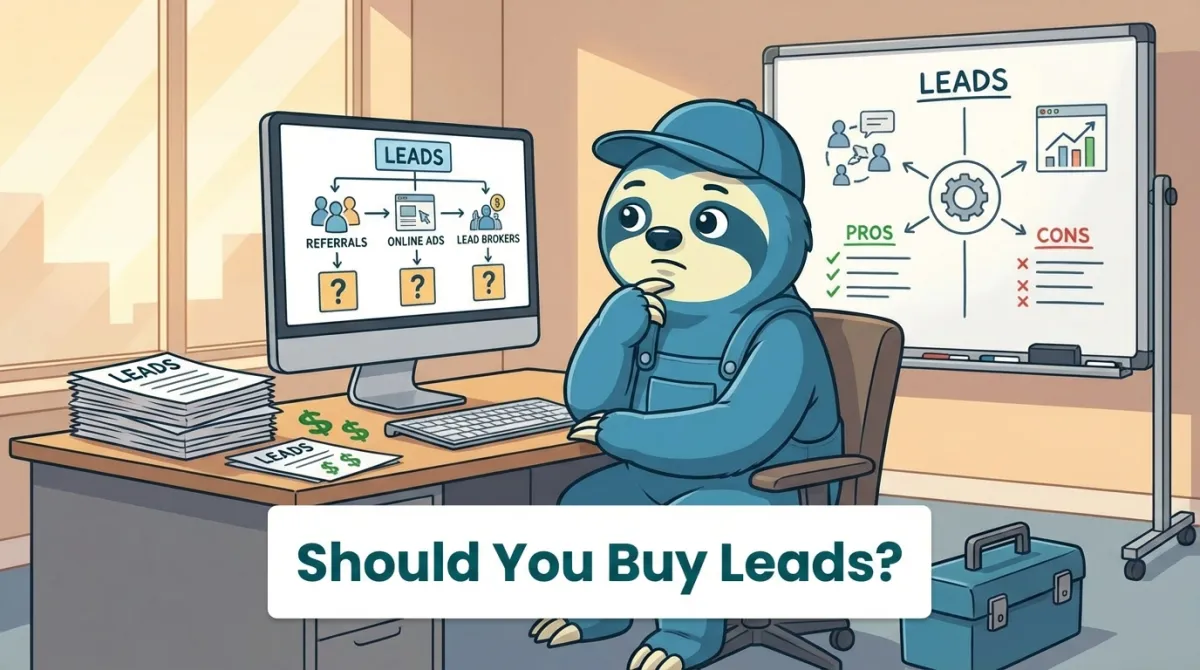
Every contractor has heard the pitch. "Sign up, set your budget, and we'll send you clients." It sounds almost too easy -- and if you've spent any time in the trades, you know that "too easy" usually means "too expensive."
Paid lead platforms like Angi, Thumbtack, and HomeAdvisor have become a rite of passage for contractors. Some swear by them, crediting these platforms with building their business from zero. Others swear at them, pointing to burned budgets and disconnected phone numbers masquerading as "qualified leads."
The truth, as usual, is somewhere in the middle. Buying leads isn't inherently good or bad -- it depends entirely on your trade, your market, your close rate, and whether you're actually tracking the numbers. This is the honest breakdown nobody selling you leads wants you to read.
How Paid Lead Platforms Actually Work
Before we get into platform-by-platform reviews, let's demystify the business model. Understanding how these companies make money helps you understand why your experience might be frustrating.
The basic model:
- A homeowner visits the platform (or searches Google and clicks a platform's ad)
- They describe the job they need done
- The platform matches them with contractors in the area
- Contractors pay for the "lead" -- the homeowner's contact information
Simple enough. But here's where it gets interesting.
Shared Leads vs. Exclusive Leads
Most platforms sell shared leads, meaning the same homeowner's information gets sent to 3-5 (sometimes more) contractors simultaneously. You're not just paying for a lead -- you're paying for a chance at a lead while racing against other contractors who got the exact same notification.
Exclusive leads -- where only you receive the homeowner's info -- exist on some platforms but cost significantly more. The trade-off is obvious: less competition, but higher per-lead cost.
How Pricing Works
Lead pricing varies based on:
- Trade type: A roofing lead costs more than a lawn care lead because the job value is higher
- Market size: Leads in Los Angeles cost more than leads in Topeka
- Competition: More contractors in your area = higher prices
- Lead type: Exclusive costs more than shared
Most platforms charge per lead regardless of whether that lead answers the phone, responds to your message, or has any actual intention of hiring someone.
That last point is worth repeating.
Angi: The 800-Pound Gorilla
Angi is what you get when you merge Angie's List (a trusted review platform) with HomeAdvisor (an aggressive lead generation machine) and try to pretend the result is one cohesive product. The merger happened under parent company ANGI Homeservices, and depending on who you ask, it either streamlined the experience or created a confusing mess.
How It Works Now
Angi operates as a combined marketplace and lead platform. Homeowners can browse contractor profiles, read reviews, and request quotes. Contractors can set up profiles for free (the old Angie's List model) or pay for leads (the HomeAdvisor model). In practice, the paid lead side dominates.
When a homeowner submits a request, Angi sends their information to multiple contractors in the area. You get charged when the lead is delivered, not when you win the job.
What Leads Cost
Angi lead costs range widely:
| Trade | Typical Lead Cost |
|---|---|
| Handyman services | $15 - $30 |
| Plumbing | $25 - $60 |
| Electrical | $25 - $65 |
| HVAC | $30 - $80 |
| Roofing | $40 - $100+ |
| Remodeling | $50 - $100+ |
These numbers shift based on your market. In major metros, expect to be at the higher end -- or beyond it.
The Honest Pros
- Massive user base: Angi has significant brand recognition with homeowners, which means real volume
- Review integration: Your review history from the old Angie's List carries weight
- Broad category coverage: Almost every trade is represented
- Some leads are genuinely ready to hire: Not all leads are tire-kickers
The Honest Cons
- Shared leads are the default: Expect 4-5 other contractors getting the same lead, turning every opportunity into a speed contest
- Aggressive upselling: The sales team will push you toward higher spend levels relentlessly
- Auto-charge complaints: Many contractors report being charged for leads they didn't want or couldn't use, with a clunky credit request process
- Inconsistent lead quality: Some leads are solid homeowners ready to hire. Others are people who filled out a form on a whim, gave a wrong number, or are purely price-shopping with no intention of hiring at your price point
- Contract lock-in: Some contractors report difficulty canceling or reducing their spend commitments
Best For
Established contractors in high-ticket trades who can respond within minutes and have a strong phone game. If you close at 30%+ and your average job is over $2,000, the math can work. If you're doing $200 handyman calls, it probably won't.
Verdict
Mixed. Angi can work, but it requires discipline, fast response times, and honest tracking of your numbers. The platform's tendency to prioritize its own revenue over contractor experience is a real concern, and you should go in with eyes open.
Thumbtack: The Pick-Your-Battles Option
Thumbtack takes a slightly different approach that many contractors find more palatable. Instead of automatically charging you for every matched lead, you browse available leads and choose which ones to respond to.
How It Works
A homeowner posts a job request. You see the details -- what they need, their budget range, their location -- and decide whether to send a quote. You're charged when you respond, not when a lead is pushed to you.
This one difference changes the entire dynamic. You have agency. You can skip the leads that smell like trouble and invest in the ones that look promising.
Thumbtack also offers an "Instant Match" feature where your profile is automatically shown to homeowners who match your criteria. This is more passive but lets clients come to you.
What Leads Cost
| Trade | Typical Lead Cost |
|---|---|
| Cleaning services | $10 - $25 |
| Lawn care | $10 - $30 |
| Plumbing | $20 - $50 |
| Electrical | $20 - $55 |
| HVAC | $25 - $65 |
| Remodeling | $35 - $80+ |
Generally a bit cheaper than Angi, though this varies by market.
The Honest Pros
- You choose your leads: This alone makes Thumbtack feel fairer than platforms that auto-send and auto-charge
- Good for niche services: If you specialize in something specific, you can target precisely the leads that fit
- Transparent pricing: You see the cost before you commit
- Decent for newer contractors: Lower barriers to entry than Angi
- Profile-driven: Strong profiles with good reviews get organic visibility
The Honest Cons
- Price-shopping culture: Many Thumbtack users are explicitly comparing multiple quotes, and they lean toward the cheapest option
- Race to respond: Even though you choose your leads, being first still matters enormously
- Some low-quality leads: People exploring costs with no real timeline or commitment
- Review dependency: Without reviews on the platform, you'll struggle to win against established pros
- Smaller coverage in some markets: Rural areas may have limited lead volume
Best For
Newer contractors building their initial client base, or specialists in niche services where the competition on the platform is thinner. Also decent for contractors who want more control over their lead spend.
Verdict
Decent, especially for starting out. The choose-your-own-lead model is genuinely better than being auto-charged. But manage your expectations -- you'll still need to be fast, professional, and priced competitively.
HomeAdvisor: A Platform in Transition
HomeAdvisor used to be the dominant paid lead platform for home services. Then the merger with Angi happened, and things got complicated.
What Happened
HomeAdvisor was acquired by Angi's parent company (IAC/InterActiveCorp) and has been gradually folded into the Angi brand. The HomeAdvisor website still exists in some form, but it largely redirects to Angi. Contractors who had HomeAdvisor accounts found their agreements restructured, sometimes with different pricing, different lead quality, and different terms than what they originally signed up for.
Why Contractors Are Frustrated
The frustration with HomeAdvisor predates the merger, but the transition amplified it:
- "Leads" that were barely leads: Widespread complaints about being charged for wrong numbers, duplicate leads, and people who had no idea they'd even submitted a request
- Difficult cancellation process: Horror stories about being locked into annual commitments and struggling to reduce spend
- Opaque billing: Charges appearing without clear connection to specific leads
- The bait and switch feeling: Many contractors felt the platform they signed up for disappeared and was replaced by something worse
Current State
For practical purposes, HomeAdvisor is Angi now. If you're evaluating lead platforms today, you're evaluating Angi's current offering, not the HomeAdvisor of 2018. The brand still carries negative sentiment among many contractors, and that reputation isn't unearned.
Other Platforms Worth Knowing About
The lead platform landscape extends beyond the big names. Here's a quick rundown:
Bark -- Similar model to Thumbtack with a credit-based system. You buy credits and spend them on leads you choose. Decent in some markets, limited in others. Worth testing if Thumbtack doesn't have volume in your area.
Yelp -- Not primarily a lead platform, but Yelp's advertising program lets you promote your business to people searching for services. The "Yelp Verified License" badge adds credibility. However, Yelp's reputation among business owners for aggressive sales tactics and questionable review filtering is well-documented.
Porch -- Focuses on home services leads, often partnering with retailers like Lowe's. Lead quality reports vary widely. Smaller platform with less competition but also less volume.
Google Local Service Ads (LSAs) -- This deserves special mention because it's fundamentally different and, for most contractors, significantly better than third-party lead platforms.
Why Google LSAs Stand Apart
Google Local Service Ads aren't a lead platform in the traditional sense. They're ads that appear at the very top of Google search results when someone searches for a service you offer. Key differences:
- Pay per lead, not per click: You only pay when someone actually contacts you through the ad
- Higher intent: These are people actively searching for your service right now, not browsing a marketplace
- Google Guaranteed badge: Passes a background check and gets a trust badge from Google
- Dispute process: You can dispute irrelevant leads and get credits
- Direct connection: The homeowner calls you directly or messages through Google
LSAs typically deliver better ROI than Angi or Thumbtack because the leads are higher intent. The person typed "plumber near me" into Google -- they have an active problem. Availability varies by trade and market, but if LSAs are available in your area, they should be your first paid lead channel before any third-party platform.
The Math That Actually Matters
Here's where most contractors go wrong with lead platforms: they focus on cost per lead when they should be focused on cost per acquired client.
These are very different numbers, and confusing them is expensive.
The Real Calculation
Let's run a realistic scenario:
| Metric | Number |
|---|---|
| Leads purchased | 10 |
| Cost per lead | $50 |
| Total spent | $500 |
| Leads who answered the phone | 6 |
| Leads who scheduled an estimate | 3 |
| Quotes sent | 3 |
| Jobs won | 1 |
Your actual cost per acquired client: $500 -- not $50.
That 10% close rate (1 out of 10 leads) is actually common for shared leads on platforms like Angi. Some contractors do better, many do worse.
When the Math Works
If that one job is a $5,000 kitchen remodel or a $4,000 HVAC installation, spending $500 to acquire it might be perfectly acceptable. You spent 10-12% of revenue on client acquisition, which is within a healthy range for most service businesses.
The math works when:
- Average job value is $2,000+
- Your close rate on platform leads is 15%+
- Cost per acquired client stays under 15-20% of job revenue
- The client has potential for repeat business or referrals
When the Math Doesn't Work
Now imagine you're a handyman doing $150-$300 jobs. Same $500 to acquire one client, but that client pays you $250. You just lost $250 before you even bought materials.
The math fails when:
- Average job value is under $1,000
- Your close rate is below 10%
- Cost per acquired client exceeds 25%+ of job revenue
- Leads are predominantly price-shoppers who chose the cheapest bid
- You're paying for leads in categories with slim margins
Track or Die
The single most important thing you can do when buying leads is track everything. Not in your head. Not on a napkin. In a system.
For every lead source, you need to know:
- How many leads came in
- How many you contacted
- How many became quotes
- How many became jobs
- Revenue from those jobs
Without this data, you're guessing. And guessing with marketing budgets is how contractors go broke. A lead management system that tracks source attribution makes this straightforward instead of painful.
When Buying Leads Makes Sense
Buying leads isn't always a bad idea. Here are the scenarios where it can legitimately work:
1. You're just starting out and have zero pipeline. When you're brand new with no reviews, no Google presence, and no referral network, paid leads can fill the gap while you build organic channels. Think of it as paying rent while you build the house.
2. You're in a high-ticket trade. Roofers, remodelers, HVAC companies -- trades where a single job pays $3,000-$20,000 can absorb the cost of lead acquisition. The margins support it.
3. You're expanding into a new market. Moving into a new city? You have no local reputation yet. Paid leads can accelerate your presence while you build local SEO and reviews.
4. You have seasonal gaps to fill. If your organic channels carry you through peak season but slow seasons leave gaps, strategic lead buying during those windows can keep crews productive.
5. You're testing a new service offering. Adding a new service? Paid leads let you validate demand and build a portfolio of completed work quickly.
When It's a Money Pit
And here are the scenarios where buying leads will drain your bank account:
1. You can't respond fast enough. If you're on a job and can't return a lead's call within 5 minutes, you're paying for leads that go to the contractor who can. Speed to contact is everything on shared leads.
2. Your average job is under $500. The math simply doesn't support it for small jobs. You'll spend more acquiring the client than the job is worth.
3. You're not tracking ROI. If you can't tell me exactly how much you spent on leads last month and exactly how much revenue those leads generated, you're flying blind. Stop buying until you have tracking in place.
4. You have no sales process. A lead is not a client. If you answer the phone with "Yeah?" instead of a professional greeting, if you don't follow up on missed calls, if your quotes take a week -- you're paying for leads and then fumbling them.
5. Your reviews are terrible (or nonexistent). On platforms where homeowners see your profile, bad reviews or an empty profile kill conversions. Fix your reputation before you pay for more eyeballs on it.
6. You're already booked out 2-3 weeks. Why are you paying for leads when you can't serve the clients you already have? Invest in capacity first, then fill it.
The Better Long-Term Strategy
Here's the uncomfortable truth about buying leads: you're renting someone else's audience. The moment you stop paying, the leads stop coming. You've built nothing.
Compare that to owning your lead generation:
| Strategy | Monthly Cost | Time to Results | Long-term Value |
|---|---|---|---|
| Angi/Thumbtack | $500 - $3,000+ | Immediate | Zero when you stop paying |
| Google Local Service Ads | $500 - $2,000+ | 1-2 weeks | Zero when you stop paying |
| Google Business Profile | Free | 2-4 weeks | Compounds forever |
| SEO / website | $0 - $2,000 | 3-6 months | Compounds forever |
| Reviews strategy | Free | Ongoing | Compounds forever |
| Referral program | Low | Ongoing | Compounds forever |
The best contractors use paid leads as a bridge, not a destination. They buy leads to fill the pipeline today while building organic channels that will fill it for free tomorrow.
What "Owning Your Leads" Looks Like
Google Business Profile -- Free, powerful, and the number one source of local leads for contractors. Optimize it, post to it regularly, and collect reviews relentlessly.
Your own website -- Doesn't need to be fancy. It needs to be fast, mobile-friendly, have your services listed, and have a way for people to contact you. A simple contact form connected to a lead management tool ensures nothing falls through the cracks.
Google reviews -- The most underrated lead generation tool in existence. Contractors with 50+ reviews and a 4.5+ rating get organic calls daily. Every job is a chance to earn one.
Referral programs -- Your best clients know other people who need your services. A simple "refer a friend" incentive or even just consistently asking for referrals after a job can generate your highest-quality leads at near-zero cost.
Local SEO -- Service pages for every city you work in, content that answers common client questions, and consistent citations across directories. This takes time but produces leads indefinitely.
The contractor who invests in these channels for 12 months will look back at their lead platform bills and wonder why they waited so long.
If You Do Buy Leads, Follow These Rules
Still going to buy leads? Fair enough. Here's how to avoid the worst outcomes:
Rule 1: Speed Kills (the Competition)
Call within 5 minutes or don't bother. This isn't an exaggeration. Studies consistently show that the first contractor to make contact wins the job a disproportionate amount of the time. If you can't respond fast, you're subsidizing the contractor who can.
Set up your phone so lead notifications are impossible to miss. Better yet, have a system that alerts you immediately when new leads come in -- whether from Angi, Thumbtack, your website, or anywhere else.
Rule 2: Set a Hard Monthly Budget
Decide what you can afford to spend and don't exceed it. Period. Platforms are designed to encourage you to spend more. "Just increase your budget by $200 and you'll get 30% more leads" sounds great until you realize those extra leads have the same low conversion rate.
Start small. $300-$500/month. Track results. Scale only when the math proves it works.
Rule 3: Track Everything in One Place
Leads come from Angi, Thumbtack, Google, your website, referrals, yard signs. If you're not tracking every lead with its source, you have no idea what's working and what's wasting money.
Every lead should be logged with:
- Source (which platform or channel)
- Date received
- Status (contacted, quoted, won, lost)
- Revenue generated (if won)
This data tells you exactly which channels deserve more budget and which should be cut.
Rule 4: Know Your Numbers Cold
At minimum, know these for every lead source:
- Cost per lead: What you pay the platform
- Contact rate: What percentage actually answer or respond
- Quote rate: What percentage get a formal quote
- Close rate: What percentage of quotes become jobs
- Cost per acquired client: Total spend divided by jobs won
- Revenue per acquired client: Average job size from that source
- ROI: Revenue divided by spend
If you can't fill in those numbers right now, pause your lead buying and figure them out first.
Rule 5: Don't Put All Your Eggs in One Platform
Diversify. Run a small budget on two platforms simultaneously. Compare the numbers. You might find Thumbtack works great for your plumbing services but Angi is better for your HVAC work. Markets and platforms shift -- what worked last year might not work this year.
Rule 6: Know When to Walk Away
If after 90 days of disciplined tracking your cost per acquired client is more than 20% of your average job revenue, the platform isn't working for your business. That's not a failure on your part -- it's just math. Reallocate that budget to channels that perform better.
The Bottom Line
Buying leads is neither a silver bullet nor a scam. It's a tool, and like any tool, its value depends entirely on how and when you use it.
The contractors who succeed with paid leads share a few traits: they respond fast, they track everything, they set hard budgets, and they treat lead platforms as one channel among many -- not their entire marketing strategy.
The contractors who get burned share different traits: they set it and forget it, they don't track ROI, they rely on a single platform for all their business, and they keep spending even when the math doesn't work because stopping feels scarier than continuing.
Build your own lead generation engine. Use paid leads strategically while that engine grows. And above all, know your numbers. The contractor who knows their cost per acquired client from every source has a massive advantage over the one who's "pretty sure it's working."
Tracking leads from paid platforms, referrals, your website, and everywhere else shouldn't require a spreadsheet and a prayer. WorkZen's lead management tools capture every lead, track the source, and show you exactly which channels are making you money -- and which ones are burning it. Start for free.
Frequently Asked Questions
Ready to transform your field service business?
Start using WorkZen today. It's free to get started!