Chargebacks: A Contractor Protection Playbook
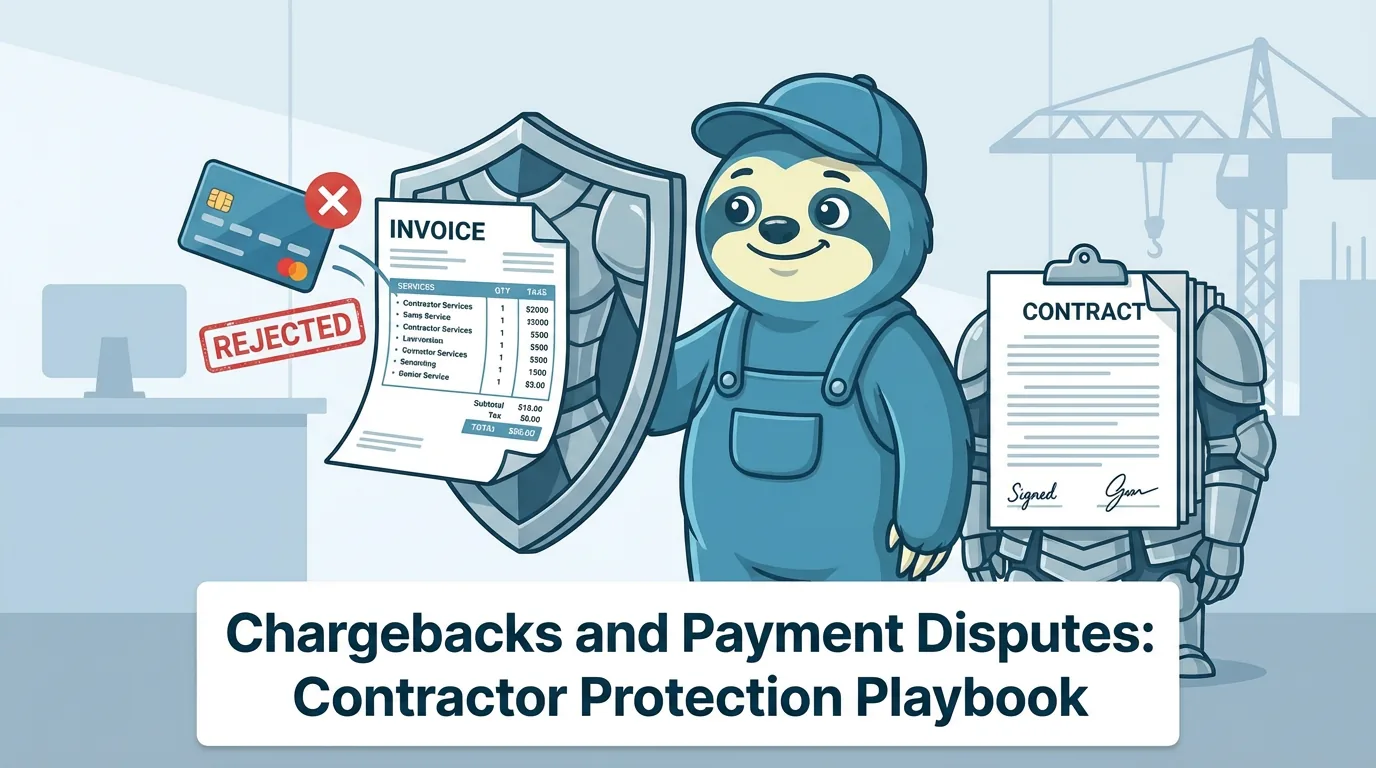
A chargeback hits different than a late payment. Late payments are frustrating but predictable - you chase the money, maybe offer a payment plan, and eventually collect most of what you are owed. A chargeback reverses money you already received. The funds disappear from your account, a dispute fee lands on top, and you are suddenly proving to a bank that you actually did the work a client already approved. For contractors who run lean cash flow, a single large chargeback can disrupt payroll or supplier payments for weeks.
The uncomfortable truth is that chargebacks in the service industry are rising. More clients pay by card, more work happens on verbal agreements, and more disputes get filed because the chargeback process is easier than calling the contractor to discuss a concern. The good news is that most chargebacks are preventable with better documentation habits, and most disputes are winnable when you have the right evidence. This is not about becoming a paperwork machine - it is about building a handful of habits that protect your revenue without slowing down your operation.
Why Contractors Get Chargebacks
The most common reason service contractors face chargebacks is scope disagreement. A client remembers the conversation differently than you do, sees the final invoice as higher than expected, and disputes the charge with their bank rather than picking up the phone. This is especially prevalent in trades where the final scope often differs from the original estimate - plumbing diagnostics that reveal additional work, electrical panels that need more circuits than planned, or HVAC installs where ductwork modifications were discussed verbally but never documented.
Client remorse is the second driver, particularly on larger jobs. A homeowner approves a 4,000-dollar repair in the stress of a broken furnace, gets the system running again, then has second thoughts about the price when the credit card statement arrives. The chargeback system gives them a no-confrontation way to claw back money, and the burden of proof shifts entirely to you.
Unauthorized card use is less common but harder to fight. A spouse or tenant uses a card without the account holder's knowledge, or a client disputes the charge claiming their card was stolen. These situations are almost impossible to win unless you collected a signature from the cardholder at the time of payment, which is why point-of-sale signatures remain relevant even in the age of tap-to-pay.
| Chargeback Reason | How Common | Winnable With Documentation? |
|---|---|---|
| Scope disagreement | Very common | Yes - signed work authorization |
| Client remorse | Common | Yes - signed approval + completion proof |
| Unauthorized card use | Less common | Difficult - requires cardholder signature |
| Service not delivered | Rare | Yes - photos + completion records |
| Duplicate charge | Rare | Yes - transaction records |
Building Chargeback-Proof Documentation
The single most effective chargeback prevention tool is a signed work authorization that clearly describes the scope, price, and payment terms before work begins. This does not need to be a complex legal document. A one-page work order with the job description, estimated total, and the client's signature is enough to defeat most scope-related disputes. Digital signatures collected on a tablet or phone at the job site carry the same weight as ink.
Before and after photos are your second line of defense. Timestamped photos showing the condition before work started and the completed result create visual evidence that is difficult for a client to dispute. Train your techs to photograph the problem, any hidden issues discovered during work, and the finished result as standard operating procedure on every job. This habit takes two minutes and has saved contractors thousands of dollars in dispute evidence. 📋
Change order documentation is where most contractors fall short. When the scope expands mid-job - and it often does in service work - getting written approval before proceeding is critical. A text message from the client saying "go ahead with the extra work" is admissible evidence. A verbal okay in the hallway is not. Build the habit of texting or emailing scope changes with the additional cost and getting a written confirmation before proceeding.
The Dispute Response Process
When a chargeback notification arrives, time is your enemy. Most processors give you 7-21 days to respond with evidence, and that window is firm. Missing the deadline means automatic loss regardless of how strong your case is. Set up alerts so chargeback notifications get immediate attention rather than sitting in an email inbox for a week.
Your response package should be organized and specific. Include the signed work authorization, before and after photos, any change order approvals, the final invoice, and proof of completion or client satisfaction. If the client sent a text saying "looks great, thanks" after the job, include that screenshot. Payment processors review hundreds of disputes daily - make your evidence easy to review by organizing it logically and leading with your strongest documentation. 🛡️
The response itself should be factual and unemotional. Explain the work performed, reference the signed authorization, note any communications confirming satisfaction, and attach your evidence. Avoid editorializing about the client's character or motives. The processor's job is to determine whether the charge was authorized and the service was delivered, not to mediate a personal conflict between you and the client.
Timeframes and Evidence Requirements by Card Network
Visa and Mastercard handle disputes slightly differently, and knowing the distinctions matters when you are building your response. Visa's dispute process gives merchants 20 days to respond to the initial notification and requires what they call "compelling evidence" - documentation that proves the cardholder authorized the transaction and received the service. Mastercard's process is similar but uses a two-phase approach where an initial chargeback can escalate to arbitration if either party contests the first ruling.
American Express operates its own dispute system that tends to favor the cardholder more heavily than Visa or Mastercard. Amex disputes often move faster and have shorter response windows, so prioritize these when they come in. Discover follows a process similar to Visa but with its own timeline variations.
| Card Network | Response Window | Dispute System | Cardholder Bias |
|---|---|---|---|
| Visa | 20 days | Compelling evidence standard | Balanced |
| Mastercard | ~20 days | Two-phase (can escalate to arbitration) | Balanced |
| American Express | Shorter (varies) | In-house system | Favors cardholder |
| Discover | Similar to Visa | Visa-like process | Balanced |
Across all networks, the evidence that matters most is consistent: proof of authorization, proof of delivery, and proof of satisfaction. If you have all three documented, your win rate on disputes will be significantly higher than the industry average. Most contractors who lose disputes lose them because they have verbal agreements and no documentation, not because the bank was unfair.
How Payment Processors Handle Your Dispute Rate
Payment processors track your chargeback ratio - the number of chargebacks divided by your total transactions over a rolling period. The critical threshold is 1%. Staying below 1% means you are a normal merchant with normal dispute activity. Crossing that line triggers consequences that escalate quickly.
At the first level, your processor may place you in a monitoring program. This means increased scrutiny on your account, potential holds on settlement funds, and usually a conversation with your account manager about what you are doing to reduce disputes. If your rate stays elevated, processors can increase your per-transaction fees, require you to maintain a reserve balance (essentially holding a percentage of your revenue in escrow), or add rolling reserves that further constrain cash flow.
The worst-case scenario is account termination. If your chargeback rate stays above 1-2% for several consecutive months, your processor can close your merchant account. This puts you on the MATCH list (Member Alert to Control High-Risk Merchants), which is essentially a blacklist shared across processors. Getting off this list takes time, and finding a new processor willing to take you on at reasonable rates becomes very difficult. Keeping your dispute rate low is not just about winning individual cases - it is about protecting your ability to accept card payments at all. ⚠️
| Chargeback Rate | Status | Likely Consequences |
|---|---|---|
| Below 0.5% | Healthy | No action, normal processing |
| 0.5% - 1.0% | Caution zone | Possible processor review |
| Above 1.0% | Monitoring threshold | Fee increases, reserve requirements, monitoring program |
| Above 1.5% - 2.0% (sustained) | High risk | Merchant account termination, MATCH list |
Reducing Disputes Through Better Communication
Most chargebacks never need to happen. They are the result of communication failures, not service failures. A client who feels surprised by a charge is far more likely to dispute it than a client who understood and approved the cost every step of the way. The most effective dispute prevention is not better documentation - it is better communication that makes documentation unnecessary.
Walk clients through the invoice before collecting payment. Explain each line item, reference the original estimate, and highlight any change orders that were approved during the job. This takes two minutes and gives the client a chance to raise concerns face-to-face rather than through their bank. Most scope disagreements dissolve when someone takes the time to explain the charges in person.
Follow-up communication after the job also reduces disputes. A simple text or email the day after completion asking if everything is working properly accomplishes two things: it catches legitimate issues before they become chargebacks, and it creates a written record of client satisfaction that becomes evidence if a dispute is filed later. Clients who feel heard and respected dispute charges at a fraction of the rate of clients who feel ignored. 💡
The Real Cost of Chargebacks
The visible cost of a chargeback is the reversed transaction amount plus the dispute fee, which typically ranges from 15 to 100 dollars depending on your processor. But the full cost is significantly higher when you account for the hidden expenses. The time your team spends gathering evidence and writing responses has a real labor cost. The cash flow disruption of having funds pulled from your account creates its own cascade of problems.
Then there are the opportunity costs. Every hour you spend fighting a chargeback is an hour you are not spending on revenue-generating activities. For small operations where the owner handles disputes personally, this time comes directly out of selling, scheduling, or managing the crew. A 500-dollar chargeback that takes three hours to dispute has an effective cost closer to 800-1,000 dollars when you factor in time and fees.
The long-term costs of a high dispute rate compound further. Higher processing fees mean lower margins on every future transaction. Reserve requirements tie up working capital that could fund growth. And the stress and distraction of ongoing payment disputes erodes the focus that should be going into running a better operation. Prevention is not just cheaper than dispute resolution - it is dramatically cheaper.
Building a Chargeback Response System
Treat chargebacks like any other operational process: build a system once and run it consistently. Create a dispute response template that your admin team can fill in for each case. Store your evidence - work authorizations, photos, change order approvals, completion confirmations - in a structured system tied to each job so gathering documentation takes minutes, not hours.
Designate one person as the chargeback owner in your organization. This person monitors incoming notifications, initiates the evidence-gathering process, submits responses within the required timeframe, and tracks outcomes. Having a clear owner prevents disputes from falling through the cracks during busy periods, which is exactly when they tend to arrive.
Review your chargeback data quarterly to identify patterns. Are disputes concentrated around specific job types, price ranges, payment methods, or individual techs? Patterns reveal systemic issues that process changes can address. If most of your chargebacks come from jobs over 2,000 dollars, that tells you to add an extra confirmation step for larger jobs. If one tech generates more disputes than others, that points to a communication or documentation training issue. The data tells you where to invest your prevention efforts for maximum impact. 📈
Payment Controls That Prevent Problems
Collecting payment at the job site rather than billing after the fact significantly reduces chargeback risk. When a client pays while standing next to the completed work, they are much less likely to later claim the service was not delivered or not satisfactory. Mobile payment collection with digital signatures ties the payment directly to the job in a way that remote invoicing does not.
For larger jobs, consider collecting deposits at authorization and progress payments at defined milestones. This reduces the size of any single chargeback exposure and creates multiple documented touchpoints where the client approved both the work and the payment. A 5,000-dollar job collected as a 1,500-dollar deposit, a 2,000-dollar progress payment, and a 1,500-dollar final payment is much harder to dispute than a single 5,000-dollar charge after completion.
Clear cancellation and refund policies documented in your service agreement give you additional protection. When a client knows upfront that completed work is non-refundable and that concerns should be directed to your office rather than their bank, the path of least resistance shifts away from chargebacks and toward direct resolution. These policies only protect you if the client agreed to them in writing before the work began, so include them in your standard work authorization.
Frequently Asked Questions
Ready to transform your field service business?
Start using WorkZen today. It's free to get started!