Trade School vs Apprenticeship: Which Pays Faster?
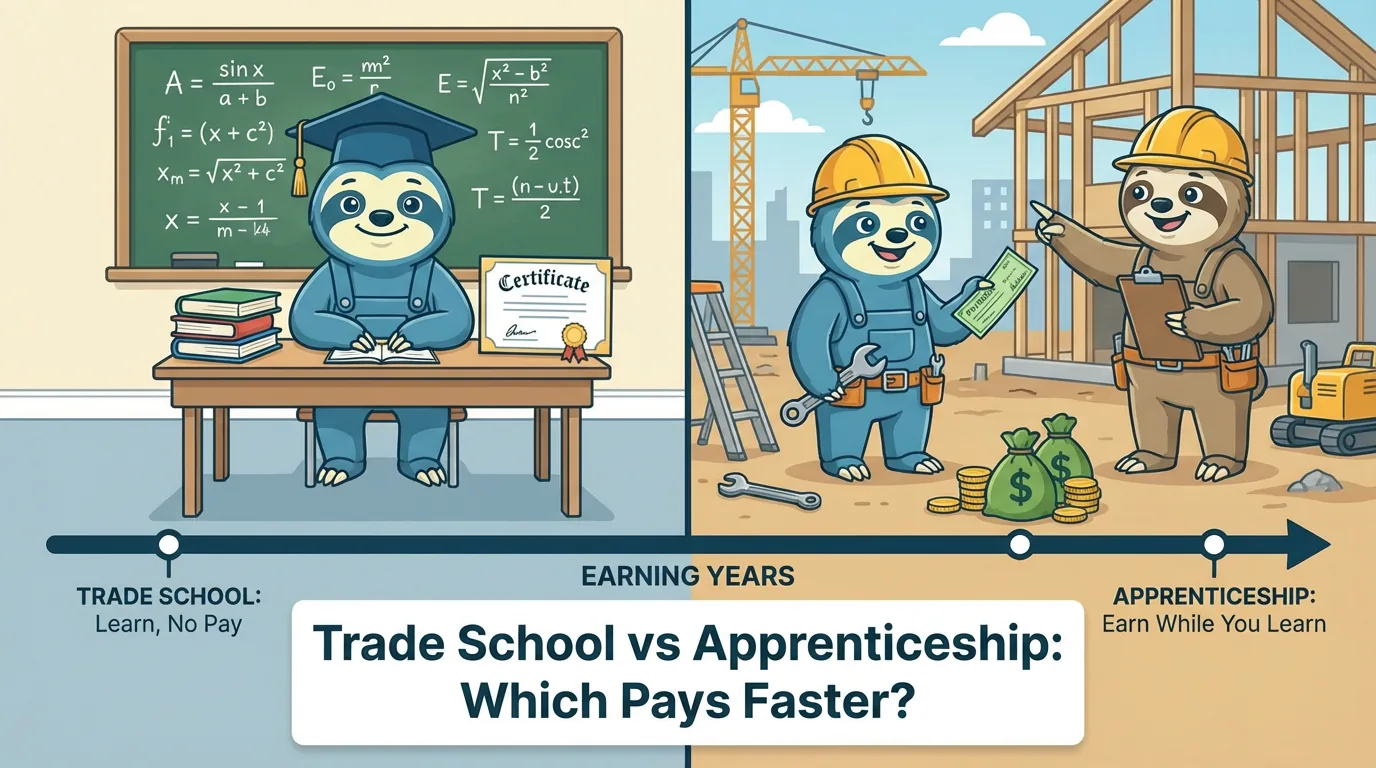
The trade-school-versus-apprenticeship debate gets treated like a personality test. It is not. It is a financial and career-timing decision that can shape your first five years in the trades. If you choose with good local data, you can accelerate earnings and experience. If you choose on vibes, you can burn time and money fixing a path that never matched your market in the first place.
In 2026, this decision matters even more because labor demand is high but pathways remain fragmented. Some regions have strong apprenticeship pipelines. Others have waitlists, weak sponsorship availability, or uneven mentorship quality. At the same time, trade schools vary wildly in quality, employer reputation, and graduation outcomes. One program can open doors quickly; another can leave you with debt and no direct hiring channel.
The right question is not "Which path is best globally?" The right question is: Which path gets me to skilled, paid, compounding experience fastest in my local reality? That is the lens this guide uses.
Side-by-Side: How the Two Paths Actually Feel in Year One
Trade school usually feels more structured in the short term. You have a clear schedule, predictable classroom progression, and a defined curriculum. For many learners, that structure builds confidence and reduces anxiety, especially if they are new to tools, code, and technical fundamentals. You know where to be, what is being taught, and when assessments happen.
Apprenticeship, by contrast, feels more dynamic and less linear. You earn while learning, but your quality of learning depends heavily on the job environment, the crew, and the mentor quality around you. Some apprentices accelerate quickly under great supervision. Others spend too much time doing repetitive low-skill tasks without enough deliberate instruction. The upside is immediate income; the risk is inconsistent training depth.
Both paths can work. The deciding factor is alignment between your learning style and your local opportunity structure, not social media narratives about which route is "real" trades training. ⚙️
Quick Comparison Table
| Category | Trade School | Apprenticeship |
|---|---|---|
| Upfront cost | Higher (tuition, books, tools) | Lower direct tuition; income starts earlier |
| Early cash flow | Often negative or low | Positive earlier due to paid work |
| Learning format | Classroom-first, standardized | Jobsite-first, variable by employer |
| Network effect | Depends on school-employer pipeline | Depends on contractor/sponsor quality |
| Speed to field confidence | Good for theory and fundamentals | Strong for real-world problem solving |
| Main risk | Debt without strong placement outcomes | Inconsistent mentorship/training quality |
| Best for | Learners wanting structured foundation | Learners wanting immediate paid experience |
This table is a starting framework, not a final answer. Your province/state, trade, and sponsor availability can flip the outcome quickly.
Five-Year Money Reality: Where People Get Misled
The internet loves one-number answers: "Apprenticeship pays faster" or "School gets you certified faster." In reality, each route has a different earnings curve. Apprenticeship often wins the first 24 months because you are paid while progressing. Trade school can narrow or close the gap later if it leads to higher-quality placement, faster exam readiness, or stronger long-term mobility.
The biggest financial mistake is comparing only hourly wage and ignoring hidden costs. Trade school candidates often undercount financing costs and living expenses during training. Apprentices often undercount income volatility, unpaid travel time, and weak mentorship periods that slow real skill growth. You need a full-model comparison, not a headline comparison.
A practical way to decide is to model cumulative earnings, not single-year earnings. Cumulative earnings captures the real trade-off between short-term income and long-term positioning.
Earnings Snapshot Table (Illustrative)
| Year | Trade School Path (Net) | Apprenticeship Path (Net) |
|---|---|---|
| Year 1 | -$8,000 to $15,000 (depends on tuition + part-time work) | $32,000 to $48,000 |
| Year 2 | $35,000 to $55,000 | $42,000 to $60,000 |
| Year 3 | $48,000 to $70,000 | $52,000 to $75,000 |
| Year 4 | $60,000 to $85,000 | $60,000 to $88,000 |
| Year 5 | $68,000 to $95,000+ | $66,000 to $95,000+ |
These are directional ranges only, but the pattern is common: apprenticeship often leads early, and outcomes can converge by years 4-5 depending on market, trade, and credential progression. 💰
Graph: Cumulative Earnings Trend (Illustrative)
Below is a simple text graph showing cumulative earnings trend, where apprenticeship usually leads early while trade school can catch up over time.
Cumulative Earnings (Illustrative) Year 1 School: ███ | Apprenticeship: █████████Year 2 School: █████████ | Apprenticeship: ██████████████Year 3 School: ███████████████ | Apprenticeship: ██████████████████Year 4 School: ███████████████████ | Apprenticeship: █████████████████████Year 5 School: ███████████████████████| Apprenticeship: ███████████████████████Key takeaway: the early gap can be significant, but long-term parity is possible when either path is executed well with strong placement and progression decisions. 📈
When Trade School Is the Smarter Choice
Trade school is often the better move when your local apprenticeship entry points are heavily bottlenecked or when employers in your area strongly value specific school credentials. It can also be the right choice when you need a confidence-building technical foundation before entering high-pressure jobsite environments.
It is especially useful for learners who benefit from structured pacing, formal lab practice, and repeated concept reinforcement before field deployment. For some candidates, that structure reduces early burnout and improves long-term retention in the trade.
Trade school is not "paying to delay." In the right context, it is a strategic staging platform. The mistake is enrolling without validating employer outcomes first.
When Apprenticeship Is the Smarter Choice
Apprenticeship is often strongest when you can secure a quality sponsor with real training intent, not just labor demand. If you are learning under people who explain, correct, and progressively increase responsibility, apprenticeship can be an extraordinary accelerator.
It also tends to fit candidates with immediate cash-flow pressure. Earning from day one can reduce debt exposure and allow faster financial stability while skills compound in real environments.
The risk is uneven quality control. Apprenticeship without mentorship can become cheap labor with limited development. Before accepting a role, ask direct questions about training structure, supervision, and progression checkpoints. 🛠️
What to Ask Before You Decide
Use this decision checklist with real employers and programs:
- What are first-year realistic earnings after costs?
- How quickly do graduates/apprentices move into higher-skill responsibilities?
- What does exam/certification pass support look like?
- Who is accountable for training quality?
- What percentage of entrants are still in the trade after two years?
Then compare your options side by side in writing. Decision quality improves when assumptions are explicit.
Final Recommendation Framework
If your priority is immediate income and field repetition, apprenticeship often wins early. If your priority is structured fundamentals and formal progression confidence, trade school may be the better first step. If possible, the hybrid route often delivers the best blend: structured foundational training plus paid apprenticeship progression.
No single route is universally best. The best route is the one that gives you dependable skill growth, sustainable cash flow, and long-term mobility in your local market. ✅
Use this guide as a practical decision model, then pressure-test it with three employer conversations and one program conversation this week. The right choice becomes obvious when your assumptions meet real-world data.
Frequently Asked Questions
Ready to transform your field service business?
Start using WorkZen today. It's free to get started!