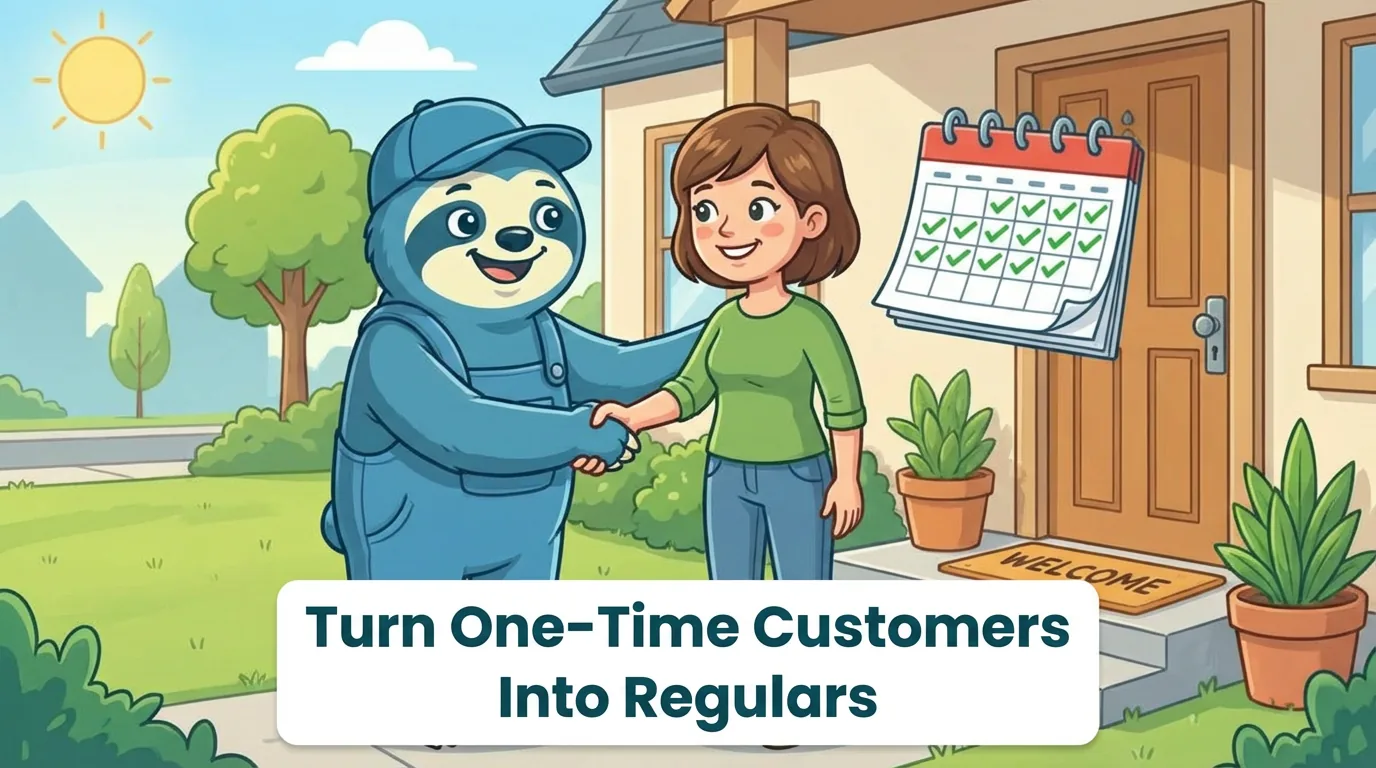
How to Turn One-Time Customers Into Repeat Clients
Most service businesses do not struggle because they cannot deliver good work. They struggle because they have to keep paying for the same first conversation over and over again. A lead comes in, the team books the job, they complete the work, they send the invoice, and then the relationship goes quiet. The next month, the owner is back in the same position, buying attention again with ad spend, time, discounts, and stress. That loop repeats until someone intentionally breaks it. 🔁
That cycle feels normal because it is common, but common does not mean healthy. When your revenue depends on constantly replacing clients rather than growing lifetime value, small disruptions hit harder. One slow week in paid ads hurts. A dip in reviews hurts. A missed call hurts. In a one-and-done model, every leak in the top of the funnel becomes a real financial risk because there is no stable base of repeat demand underneath the business. Activity can look high while resilience stays low.
The contractors who grow more predictably do something different. They treat job completion as the start of a long relationship, not the end of a transaction. They build follow-up systems that feel useful, timely, and human. They make it easy for clients to remember them, trust them, and come back without feeling like they are being "marketed to" every week. That shift, from transactional thinking to relationship design, is where repeat revenue begins.
Why One-Time Revenue Feels Busy but Stays Fragile
On paper, a one-time job can look profitable. You close the work, you get paid, and you move to the next lead. The problem is that your acquisition cost never gets a chance to compound. Every month starts near zero. Every month requires fresh outreach. Every month depends on how well your ads, referrals, and response times perform in that exact period. The business may be active, but it is not stable.
Owners often notice this pattern emotionally before they notice it in their reports. They feel "always on." If they stop pushing, demand drops. If they take a week off, pipeline quality weakens. If they pause ad spend, booking volume thins quickly. That pressure is not only a workload issue. It is a structural issue. The company is optimized for immediate conversion but under-built for long-term retention.
There is also a margin problem hidden inside this model. Repeat clients usually buy faster, require less education, and trust your recommendations more readily because previous outcomes already reduced uncertainty. New clients, by contrast, need more explanation, more reassurance, and often more follow-up before they book. If your business is mostly new-client revenue, your team spends a larger share of its time proving credibility instead of delivering work. That means you are spending more energy to earn the same dollar. 💸
Two realities make this especially expensive for owner-led teams:
- Your time gets pulled into proving, not improving. Instead of refining systems, you repeatedly re-explain your credibility to brand-new prospects.
- Revenue quality becomes inconsistent. Some weeks look strong, but margins and scheduling stability fluctuate because demand depends on fresh acquisition volume.
Why Good Clients Quietly Drift Away
Most clients do not leave because they had a terrible experience. They leave because they forgot. In home services especially, memory drives buying behavior more than loyalty statements do. A homeowner may honestly like your work and still call someone else months later if that other company was visible at the moment a need appeared. In practice, the business that is easiest to recall often wins the next job.
Another reason clients drift is that many companies disappear after payment. There is no closing loop, no meaningful check-in, no reminder tied to seasonality, and no clear next step. The client interprets silence as completion, not continuity. From the business side, it feels like a lead-generation challenge. From the client side, it feels like there was simply nothing else to do.
Timing is the third factor. Follow-up often fails because it arrives either too early or too late. A generic "how did we do" message sent five minutes after service feels automated and thin. A reminder sent nine months after a seasonal service window has passed feels irrelevant. Retention improves when communication matches the real life cycle of the service you provide, not just the convenience of your calendar.
If you want a quick diagnostic of why clients are drifting, start here:
- No clear next step after job completion
- No service history context in future messages
- No seasonal relevance in timing or language
- No ownership of retention quality inside the team
Build a Post-Job Experience Clients Actually Remember
If you want repeat work, the post-job window is your highest-leverage moment. Trust is highest right after a successful outcome, and the client is most receptive to practical next steps when the service is still fresh in their mind. This is where many businesses leave money on the table by ending communication at invoice delivery.
A better approach is to treat completion as a mini handoff, not a finish line. Give the client a short recap of what was done, what to watch for, and what preventive action makes sense over the next season. Keep it plain, specific, and non-alarmist. You are not trying to scare them into another booking. You are helping them protect the result they just paid for.
That posture matters. Clients can feel the difference between education and upsell language. When they feel served rather than sold to, they become more open to future recommendations. The trust needed for repeat work is rarely built through "offers." It is built through consistency, clarity, and the feeling that your company makes home maintenance easier, not louder. Trust compounds when clients feel remembered, not targeted. 🤝
Follow-Up Should Feel Like Service, Not Campaigns
Most follow-up systems fail because they are designed like marketing campaigns instead of client care. They are either too frequent, too promotional, or too generic. A better retention rhythm is slower and smarter. It reflects actual maintenance cycles and common homeowner concerns tied to weather, usage, and equipment age.
Think in terms of meaningful moments. Each touchpoint should have a clear reason to exist and feel timely in the client's actual life. 📅
| Touchpoint | Timing | Purpose | Example Message Angle |
|---|---|---|---|
| Quality check | 1 week after job | Confirm results, catch any issues early | "Everything holding up well?" |
| Maintenance tip | 1 month after job | Add value tied to the original service | Seasonal tip connected to what was done |
| Seasonal prep | 6 months after job | Align with weather or usage cycles | "Before the season hits, here's what to watch for" |
| Annual check-in | 12 months after job | Invite inspection before issues turn urgent | "Your annual [service] window is coming up" |
You do not need long copy to make this work, but you do need relevance. A homeowner who had a drainage issue should not receive a random generic newsletter. They should receive focused guidance connected to what was done and what commonly happens next. Relevance is what makes follow-up feel thoughtful rather than automated noise.
Design Recurring Offers That Feel Useful and Fair
Repeat revenue grows faster when clients can say yes to continuity without feeling trapped in a contract they do not understand. Many service agreements fail because they are written from the business perspective first, with too much fine print and too little clarity about client benefit. Owners focus on recurring billing. Clients focus on peace of mind and predictability.
A strong recurring offer is simple to explain in one minute. It answers three questions clearly: what is included, when it happens, and why it saves stress or money over time. If those answers are vague, conversion drops. If those answers are concrete, clients make decisions faster because they can map value to their own household reality.
Positioning also matters. The best recurring offers are framed as prevention and convenience, not as fear response. You are not promising that nothing will ever go wrong. You are promising that your client will have a reliable plan, priority support, and a professional who already understands their property history. That is what turns an offer into a service relationship.
Build the Retention Engine Inside Your Workflow
Retention should not depend on memory. If it lives in one owner's head, it disappears during busy season. The process has to be operationalized so the right follow-up happens whether the day is calm or chaotic. That means clear triggers, ownership, and review cadence.
Inside WorkZen, this usually starts with clean tagging and structured stages. Every completed job should have a service category, a completion date, and a next-best follow-up window. From there, automation can handle timing while your team controls quality. The message content still needs a human voice, but delivery should not require manual tracking for every account.
Ownership is where most teams slip. If "someone" is supposed to check follow-up quality, no one does it consistently. Assign one person responsibility for retention hygiene each week, including message quality checks, response handling, and rebooking opportunities. Retention is a revenue function, not an admin afterthought.
What to Measure Over the Next 90 Days
Improvement feels abstract until it is measured. For retention, you do not need a massive dashboard. You need a small set of indicators reviewed consistently. Those three numbers alone will tell you if your system is alive or performative.
| Metric | What It Measures | Why It Matters |
|---|---|---|
| Repeat booking rate | % of revenue from returning clients | Shows if retention is actually working |
| Time between job 1 and job 2 | Average gap from first to second booking | Shorter gaps signal stronger follow-up |
| Follow-up coverage rate | % of completed jobs with a structured sequence | Reveals execution gaps before they become revenue gaps |
Then layer in economics. Compare gross margin from repeat clients versus first-time clients. In most service businesses, repeat-client margin is healthier because conversion friction is lower and trust is already established. Seeing this clearly helps the team understand why retention work is not "extra." It is one of the most profitable activities in the company.
Finally, look at durability metrics. If new-lead volume dips for two weeks, what happens to booked work? A retention engine should reduce volatility. You will still need lead generation, but your business should no longer feel like it resets every month. Stability is the sign that your relationship model is working, and stability is what gives owners strategic room to grow. 📈
The Compounding Effect Most Owners Underestimate
The first win in retention is usually modest. A few more repeat bookings. A few easier closes. A few clients who return sooner than expected. But the real value appears over time as these behaviors compound. Better follow-up creates more repeat work. More repeat work creates more satisfied clients with recent positive experiences. Those clients produce better referrals and reviews, which lower acquisition cost and improve lead quality.
This is why retention is not a "nice" strategy for mature companies. It is core infrastructure for any service business that wants predictable growth without constant panic. It reduces dependency on expensive attention channels. It improves scheduling confidence. It gives the team room to focus on quality instead of firefighting top-of-funnel gaps every week.
If you want a practical next step, start small and do it well. Pick one service category, build one clean follow-up sequence, and track repeat bookings for one quarter. You do not need a perfect enterprise program on day one. You need a repeatable system that proves to your team, and your numbers, that relationships outperform transactions.
Frequently Asked Questions
Ready to transform your field service business?
Start using WorkZen today. It's free to get started!