Truck Stock Management: Stop Emergency Supply Runs
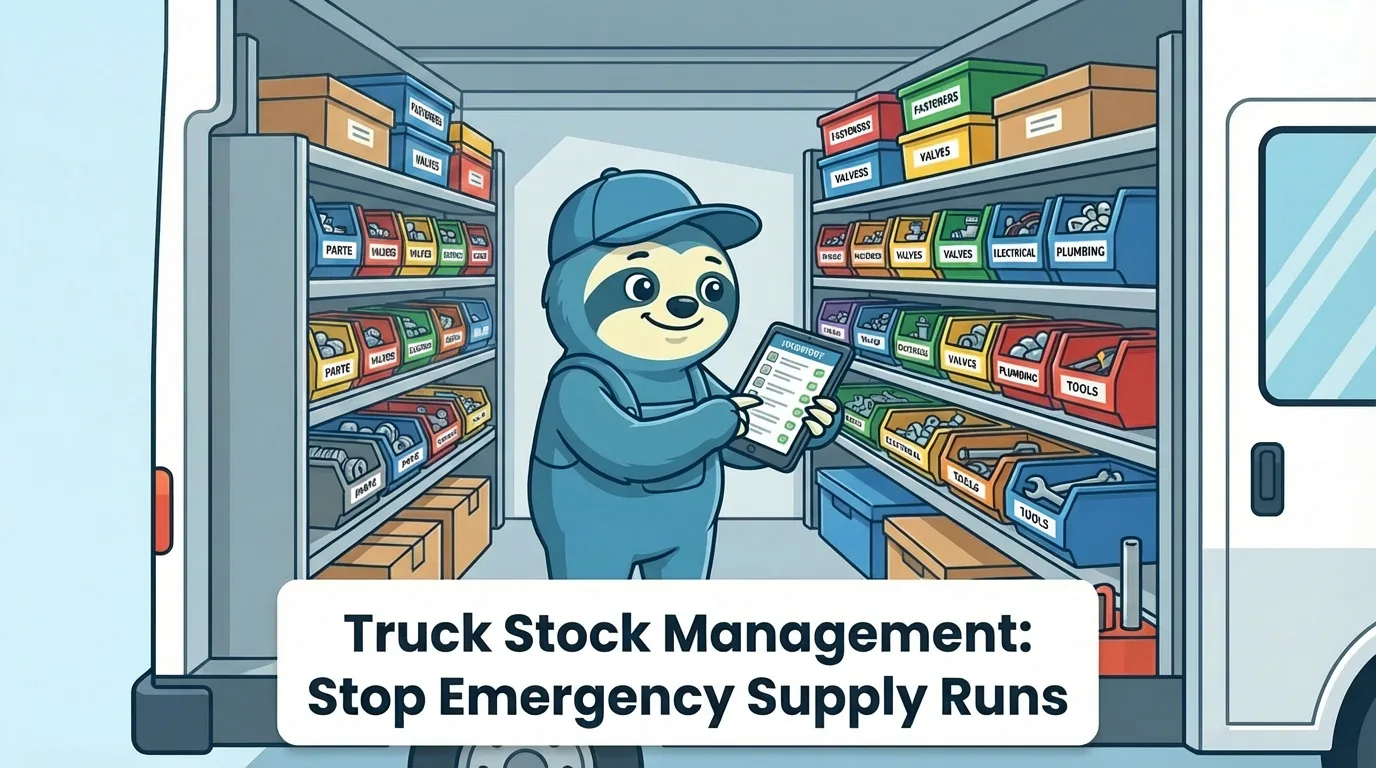
A technician pulls up to a residential AC call on a 95-degree afternoon. The diagnosis takes 10 minutes - blown capacitor, straightforward swap. But the capacitor bin on the truck has three sizes, and none of them match the unit. The tech calls the office, gets directed to a supply house 20 minutes away, drives there, waits in line for 15 minutes, drives back, and finishes the repair. What should have been a 45-minute job took two hours. The client waited in the heat. The next appointment got pushed. And the company ate an extra hour of labor cost on a repair that bills the same regardless of how long it took.
This scenario plays out thousands of times every day across the service industry. Disorganized truck inventory is one of the most expensive operational problems a service business can have, and it is also one of the most fixable. The solution is not to buy more parts or bigger trucks. It is to build a system that keeps the right parts on every truck, in the right quantities, organized so a tech can find what they need in under 60 seconds.
The Real Cost of a Supply House Run
Most owners underestimate how expensive an unplanned supply run actually is. The math is not just the cost of the part. It includes the round-trip drive time, the wait time at the counter, the fuel cost, and - most critically - the lost productivity on the current job and the ripple effect on every remaining job that day.
A single supply house run typically burns 40 to 60 minutes of a technician's time. If your loaded labor rate is $55 per hour, that one trip costs $37 to $55 in labor alone before the fuel and the part cost. If that delay pushes the next appointment back and the client cancels or reschedules, the cost multiplies. Now you have a scheduling hole, a frustrated client, and a tech who feels behind for the rest of the day. Techs who feel behind rush, and rushed work leads to callbacks.
Track how many supply runs your team makes per week. Most owners guess it is one or two. When they actually count, it is often five to ten across a three-truck operation. At $45 per run average, that is $225 to $450 per week - roughly $12,000 to $23,000 per year - in pure waste. That is money you recover simply by having the right parts on the truck before the tech leaves in the morning. 📊
| Metric | Estimate |
|---|---|
| Average time lost per supply run | 40 - 60 minutes |
| Labor cost per run (at $55/hr) | $37 - $55 |
| Supply runs per week (3-truck operation) | 5 - 10 |
| Weekly waste at $45/run average | $225 - $450 |
| Annual waste | $12,000 - $23,000 |
Building a Par Level System for Your Trucks
A par level is the minimum quantity of a specific part that should be on a truck at all times. When the quantity drops to the par level, it triggers a restock. This is the same system restaurants use to manage food inventory, and it works just as well for service trucks.
Start by pulling your job history for the last 60 to 90 days. Identify every part your technicians used and count the frequency. Parts that get used three or more times per week need a par level of at least four to five units to provide a buffer for busy weeks. Parts used once a week need a par of two. Parts used a few times a month need a par of one. Parts used less than once a month probably should not live on the truck at all - they are better ordered per-job or kept in a central warehouse.
| Usage Frequency | Recommended Par Level | Notes |
|---|---|---|
| 3+ times per week | 4 - 5 units | Buffer for busy weeks |
| Once per week | 2 units | Covers short-term gaps |
| Few times per month | 1 unit | Minimum safety stock |
| Less than once per month | 0 - order per job | Central warehouse or order on demand |
The critical step most people skip is reviewing and adjusting par levels monthly for the first three months, then quarterly after that. Usage patterns shift with seasons, with the types of jobs you are booking, and with changes in the equipment brands common in your service area. A par level set in January will not be accurate in July. Treat par levels as living numbers, not set-and-forget targets. 🎯
Organizing Truck Bins and Shelving for Speed
Having the right parts on the truck means nothing if the tech cannot find them quickly. A tech digging through a pile of unsorted fittings for three minutes on every call loses 15 to 20 minutes per day in search time. Multiply that across five days and you have lost nearly two billable hours per week to disorganization.
The most effective truck organization systems follow one principle: every part has a labeled home. Use bin systems with clear labels - not handwritten tape that fades in six months, but printed labels or engraved plates that survive the abuse of daily use. Group parts by function, not by size. All capacitors together, all contactors together, all fittings grouped by type and then by size within each group. A plumber's truck should have a copper fittings section, a PEX section, a supply line section, and a drain section - not a random mix of everything sorted by when it was purchased.
Photograph each truck's layout and post the photo inside the rear door or in the cab. When the standard layout is visible, techs can verify their organization at a glance. New hires can learn the system in a day instead of spending weeks figuring out where the previous tech hid the three-quarter-inch couplings. Standardize the layout across all trucks in your fleet so any tech can jump into any truck and find what they need. This flexibility matters when a truck breaks down or a tech calls in sick and someone else needs to cover their route. 🚛
End-of-Day Inventory Checks
The end-of-day check is the habit that makes the entire truck stock system work. Without it, par levels are just numbers on a page and restocking happens reactively instead of proactively. The check does not need to be exhaustive. It needs to be consistent.
At the end of every workday, each tech should spend five to seven minutes scanning their truck bins and noting anything at or below par level. This is not a full physical inventory - it is a quick visual scan of the high-frequency items. Capacitors, fittings, supply lines, filters, common electrical components, whatever your trade's bread-and-butter parts are. If something is low, it goes on the restock list.
The restock list should feed into a process that ensures parts are ready before the next shift starts. For small operations, this might mean the tech swings by the supply house on their way home or first thing in the morning. For larger operations, a dedicated person or process handles restocking overnight - parts are pulled from a central inventory and placed in a staging area where techs grab their replenishment each morning. The specific process matters less than the consistency. A tech should never start their day with a truck that is missing parts they will likely need.
Restocking Workflows That Actually Work
The biggest reason restocking fails is that nobody owns the process. The tech assumes the office will handle it. The office assumes the tech will pick up parts. The parts do not get ordered. The result is the same supply house run you were trying to eliminate.
For teams of one to three trucks, the simplest workflow is tech-owned restocking with a budget. Each tech has a company credit card or supply house account and a weekly parts budget. They restock at the end of each day based on their inventory check. The office reviews purchases weekly to catch anomalies but does not micromanage daily buying. This works because the tech knows what they need better than anyone, and the immediate feedback loop - I used this part today, I need to replace it today - keeps stock levels accurate.
For teams of four or more trucks, centralized restocking is usually more efficient. Techs submit their restock lists through the field management app or a shared form by end of day. A parts manager or office coordinator consolidates the lists, pulls from warehouse stock or places orders, and stages parts for morning pickup. This reduces the number of individual supply house trips and allows bulk purchasing, which often comes with better pricing. The tradeoff is that it requires a reliable person managing the process, and any gap in that role means trucks go understocked.
| Fleet Size | Recommended Workflow | Key Benefit |
|---|---|---|
| 1 - 3 trucks | Tech-owned restocking with budget | Fast feedback loop, tech accountability |
| 4+ trucks | Centralized restocking via parts manager | Bulk purchasing, fewer individual trips |
| Any size | Specialty parts ordered at job booking | Eliminates day-of surprises for non-standard jobs |
Regardless of team size, specialty parts - items not in your standard truck stock - need a separate ordering process tied to job scheduling. When a job gets booked that requires a specific model of thermostat, a particular brand of faucet, or a hard-to-find relay, that part should be ordered immediately and tracked until it is on the truck before the scheduled job date. Nothing kills client confidence faster than a tech showing up for a scheduled appointment and announcing they do not have the part.
Tracking Parts Usage Per Job
Logging which parts get used on which job serves two purposes: it keeps your truck inventory accurate in real time, and it feeds critical data into your job costing system. When a tech logs that they used a 40/5 dual-run capacitor on job 4782, the truck inventory decrements by one and the material cost gets assigned to that job. Both records update from a single action.
The key is making this logging fast enough that techs actually do it. Mobile apps that let techs select parts from a pre-loaded list are far more effective than handwritten notes or after-the-fact data entry. A tech should be able to log parts used in under 30 seconds per job. If the process takes longer than that, compliance will drop within weeks.
Parts tracking also reveals which items you are going through faster than expected. If your par level for a specific fitting assumes four uses per week but actual tracking shows seven, you know to increase the par level before you start running out. Conversely, if a part sits on the truck for two months without being used, it is taking up space and tying up cash that could be allocated to higher-frequency items. 📦
Managing Seasonal Inventory Shifts
Service demand is seasonal, and your truck inventory should shift with it. An HVAC truck stocked for summer cooling season needs a fundamentally different parts mix than the same truck in heating season. Capacitors, contactors, refrigerant, and fan motors dominate the summer list. Ignitors, flame sensors, gas valves, and heat exchangers dominate winter. The transition period is where most companies stumble because nobody adjusts the truck stock until the calls have already shifted.
The best practice is to adjust truck inventory two to four weeks before the seasonal transition. Review the previous year's call data to identify the date range when demand shifted. If cooling calls started ramping up in mid-April last year, start adding cooling season parts to trucks by the first week of April. Reduce the par levels on heating parts that will see less demand but do not zero them out entirely - there are always off-season calls for systems that fail at odd times.
| Season | HVAC Priority Parts | Plumbing Priority Parts |
|---|---|---|
| Summer | Capacitors, contactors, refrigerant, fan motors | Outdoor hose fittings, irrigation parts |
| Winter | Ignitors, flame sensors, gas valves, heat exchangers | Water heater parts, heat tape, freeze repair clamps |
| Spring transition | Add cooling stock 2 - 4 weeks early | Add outdoor work parts |
| Fall transition | Add heating stock 2 - 4 weeks early | Add water heater and freeze protection parts |
Plumbing and electrical trades have less dramatic seasonal swings but still see patterns. Water heater failures spike in cold weather when incoming water temperatures drop and units work harder. Frozen pipe calls cluster in January and February. Outdoor electrical work picks up in spring. Track these patterns and adjust stock levels accordingly. A tech who runs out of water heater parts in January because the truck was still stocked for summer demand is losing you money on every trip to the supply house.
What to Stock vs What to Order Per-Job
Not every part belongs on the truck. Truck space is limited, and carrying too much inventory ties up cash and creates clutter that slows techs down. The decision about what to stock versus what to order per-job comes down to three factors: frequency of use, availability, and cost.
High-frequency, low-cost parts should always be on the truck. These are the fittings, connectors, fasteners, consumables, and common repair components that your techs use daily or weekly. The cost of stocking them is low and the cost of not having them - a supply run - is high. There is no scenario where it makes sense for a plumber to not carry standard copper fittings or for an electrician to not carry common wire nuts and breakers.
Low-frequency, high-cost parts should generally be ordered per-job. A $400 compressor that gets installed once a month should not sit on the truck depreciating and taking up space. Order it when the job is booked, confirm delivery before the scheduled date, and stage it for the tech. The same logic applies to specialty equipment, model-specific components, and custom-order items. The supply house trip for these items is planned and built into the job timeline, not an emergency disruption.
The gray area is moderate-frequency, moderate-cost parts. A water heater element that costs $30 and gets used twice a month might justify truck stock or might not, depending on how quickly your supplier can get it to you. If the supply house is five minutes away and always has it in stock, do not clutter the truck. If the nearest source is 30 minutes away and availability is hit-or-miss, carry one. Make these decisions based on your specific market conditions, not general rules.
The Payoff of Getting Truck Stock Right
A well-managed truck inventory system does more than reduce supply house runs. It changes the tempo of your entire operation. Techs complete more jobs per day because they spend less time searching for parts and driving to suppliers. First-call fix rates improve because the right parts are on hand more often. Client satisfaction goes up because jobs start and finish on time. Schedule density improves because the time previously wasted on parts runs gets converted to billable work.
The financial impact is real and measurable. A three-truck operation that eliminates five supply runs per week saves roughly $12,000 per year in direct waste. But the bigger number is the revenue from the additional jobs those techs can complete with the recovered time. If each eliminated supply run recovers 45 minutes of productive time, that is nearly four extra hours per week across the team. At an average job value of $300 to $500, converting even half of that recovered time into completed jobs adds $30,000 to $50,000 in annual revenue. The truck stock system pays for itself many times over, and the only investment is the discipline to maintain it. 📈
Frequently Asked Questions
Ready to transform your field service business?
Start using WorkZen today. It's free to get started!