The 4-Hour Workday Myth for Service Owners
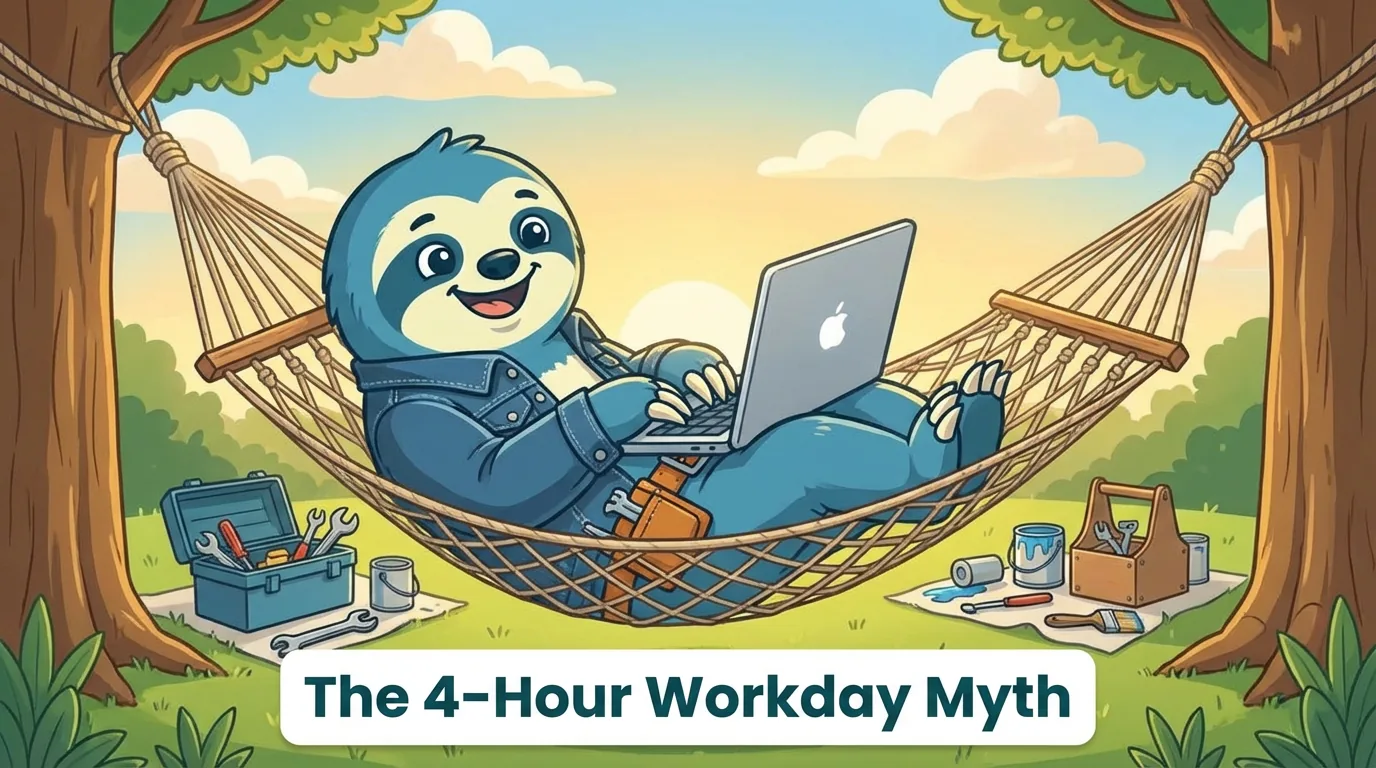
Somewhere between a podcast episode and a business book, every service business owner has encountered the dream: build systems, delegate everything, work four hours a day from a beach while your company runs itself. It is a compelling fantasy, especially when you are on hour eleven of a day that started with a callback at 6 AM and ended with an unpaid invoice at 9 PM. The problem is not that the dream is entirely wrong - it is that the path from 60-hour weeks to minimal involvement is far longer, harder, and more nuanced than the gurus selling courses want you to believe.
The four-hour workday narrative borrows heavily from the tech startup world, where software businesses can genuinely scale with minimal marginal effort once the product is built. Service businesses do not work that way. Every new job requires a crew on site. Every client interaction has unique variables. Equipment breaks, weather changes, employees call in sick, and inspectors show up with opinions. The physical, local, human nature of service work creates a floor of owner involvement that no amount of automation fully eliminates.
That does not mean you are doomed to work 60-hour weeks forever. It means the realistic goal is different than the fantasy. The real question is not "how do I work four hours a day" but "how do I go from working 60 hours a week to 30 without the business falling apart." That is an achievable target, and the path to get there is worth understanding clearly. 🎯
Where Your Time Actually Goes
Before you can reduce your working hours, you need an honest inventory of where they go. Most service business owners have never tracked their time in any structured way. They know they work too much, but they could not tell you how many hours per week they spend on sales versus scheduling versus admin versus putting out fires. Without that baseline, any time-reduction strategy is just guessing.
Spend one week logging your time in 30-minute blocks. Do not change anything about how you work - just record what you do. Most owners discover a roughly even split between five categories: sales and estimating, scheduling and dispatch, administrative work like invoicing and bookkeeping, team management and HR issues, and client communication including complaint resolution. The proportions vary by trade and business size, but almost every owner finds at least one category consuming far more time than they realized.
| Time Category | Typical % of Week | Delegatable? |
|---|---|---|
| Sales and estimating | 20-25% | Partially - stays with owner longest |
| Scheduling and dispatch | 15-20% | Yes - after documentation |
| Admin (invoicing, bookkeeping) | 15-20% | Yes - ideal first delegation |
| Team management and HR | 15-20% | Partially - depends on team maturity |
| Client communication | 20-25% | Yes - routine matters can be handled by staff |
The other revelation from time tracking is how much of the day is reactive rather than proactive. Phone calls that could have been handled by someone else. Questions from the crew that a documented process would answer. Client check-ins that an automated status update would replace. Reactive work feels productive because you are constantly busy, but it is the least efficient use of an owner's time and the easiest to systematize away. ⏰
The Tasks That Only You Can Do
Not everything on your plate deserves to be there, but some things genuinely require the owner's involvement - at least until the business reaches a certain size. The key is distinguishing between tasks that need you specifically and tasks that you have been doing because nobody else has been trained to do them.
Sales and relationship management typically stay with the owner longest. In service businesses, the owner's reputation and relationships are often the primary sales engine. Clients trust you, they know your name, and they expect to deal with you on major decisions. Delegating client-facing sales to an employee works eventually, but it requires hiring someone with genuine interpersonal skills and investing months in training them on your standards and your client base.
Strategic decisions - pricing, service offerings, hiring, expansion, equipment purchases - are legitimately owner responsibilities. These decisions require context that only the owner has: knowledge of the local market, relationships with suppliers, understanding of the team's capabilities, and a vision for where the business is heading. Trying to delegate strategy to employees who do not have this context leads to poor decisions that cost more than the time saved.
Everything else is delegatable. Scheduling, dispatching, invoicing, bookkeeping, inventory, ordering materials, answering routine client questions, managing the company's online presence, and handling payroll are all tasks that can be handled by someone else with proper training and systems. The gap between "I have to do this" and "I have always done this" is where most of the time savings live.
Why Delegation Fails the First Time
Most service business owners have tried to delegate and been burned. They hired someone, handed off a chunk of work, watched quality slip, took it back, and concluded that "nobody can do it as well as I can." This experience is so common it has become a self-fulfilling prophecy that keeps owners trapped in 60-hour weeks.
The reason delegation fails the first time is almost never the employee's fault. It fails because the owner delegates tasks without documented processes, without clear standards, without adequate training time, and without a feedback loop to catch problems early. Telling someone "handle the scheduling" without defining what good scheduling looks like, how to prioritize conflicting requests, and what to do when things go wrong is not delegation - it is abdication.
Successful delegation starts with documentation. Before you hand off a task, write down exactly how you do it - not the high-level overview, but the step-by-step details that live in your head. Which software do you open? What information do you check? How do you handle common exceptions? This documentation takes time to create, but it is the single most important investment you can make in getting your hours back. Once the process is on paper, anyone with reasonable competence can follow it, and you have a reference point for training and accountability. 💡
Which Tasks to Delegate First
The order in which you delegate matters. Start with tasks that are high-frequency, well-defined, and low-risk. These give your new hire quick wins, build their confidence, and let you verify their work easily before moving on to more complex responsibilities.
Bookkeeping and basic financial admin are the ideal first delegation for most service businesses. The work is repetitive, the rules are clear, and the output is easy to verify. A part-time bookkeeper handling invoice creation, payment tracking, expense categorization, and bank reconciliation can eliminate five to ten hours of owner time per week. The cost of a bookkeeper is modest compared to the value of those hours redirected to sales or strategic work.
Scheduling and dispatch are the next logical step. Once you have documented your scheduling logic - how you prioritize jobs, how you assign crews, how you handle reschedules - a capable office coordinator can manage daily scheduling with the owner only involved in exception handling. The key is giving the coordinator clear authority to make routine decisions without checking with you every time.
Client communication for routine matters - appointment confirmations, follow-ups, status updates, review requests - can be handled by anyone with good communication skills and access to your CRM. Automating the templated messages and having a team member handle the personalized ones removes another block of hours from your week without any loss in client experience quality.
| Delegation Priority | Task | Hours Saved / Week | Risk Level |
|---|---|---|---|
| 1 - First | Bookkeeping and financial admin | 5-10 hrs | Low |
| 2 - Second | Scheduling and dispatch | 4-8 hrs | Medium |
| 3 - Third | Routine client communication | 3-6 hrs | Low |
| 4 - Later | Sales support and estimates | 3-5 hrs | High |
| 5 - Last | Strategic decisions | Minimal | Owner only |
Building Systems That Reduce Owner Dependency
Delegation without systems is just moving your problems to someone else's desk. The goal is not to have an employee do things the same way you did them - it is to build systems that make the work more consistent, more efficient, and less dependent on any single person, including you.
Standard operating procedures for recurring tasks are the foundation. How to process a new lead. How to create an estimate. How to schedule a job. How to close out a completed project. How to handle a client complaint. Each of these should have a documented workflow that any trained employee can follow. The procedures do not need to be elaborate - a one-page checklist is usually better than a twenty-page manual. The important thing is that they exist and that your team uses them.
Technology plays a supporting role but is not a replacement for clear processes. A CRM that tracks lead status and prompts follow-up only works if someone has defined when follow-up should happen and what the message should say. Automated scheduling only works if someone has configured the rules correctly. Software amplifies good processes - it does not create them. Invest in the process first, then find the software that supports it. ⏰
Visibility tools are the final piece. As you step back from daily operations, you need a way to monitor performance without being in every conversation and on every job site. Dashboards that show daily revenue, open estimates, overdue invoices, and scheduled jobs let you spot problems early without micromanaging. Weekly reports from your team that highlight wins, issues, and upcoming priorities give you context in a format that takes ten minutes to review instead of ten hours to accumulate through direct involvement. 📈
What Realistic Time Reduction Looks Like
Forget the four-hour day. Here is what time reduction actually looks like for most service business owners as their business grows, broken down by stage.
At one to three employees, the owner is doing almost everything. Working in the field, running estimates, scheduling, invoicing, marketing, and taking calls at all hours. Total weekly hours: 50 to 70. Time reduction opportunities are limited to basic automation - online booking, automated appointment reminders, and accounting software that reduces manual data entry.
At four to eight employees, the owner can afford their first hire who is not a field tech - typically an office coordinator or admin. This person takes over scheduling, routine client communication, and basic invoicing. The owner steps out of daily field work and focuses on sales, estimating, and team management. Weekly hours drop to 40 to 50, which still feels like a lot but is a meaningful improvement.
At nine to fifteen employees, the business can support an operations manager or a senior technician who handles daily crew management. The owner focuses primarily on sales, strategic relationships, and business development. With mature systems and a competent team, weekly hours can drop to 30 to 40. This is the stage where the four-hour-day crowd claims you should be on the beach, but in reality you are still the primary driver of growth and the final decision-maker on anything significant.
| Business Stage | Team Size | Owner Weekly Hours | Key Role to Hire |
|---|---|---|---|
| Early hustle | 1-3 employees | 50-70 hrs | No capacity yet - automate basics |
| First delegation | 4-8 employees | 40-50 hrs | Office coordinator or admin |
| Growing operations | 9-15 employees | 30-40 hrs | Operations manager or team lead |
| Mature systems | 15+ employees | 25-35 hrs | General manager or department leads |
The Stages of Owner Time Reduction
Time reduction is not linear. It happens in distinct phases, each with its own challenges and breakthroughs. Understanding these phases helps you set realistic expectations and avoid the frustration of expecting smooth progress.
The first phase is chaos management - roughly year one through year three for most service businesses. You are building the business, establishing your reputation, and handling everything personally. Time reduction during this phase comes from learning to work more efficiently rather than working less. Better estimating tools save you two hours per estimate. A CRM that tracks follow-ups prevents leads from falling through cracks. These are efficiency gains, not delegation.
The second phase is initial delegation - typically when you hit four to six employees and can justify your first non-field hire. This phase is uncomfortable because you are paying someone to do work that you used to do for free, and they are not as fast or as good at it as you were. The temptation to take work back is strongest here. Resist it. Every task you reclaim trains your team that you do not really trust them, which undermines every future delegation attempt.
The third phase is system maturation - usually around year five to seven, with eight to fifteen employees. Your documented processes have been tested, revised, and internalized by your team. New hires are trained by existing employees rather than by you personally. The business has its own culture and standards that persist whether you are present or not. This is when working hours genuinely start to decline because the business has developed its own operational momentum.
The Honest Version of the Dream
The four-hour workday is a marketing hook, not a business strategy. But underneath the hype, there is a legitimate and worthy goal: building a service business that does not require the owner to be involved in every decision, every client interaction, and every fire drill. That business exists, and many contractors have built it. They just did not do it in a year, and they certainly did not do it by buying a course.
The honest version of the dream looks like this: an owner who works 25 to 35 hours per week, primarily on the highest-value activities like sales, strategic partnerships, and team development. They have a team that handles daily operations competently and autonomously. They can take a two-week vacation without the business imploding. They earn more than they did when they were working twice the hours because their time is focused on activities that drive revenue and profitability.
Getting there requires patience, investment, and a willingness to let go of control gradually rather than all at once. It requires hiring well, training thoroughly, documenting relentlessly, and building feedback loops that catch problems before they become crises. It is not glamorous, and nobody is selling a $997 masterclass on "write standard operating procedures and slowly delegate over three years." But that is the path, and the contractors who walk it consistently end up with businesses they actually enjoy running. ✅
Frequently Asked Questions
Ready to transform your field service business?
Start using WorkZen today. It's free to get started!