The Hidden Cost of Saying Yes to Every Job
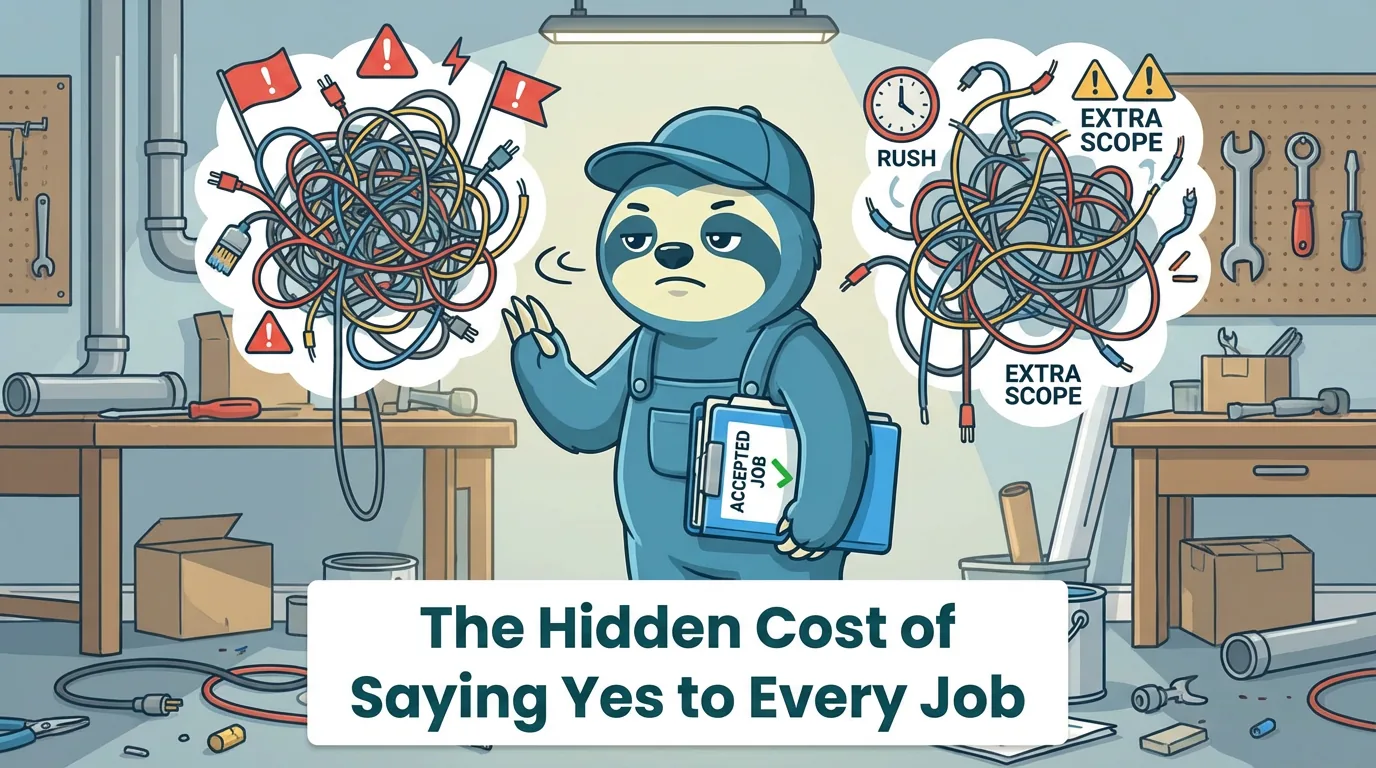
There is an unspoken rule in the trades that you never turn down work. Every phone call is an opportunity. Every estimate request could be the next big project. Saying no feels like leaving money on the table, and in a business where feast-or-famine cycles are real, the instinct to grab every job makes sense on the surface. But that instinct, left unchecked, is one of the fastest paths to a burned-out owner, a demoralized crew, and a business that is busy but barely profitable.
The most profitable service businesses in every trade share a counterintuitive trait - they say no more often than their competitors. They have learned that a full schedule is not the same as a profitable schedule, and that some jobs cost more than they pay when you account for everything they consume. Time, energy, reputation, team morale, and the opportunity to do better work for better clients all have real costs that never show up on the invoice.
The Real Cost of Low-Margin Jobs
A job that barely covers costs does not just fail to make money - it actively costs you money in ways that are easy to miss. Start with the obvious: materials, labor, overhead, and drive time. Now add the hours your office spent scheduling, communicating with the client, ordering materials, processing the invoice, and following up on payment. Add warranty risk and the likelihood of a callback. Add the fact that your crew was unavailable for other work during those hours.
When you run the full accounting on a low-margin job, the result is often negative. A $2,000 job that costs $1,800 in direct expenses looks like a $200 profit until you factor in three hours of admin time, two trips to the supplier, and a 90-minute drive each way. That $200 "profit" evaporated long before the invoice was sent, and the real margin was negative. ⚠️
The damage compounds when low-margin jobs become a pattern. If 30 percent of your schedule is filled with work that barely breaks even, you have effectively donated 30 percent of your capacity. That capacity could have been filled with jobs at your target margin - or it could have been left open for higher-value work to come in. Either way, the opportunity cost of low-margin jobs is almost always larger than the visible loss.
How Scope Creep Eats Your Profit
Scope creep is the silent killer of job profitability, and it happens most often on jobs you should have been more careful about accepting in the first place. A client asks for "just one more thing" during a project, and because you want to be accommodating, you absorb the extra work without adjusting the price. One extra task does not seem like much, but three or four of them over the course of a project can turn a profitable job into a loss.
The root cause of most scope creep is unclear job boundaries at the estimating stage. When the scope of work is vague or verbal rather than written, every party has a different mental picture of what "the job" includes. The client assumes the paint touch-ups are included. Your crew assumes they are extra. Nobody clarified it upfront, and now you are in a difficult conversation that either costs you money or costs you the relationship.
Contractors who are selective about their jobs tend to have clearer scopes because they take the time to define exactly what is and is not included before agreeing to the work. They ask more questions during the estimate, they document everything in writing, and they are not afraid to say "that would be outside the scope we discussed - I can add it as a change order if you would like." That clarity comes from confidence, and confidence comes from knowing you do not need to say yes to every job to keep the business running. 💡
The Opportunity Cost Nobody Calculates
Every hour your crew spends on a bad-fit job is an hour they are not available for an ideal-fit job. This opportunity cost is invisible in your accounting but massive in its impact on annual revenue and profitability. If your ideal job has a 40 percent margin and your bad-fit job has a 10 percent margin, every hour spent on the wrong job costs you 30 percent of potential margin.
Think about it in concrete terms. A plumbing company that fills its schedule with $300 service calls at 15 percent margin leaves no room for the $5,000 bathroom renovations at 35 percent margin that come in twice a week. The service calls feel productive because the crew is busy and the phone is ringing, but the revenue and profit potential is dramatically lower than what the same hours could produce on higher-value work.
| Job Type | Avg. Value | Margin | Profit per Job | Weekly Capacity (4 jobs) |
|---|---|---|---|---|
| Low-margin service call | $300 | 15% | $45 | $180 |
| Ideal-fit renovation | $5,000 | 35% | $1,750 | $7,000 |
The opportunity cost extends beyond direct revenue. Time spent managing difficult clients, resolving disputes on poorly scoped jobs, and dealing with warranty issues on work you should not have taken drains the owner's time away from business development, team training, and strategic planning. The owner who spends Monday handling a complaint from a bargain client is not spending Monday building the systems that would attract better clients. 📈
Identifying Your Ideal Job Profile
Every successful service business has a sweet spot - a type of job that consistently produces good margins, satisfied clients, and positive experiences for the team. Identifying that sweet spot is the foundation of learning to say no to everything else. Your ideal job profile should include the type of work, the typical job value, the geographic area, the type of client, and the expected margin.
| Profile Factor | Example - Residential Electrician | Example - Commercial Cleaning |
|---|---|---|
| Job type | Panel upgrades, whole-home rewires | Recurring office contracts |
| Job value | $3,000 - $15,000 | $2,000+ per month |
| Geography | Within 20-minute drive radius | Downtown core buildings |
| Client type | Quality-focused homeowners | Mid-size office building managers |
| Target margin | 35%+ | 40%+ |
Once you have your ideal job profile, you can evaluate every incoming lead against it. Jobs that match the profile get prioritized. Jobs that are close get considered. Jobs that are clearly outside the profile get declined or referred to another contractor. This does not mean you only take perfect jobs - it means you have a conscious filter instead of accepting everything that comes through the door.
How Bad Jobs Destroy Team Morale
Your crew knows which jobs are good and which ones are not. They know when they are driving an hour to do a job that should have been priced higher. They know when a client is going to be difficult before the first day is over. And when they see a pattern of bad jobs filling their schedule, they start to check out - or they start looking for another employer who values their time more.
Skilled tradespeople have options. Good electricians, plumbers, HVAC technicians, and carpenters can find work easily, and they will leave a company that consistently puts them in frustrating situations for thin margins. The cost of losing an experienced team member and training a replacement dwarfs the revenue from the bad jobs that drove them away.
The morale impact goes beyond retention. Crews that work primarily on well-run, well-priced jobs take more pride in their work. They are more careful, more efficient, and more likely to represent your brand well when interacting with clients. Crews that are ground down by a constant stream of difficult clients and underpriced work produce lower quality results, which creates a negative cycle of callbacks, complaints, and reputation damage. 🛑
Learning to Say No Professionally
Saying no to a potential client does not have to be confrontational or uncomfortable. The simplest approach is to be honest and helpful. "This is not the best fit for our team, but I know a contractor who specializes in this type of work - would you like me to connect you?" This response is professional, it helps the potential client, and it builds goodwill with the contractor you refer them to.
For jobs that are close but not quite right - maybe the scope is too broad, the location is too far, or the budget is too tight - you can offer a modified version that works for both parties. "We typically do not take on projects under $5,000, but if you would like us to handle the electrical portion and find another contractor for the rest, we could make that work." This approach shows flexibility without compromising your standards.
The hardest part of saying no is internal, not external. Most contractors feel guilty about turning down work because they remember the lean times when any job was a good job. That fear is real and valid, but it should not be the decision-making framework for a growing business. Building a pipeline of ideal-fit work takes time, and there will be a transition period where you are saying no to some jobs before the better ones fully replace them. That transition requires courage and patience, but the businesses that push through it are consistently more profitable and more enjoyable to run.
Building a Referral Network for Declined Work
Jobs you decline do not have to be dead ends. Every job you turn down is an opportunity to strengthen a referral relationship with another contractor. When you consistently send quality leads to contractors in complementary or overlapping trades, those contractors send work back to you. Over time, this network becomes one of your most valuable business assets.
Start by identifying three to five contractors who do the types of work you regularly decline. Maybe you focus on residential and they focus on commercial. Maybe you handle new installations and they handle repairs. Whatever the split, make sure the contractors you refer to deliver quality work - your reputation travels with every referral you make.
Keep a simple log of referrals you send and receive. This helps you identify which relationships are reciprocal and which are one-sided. A contractor who you have sent ten jobs to but who has never sent anything back is not a referral partner - they are just receiving free leads. The best referral networks are balanced, with each member actively looking for opportunities to send work to the others. That reciprocity builds trust and creates a steady stream of pre-qualified leads that cost nothing to acquire.
The Stages of Getting Selective
Getting selective about your work is not a switch you flip overnight. It is a gradual process that happens in stages as your business grows, your reputation strengthens, and your pipeline becomes more reliable. Trying to become extremely selective before you have the pipeline to support it is just as damaging as never being selective at all.
| Stage | Where You Are | What You Do | What You Gain |
|---|---|---|---|
| Early | Building cash flow and experience | Avoid the worst red-flag jobs | Instinct for problem clients |
| Middle | Pipeline growing, reputation forming | Filter actively for your ideal profile | Visible margin improvement |
| Mature | Referrals fill your schedule | Rarely take jobs outside your sweet spot | Consistent margins, proud team |
In the early stage, the goal is simply to avoid the worst jobs - the ones with clear red flags like adversarial clients, work outside your expertise, or budgets that are laughably below market rate. You still take a wide range of work, but you develop a sense for which jobs will be problematic and learn to trust those instincts.
In the middle stage, you start actively filtering for your ideal job profile. You might turn down one or two jobs per week that you would have accepted a year ago. Your schedule is mostly good work with occasional compromises when the pipeline dips. This is the stage where the discipline of saying no starts producing visible results in your profitability and team satisfaction.
In the mature stage, your reputation and referral network generate enough ideal-fit work that saying no is easy. You rarely take jobs outside your sweet spot, your margins are consistently strong, and your team does work they are proud of. Getting here takes years, not months, but every contractor who reaches this stage will tell you the same thing - learning to say no was the single most important decision they made for their business. 🎯
Frequently Asked Questions
Ready to transform your field service business?
Start using WorkZen today. It's free to get started!