Truck Wraps and Yard Signs: Cheap Brand Visibility
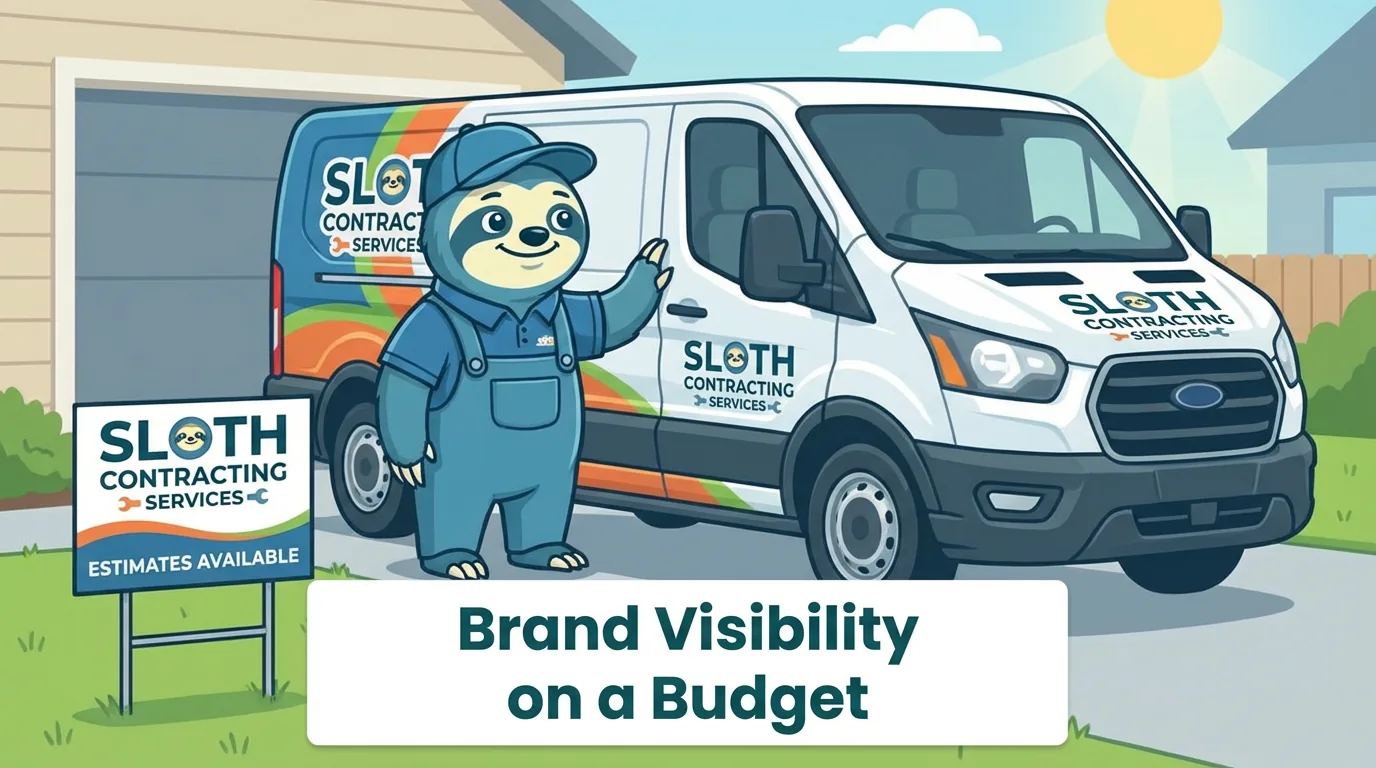
Service business marketing has tilted heavily toward digital channels in the past decade, and most owners now spend the majority of their marketing budget on Google Ads, Local Service Ads, social media, and SEO. That mix is not wrong, but it has crowded out three of the most cost-effective and durable marketing channels available to a local service business - the vehicles your crews drive every day, the people they wear into a client's home, and the yard signs that mark active job sites. These three channels have a combined annual cost less than what most shops spend on Google Ads in a month, and they generate impressions and trust signals that no digital channel can match. 🚐
The reason these channels get underused is psychological. Digital marketing produces dashboards and reports, which feels like real activity. Physical marketing - a wrapped truck driving normal routes, a tech in a clean uniform, a sign in a front yard - produces invisible accumulation that does not show up in any analytics tool. The impact is real but slow, which makes it easy to dismiss in favor of something that produces a click count next week. Owners who understand the long game build all three of these channels deliberately, and the compounding visibility delivers years of low-cost brand presence in their service area.
Why Physical Visibility Still Wins in Local Trades
Local service businesses compete in a fundamentally different marketplace than e-commerce or national brands. Your prospective client is a homeowner within 30 miles of your shop who needs a service performed at their address, by a person they trust, on a date that works for them. The deciding factors are nearly always proximity, perceived professionalism, and trust signals that a digital ad cannot deliver effectively.
A wrapped service van parked in a homeowner's driveway during one job is seen by every neighbor on the street, every passing car, and every delivery driver and meter reader who walks by during the work. None of those impressions are click-trackable, but every one of them is geo-targeted by definition - the people seeing it are within walking distance of where the service was performed, and they have all just witnessed a real-life proof point that you operate in their neighborhood. The cost per impression is essentially zero after the wrap is installed.
Uniforms create the same effect at a smaller scale. A tech in a clean polo with a clear logo, walking up to a client's door, makes an impression that lasts well beyond the visit. Clients tell their friends about the experience. Neighbors who happen to be outside watch the interaction. Photos taken by the client - of the work, of the tech, sometimes of the truck - get shared on social media and neighborhood apps. Every one of those moments is brand-building that cost you a few dollars in apparel and a few minutes of training.
Yard signs are the most direct conversion tool of the three because they signal both professional capability and social proof simultaneously. A sign in a yard says two things: "this contractor performs work in this neighborhood" and "this neighbor trusted them enough to let the sign stay up." Both messages are powerful for the prospect who has been thinking about the same project but has not committed yet.
Truck Wrap Strategy: What Actually Works
Most contractor truck wraps fail because they try to cram too much information onto a moving vehicle that is visible to a viewer for 3 to 8 seconds. The wrap that produces results is designed for legibility at speed, not for completeness of information. Three elements need to read instantly: company name, service category, and contact method.
The hierarchy on a well-designed wrap is brutal. Company name is the largest element, in a font that reads at 100 feet. Service category - "HVAC," "Plumbing," "Electric" - is second largest, immediately below the company name. Phone number is the only contact method that should appear, in a size that someone driving could mentally capture during a brief glance. Everything else - tagline, web address, certifications, social handles - should be smaller secondary elements that fill space but do not compete with the primary message.
| Wrap Element | Recommended Size / Treatment |
|---|---|
| Company name | Largest text, high contrast, centered or front-weighted |
| Service category | Second largest, immediately under company name |
| Phone number | Third largest, on rear and sides |
| Tagline | Optional, small, only if memorable |
| Website | Small, rear panel only |
| Certifications / badges | Small cluster on rear or rear quarter panel |
| Social handles | Skip or very small |
Color choice matters more than most owners realize. High-contrast color schemes - dark base with light text, or light base with dark text - read at a distance. Multi-color gradient designs and photographic backgrounds typically reduce legibility because they reduce contrast between text and background. The wraps that look most impressive in design proofs are often the worst at the actual job of being readable on a moving vehicle.
Quality of installation determines wrap lifespan. A 3,500-dollar professional wrap installed correctly lasts 5-7 years. A 1,500-dollar discount wrap installed by an inexperienced shop often peels or fades within 18 months. The cheaper option ends up costing more on an annual basis because you replace it more frequently. Get quotes from at least three reputable wrap shops, check their portfolio of past work that has been on the road for several years, and pay for quality installation on quality vinyl.
Uniform Programs That Build Trust
Service uniforms operate at a different scale than truck wraps but produce a similar effect on trust and recognition. The client who opens their door to find a tech in a clean polo with a logo and an embroidered name patch starts the visit with an entirely different perception than the client who opens the door to a stranger in plain clothes. The professional appearance is doing meaningful work in the first 15 seconds before any conversation starts. 👔
Build a uniform program around three seasonal layers. Warm-weather: branded polo or t-shirt in two or three colors, work pants. Cool-weather: branded long-sleeve work shirt and a logo work jacket. Cold-weather: branded outerwear with logo embroidered or patched, weather-appropriate pants. Each tech needs enough rotation that they can present clean uniforms every day without daily laundry pressure - typically 5-7 polos, 3-4 long-sleeve shirts, 2 jackets.
| Garment | Per-Tech Quantity | Annual Replacement Rate |
|---|---|---|
| Branded polo / t-shirt | 5-7 | 30-50% (replace 3 per year) |
| Long-sleeve work shirt | 3-4 | 25-30% (replace 1 per year) |
| Logo work jacket | 1-2 | 10-15% (replace every 5-7 years) |
| Cold-weather outerwear | 1 | 10% (replace every 8-10 years) |
| Logo cap (optional) | 1-2 | 50% (replace 1 per year) |
The investment per tech runs 200-400 dollars in the first year for the full setup, and 75-150 dollars annually for replacement of worn items. Compared to almost any other marketing line item, the cost is trivial and the return - in client perception, in tech pride, in repeated impressions across thousands of homes per year - is significant.
Embroidery beats screen printing for everything except cheap promotional items. The embroidered logo signals quality at close range, holds up through hundreds of washes, and gives the uniform a polished appearance that screen printing cannot match. The cost premium is 8-15 dollars per garment, which is rounding error on a 35-dollar polo and pays back in perception every time the uniform is worn.
Pay for the uniforms, do not require employees to buy them. Some shops try to recover uniform costs by deducting from paychecks or making employees pay upfront, and this is a counterproductive cheap move. The uniforms exist to serve your branding, not the employee's wardrobe. Treat them as marketing investment, provide them at no cost, and require that they be worn correctly. ✅
Yard Sign Programs That Generate Real Leads
Yard signs at active and recently completed jobs are the most underused marketing tool in residential trades. The cost is trivial - 8 to 18 dollars per sign at scale - and a single sign that produces one lead in its lifespan has paid for itself dozens of times over. Yet most shops either do not run a sign program at all or run it sporadically based on whether the tech remembered to bring signs that day.
The structural fix is making signs part of standard job materials, like fasteners or drop cloths. Every truck carries a stock of 10-15 yard signs at all times. Every job ends with the tech asking the client if they would be willing to have a sign in their yard for two weeks. The script is short: "We post a sign at jobs we are proud of - any chance we can put one up for a couple weeks? It really helps small companies like us." Most clients say yes when asked simply.
Sign design follows similar principles to truck wraps but optimized for stationary viewing at slower speeds. A passing pedestrian or driver has 5-15 seconds with the sign, much longer than a moving vehicle. The hierarchy can include slightly more information.
| Sign Element | Treatment |
|---|---|
| Company name | Largest, high contrast |
| Service category | Second largest |
| Phone number | Third largest, large enough to read from sidewalk |
| QR code | Small, links to a landing page that tracks sign attribution |
| Website | Optional, smaller than phone |
| Tagline | Optional, only if meaningful |
The QR code is the secret weapon. A QR code that links to a sign-specific landing page lets you measure exactly how many leads come from each sign location, which jobs produced the highest sign-driven response, and which neighborhoods have highest sign-to-lead conversion. The data informs everything from where to push for sign permission aggressively to where to invest more in other local marketing.
Track sign performance by ZIP code or neighborhood over a 12-month period. Some neighborhoods will produce 5-10 leads per sign because of demographics, density, or word-of-mouth dynamics. Other neighborhoods might produce one lead per ten signs. The first kind of neighborhood is where you want to push hard for sign permission and consider offering a small incentive like a 25-dollar gift card to clients who agree to keep the sign up for 30 days instead of 14.
Coordinated Visibility: Making the Three Channels Work Together
The biggest leverage comes when all three channels reinforce each other on the same job. A wrapped truck pulls into a driveway. A tech in a branded uniform walks up to the door. The work gets completed professionally. A branded yard sign goes up before the truck pulls away. Every neighbor who sees any one element gets multiple impressions of the same brand, and the cumulative effect is significantly more than the sum of the parts.
Standardize the choreography. The truck parks visibly, not hidden in the driveway. The tech wears a complete uniform regardless of the weather - a shorts-and-t-shirt summer day still gets the branded polo, not a plain t-shirt. The sign goes up at the end of the job, not next visit, not when the tech remembers - every time. Build it into the job completion checklist so it is not optional.
The choreography compounds because service work tends to cluster in neighborhoods. A homeowner who calls a plumber typically tells a friend or neighbor when something needs work. That neighbor is much more likely to call you if they have already seen the wrapped truck, the uniformed tech, and the yard sign in the original client's yard. By the time they make the call, you have built three layers of trust signals before any digital touchpoint.
Train techs to be photo-aware on every job. A two-second photo of the truck parked at the job, the sign in the yard, and the tech in uniform doing the work creates content that goes on Google Business Profile, Instagram, the company website, and direct mailers. The same job that produced a sign and a wrap impression also produces a half-dozen pieces of content that extend the visibility for weeks afterward.
Cost Comparison: Physical Visibility vs Digital Equivalent
Putting numbers on the comparison illustrates the leverage. A small service business with five wrapped trucks, full uniforms for ten techs, and a steady yard sign program spends roughly the following annually:
| Channel | Annual Cost (5 vehicles, 10 techs) |
|---|---|
| Truck wraps (amortized over 6 years) | $2,500 - $3,800 |
| Uniforms (full program, replacement) | $1,500 - $3,000 |
| Yard signs (300 signs at 12 dollars each) | $3,600 |
| Sign installation labor (built into job time) | minimal |
| Total annual cost | $7,600 - $10,400 |
For comparable annual impressions through paid digital advertising, the cost would run 25,000 to 60,000 dollars depending on market and channel mix. The digital impressions also disappear the moment the budget pauses, while the physical visibility continues regardless of monthly cash flow.
This does not mean replacing digital marketing with physical visibility - it means building both. Most service businesses are over-indexed on digital because the dashboards are visible and under-indexed on physical because the impact is invisible week-to-week. Rebalancing typically means continuing your existing digital spend while adding the missing physical layer, which produces a meaningful step-change in total brand presence at modest incremental cost.
Pulling It All Together
Physical brand visibility is one of the few areas in service business marketing where modest, consistent investment compounds for years. A wrap on the road today is still generating impressions in five years. A uniform standard set this season becomes the default for every tech you ever hire afterward. A yard sign program that runs on every job for the next decade puts your name in front of tens of thousands of homeowners at a cost that would make digital marketing managers weep. 💪
The discipline is the unglamorous part. Wraps need to be reordered every five to seven years. Uniforms need to be replenished as items wear out. Yard signs run out and need restocking. Each of these is a small operational task that is easy to defer, and deferral is what causes the program to decay. Owners who treat physical visibility as a permanent line item with someone responsible for keeping it running consistently produce the cumulative effect that makes the channel work. Everyone else has a wrapped truck that is starting to peel, three uniforms in rotation across eight techs, and a box of mildewed yard signs in the corner of the shop that nobody has touched in months.
Frequently Asked Questions
Ready to transform your field service business?
Start using WorkZen today. It's free to get started!