Flat Rate vs Hourly: Which Actually Pays More?
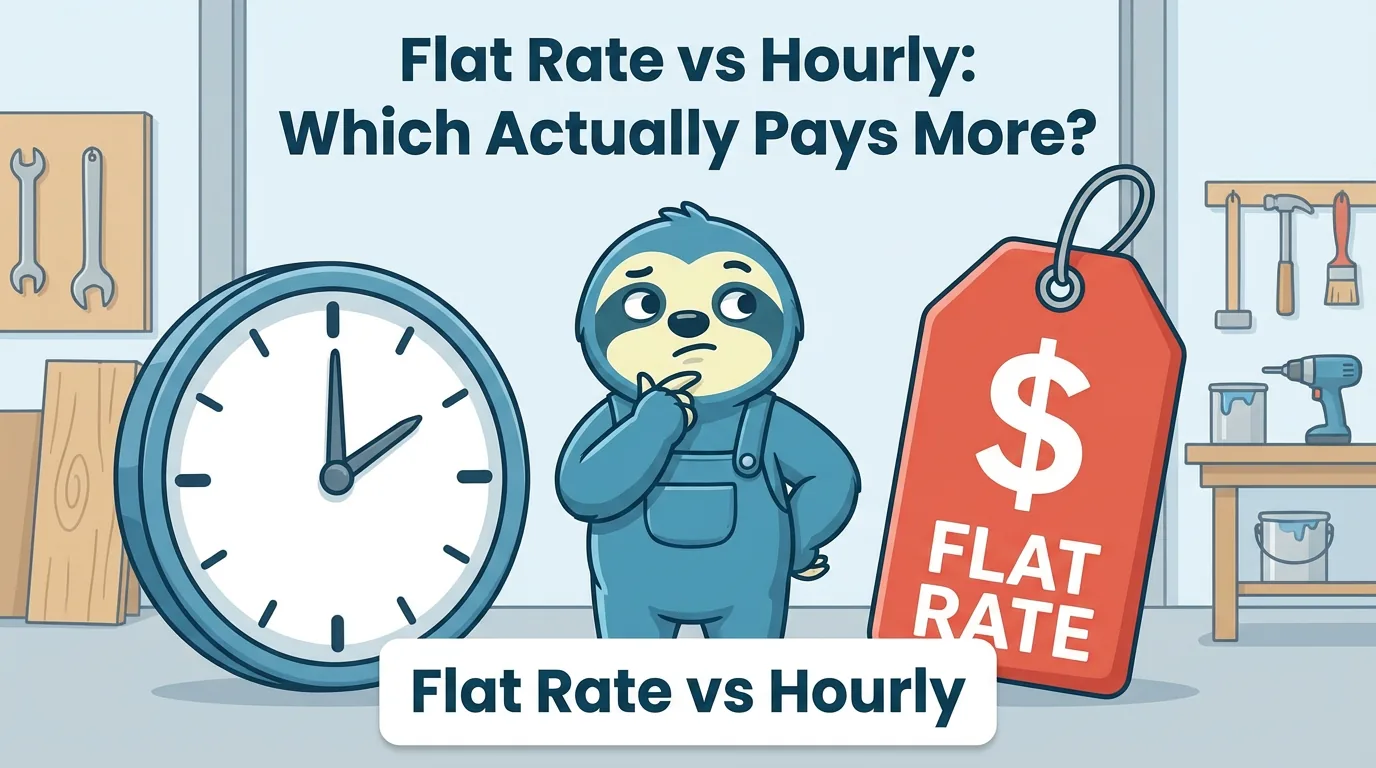
The flat rate versus hourly pricing debate has split the trades for decades. Hourly billing feels safe - you get paid for every minute you work, and if a job runs long, the client covers the extra time. Flat rate feels risky - if you underestimate, you eat the difference. But the businesses that consistently generate the highest revenue per technician and the healthiest profit margins are overwhelmingly flat rate shops. The reason comes down to how each model shapes behavior, client perception, and your ability to scale.
Neither model is universally better. The right choice depends on your trade, your job mix, your team's experience level, and the type of clients you serve. But understanding the real financial mechanics of each approach - not just the surface-level pros and cons - is what separates pricing decisions that grow your business from ones that quietly shrink it.
How Each Model Actually Works
Hourly pricing is straightforward on the surface. You set a labor rate - say $95 per hour - and bill the client for actual time spent on the job plus materials. The client pays for exactly what they get, and you get paid for exactly what you do. Most hourly models include a minimum charge, typically one hour, to cover the trip and basic diagnostic time.
Flat rate pricing sets a fixed price for a defined scope of work before the job begins. A standard water heater replacement might be $1,800 regardless of whether it takes three hours or five. The price is determined by your cost analysis of the average job, not by the clock on any individual job. You build your price book by calculating average labor time, material costs, overhead allocation, and profit margin for each job type you commonly perform.
The mechanical difference between these models creates dramatically different incentive structures. Under hourly billing, there is zero financial incentive to work faster. A tech who finishes a job in two hours earns the company $190, while a tech who takes four hours on the same job earns $380. Under flat rate, the opposite is true - a tech who completes the $1,800 water heater swap in three hours instead of five generates the same revenue in less time, freeing capacity for another job.
| Scenario | Hourly ($95/hr) | Flat Rate |
|---|---|---|
| Tech completes 1 job in 2 hrs | $190 revenue | $450 (fixed price) |
| Tech completes 1 job in 4 hrs | $380 revenue | $450 (fixed price) |
| Tech completes 2 jobs in 8 hrs (4 hrs each) | $760/day | $900/day |
| Tech completes 3 jobs in 8 hrs (2.5 hrs each) | $760/day | $1,350/day |
The table makes the leverage clear: hourly caps daily revenue at hours times rate, while flat rate rewards speed and unlocks meaningful upside. 💰
When Flat Rate Wins
Flat rate pricing dominates in situations where job scope is predictable and your team has enough experience to estimate accurately. Residential service work is the classic flat rate environment. Standard repairs, equipment replacements, maintenance visits, and installations follow patterns that become highly predictable after tracking a few dozen of each type.
Experienced technicians thrive under flat rate because their speed translates directly to earning capacity. A seasoned plumber who can complete a garbage disposal replacement in 45 minutes earns the same flat rate as a junior tech who takes 90 minutes. For the business, this means your best people generate significantly more revenue per day. For the techs, flat rate creates a direct reward for skill and efficiency that hourly billing completely ignores.
Client preference also favors flat rate in most residential and small commercial settings. Homeowners do not want to watch the clock while a technician works in their basement, wondering whether every trip to the truck is adding to their bill. A flat rate eliminates that anxiety entirely. The client knows the price before the work begins, which reduces disputes, speeds up approval, and builds trust. Service companies that switch from hourly to flat rate consistently report fewer billing complaints and faster payment collection. ✅
When Hourly Wins
Hourly billing makes sense when the scope of work is genuinely unpredictable. Diagnostic troubleshooting is the clearest example - when you do not know what is wrong yet, you cannot quote a fixed price to fix it. Charging hourly for the diagnostic phase and then quoting flat rate for the repair is a hybrid approach that protects both you and the client.
Complex commercial projects with variable conditions also favor hourly or time-and-materials billing. A commercial HVAC retrofit in a building with undocumented ductwork, unknown insulation conditions, and potential asbestos concerns has too many variables for a responsible flat rate quote. Underquoting a job like that can wipe out a month of profit. Hourly billing on complex commercial work transfers the scope risk to the client, which is appropriate when the client controls the conditions that drive job duration.
New or inexperienced technicians also perform better under hourly billing in the short term. A tech who is still learning takes longer on every job, and flat rate pricing on slow work produces razor-thin margins or outright losses. Use hourly billing for junior techs while they build speed, then transition them to flat rate once their completion times approach the company average for each job type.
Calculating Flat Rates That Actually Protect Your Margin
The most common mistake in flat rate pricing is setting rates based on what feels right or what competitors charge rather than on your own cost data. A flat rate that does not account for your actual overhead, your team's actual speed, and your target profit margin is just a guess wearing a suit.
Start with your fully loaded labor cost. That is not just the tech's hourly wage - it includes payroll taxes, workers comp, health insurance, vehicle costs, tool allowances, uniforms, and training. For most service businesses, the fully loaded cost of a $30-per-hour tech is somewhere between $45 and $55 per hour. Use your real numbers, not industry averages.
Next, track average job duration for each job type across your team. Do not use your fastest tech's time or your slowest - use the median. If your team averages 2.5 hours on a standard furnace tuneup, multiply that by your fully loaded labor rate. Add average material cost for that job type. Then add your overhead allocation - rent, office staff, software, insurance, marketing - divided across your expected monthly job count. Finally, add your target profit margin on top of the total.
| Cost Component | Example Amount | Notes |
|---|---|---|
| Labor (2.5 hrs x $50 fully loaded) | $125 | Use median team time, not best or worst |
| Materials (average for job type) | $40 | Based on historical job data |
| Overhead allocation (per job) | $30 | Total monthly overhead / monthly job count |
| Total Cost | $195 | Your break-even floor |
| Target margin (20% net) | $49 | Divide total cost by 0.80, subtract cost |
| Flat Rate Price | $244 | What you quote the client |
If you want 20% net margin, divide your total cost by 0.80 to get the flat rate price. That math produces rates that generate real profit rather than just covering costs. 📊
How Pricing Models Shape Technician Behavior
The incentive structures created by each pricing model have ripple effects that go far beyond the invoice. Under hourly billing, technicians have no motivation to improve their speed or efficiency. In fact, the incentive runs the other direction - slower work generates more revenue per job. This does not mean your techs are deliberately sandbagging, but the system does not reward them for getting faster.
Under flat rate, efficiency becomes valuable. Techs who develop faster diagnostic skills, who organize their trucks for quick part access, and who plan their work sequence before starting earn more per hour of their time. The best flat rate shops pair this incentive with performance bonuses tied to daily or weekly revenue targets, creating alignment between what is good for the tech and what is good for the business. 🎯
There is a risk to monitor on the flat rate side: rushing. A tech incentivized to finish fast might cut corners on quality, skip cleanup, or leave without verifying the repair holds. Guard against this by tying bonuses to both speed and callback rates. A tech who finishes fast but generates warranty calls is not actually efficient - they are creating future costs. The right structure rewards completing jobs quickly and correctly on the first visit.
Client Perception and Trust
How clients perceive your pricing model directly affects close rates, satisfaction scores, and referral likelihood. Flat rate pricing signals confidence and transparency. When you tell a homeowner that their AC repair will be $650 before you start work, you are saying "I know what this takes, I know what it costs, and I stand behind this price." That confidence builds trust.
Hourly pricing introduces uncertainty that erodes trust, even when the final bill is fair. A client watching the clock while a tech troubleshoots feels anxious, and that anxiety colors their perception of the entire experience. The same $650 repair feels more expensive when it arrives as "6.5 hours at $95 per hour plus $32 in materials" because the client spent the whole time wondering how high the bill would go.
The trust advantage of flat rate also reduces the sales friction on larger jobs. Quoting a flat $4,500 for a water heater replacement with all parts, labor, and warranty included is a cleaner conversation than presenting an estimate that itemizes 15 hours of labor at $95, a $900 tank, $300 in fittings, and a disclaimer that the price could change if complications arise. Clients approve flat rate quotes faster because they understand exactly what they are agreeing to. 💡
The Hybrid Approach
The most practical solution for many service businesses is a hybrid model that uses flat rate for predictable work and hourly for everything else. Build a flat rate price book covering your 15 to 20 most common job types - the bread-and-butter work that your team performs weekly. These are the jobs where you have enough data to set accurate rates and enough volume that the averages smooth out.
For uncommon jobs, complex troubleshooting, and commercial projects with variable scope, bill hourly or time-and-materials with a not-to-exceed estimate. This protects your margin on unpredictable work while giving the client a ceiling they can budget against. The not-to-exceed approach captures most of the trust benefit of flat rate while retaining the scope flexibility of hourly.
As your price book grows and your data improves, you can gradually convert more job types from hourly to flat rate. The goal over time is to have 70-80% of your revenue coming from flat rate jobs and 20-30% from hourly or T&M work. That mix maximizes the efficiency and trust benefits of flat rate while keeping hourly available for the jobs that genuinely need it.
Making the Transition
Switching from hourly to flat rate is a process, not a single decision. Start by tracking detailed job data for 90 days if you do not already have it. Record the job type, total labor hours, material costs, and any complications for every job. This data becomes the foundation of your price book.
Build flat rate pricing for your five most common job types first. Run both pricing models in parallel for 30 days - quote the flat rate to the client but also track what the job would have cost at your hourly rate. Compare the results. If your flat rates are consistently higher than the hourly equivalent, you are pricing correctly. If they are consistently lower, your rates need adjustment before you go fully flat rate.
Roll out flat rate gradually by job type rather than flipping the entire business overnight. Train your team on how to present flat rate quotes, how to define scope clearly, and how to handle situations where a job exceeds the expected scope. The transition takes most companies three to six months to complete, but the revenue and margin improvements are visible within the first month of implementation.
Frequently Asked Questions
Ready to transform your field service business?
Start using WorkZen today. It's free to get started!