Minimum Service Fees: Protect Small-Job Margin
A homeowner calls about a running toilet. The fix takes 12 minutes - a worn flapper that costs $4 in parts. The technician drove 25 minutes each way, spent 10 minutes diagnosing and chatting with the client, and completed the repair in under a quarter hour. If you billed by the hour at $95, the invoice comes to maybe $95 for one hour minimum. But your actual cost for that call - loaded labor for the drive and on-site time, fuel, vehicle wear, insurance, overhead - was somewhere around $110 to $130. You lost money. Not a lot, but you lost money. And if that happens three or four times a week, you are donating $15,000 to $25,000 per year in margin to jobs that feel productive but are not. 💰
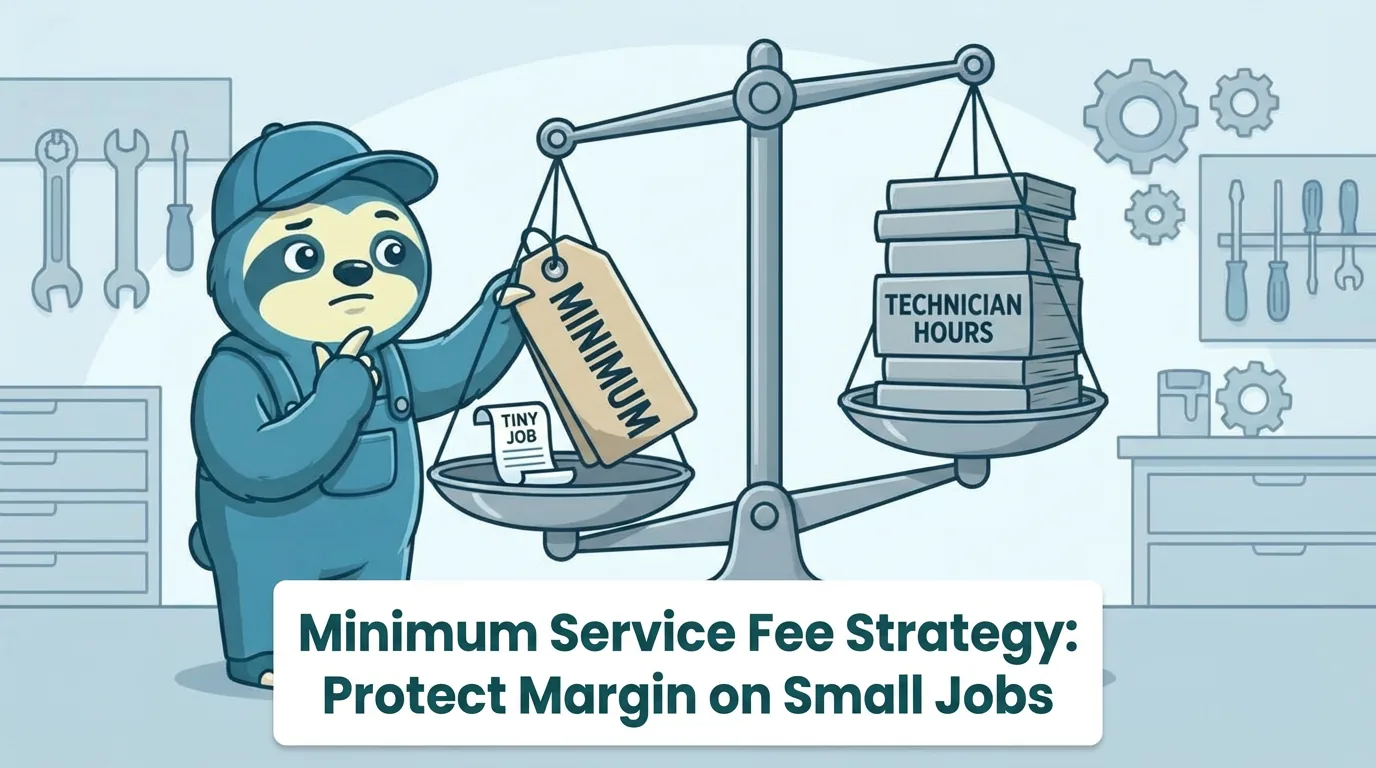
Minimum service fees exist to prevent this. They establish a floor price for any service call regardless of how simple the repair turns out to be. The concept is straightforward: it costs your business a fixed amount just to put a trained, licensed technician in a truck and send them to a client's home. That cost exists whether the repair takes 10 minutes or two hours. A minimum fee ensures that every truck roll at least covers its own cost and contributes something to overhead and profit.
Calculating Your True Cost Per Truck Roll
Before you can set a minimum fee, you need to know what it actually costs to dispatch a technician to a job site. This number is higher than most owners think because it includes expenses that are easy to overlook.
Start with labor. Your technician's loaded labor rate is not just their hourly wage. It includes payroll taxes, workers' compensation insurance, health benefits, paid time off, uniforms, training, and any tools or equipment you provide. A tech earning $30 per hour probably costs you $42 to $48 per hour when you load in all employer costs. A typical small job consumes 1 to 1.5 hours of that tech's time once you count drive time both ways, on-site diagnosis, the repair itself, and the closeout. That means $42 to $72 in labor cost before you touch a single part.
Vehicle costs come next. Fuel for a 20-mile round trip in a service van costs $6 to $10 depending on the vehicle and current fuel prices. But fuel is just the beginning. Monthly vehicle payments or depreciation, commercial auto insurance, maintenance, tires, registration, and the inevitable repairs on a work truck that gets driven hard every day all contribute to a per-mile cost. Most service vans cost $0.55 to $0.85 per mile to operate when you account for everything. A 30-mile round trip adds $16 to $25 in vehicle cost to the job.
Overhead allocation rounds out the picture. Your monthly rent, utilities, office staff, software subscriptions, phone system, accounting, licensing, and advertising all need to be spread across your jobs. If your total monthly overhead is $10,000 and your team completes 160 jobs per month, each job carries roughly $62 in overhead cost. Add that to your labor and vehicle costs and you are looking at $120 to $160 as the true cost of a truck roll before the tech even starts the repair.
| Cost Component | What It Includes | Estimated Range per Job |
|---|---|---|
| Loaded labor | Wages, payroll taxes, benefits, training | $42 - $72 |
| Vehicle costs | Fuel, depreciation, insurance, maintenance | $16 - $25 |
| Overhead allocation | Rent, utilities, admin, software, advertising | $55 - $65 |
| Total true cost | All-in cost before any repair work | $113 - $162 |
Setting the Right Number for Your Market
Your minimum service fee should cover the cost per truck roll calculated above plus a margin that makes the job worth doing. A fee that merely breaks even is not a minimum - it is a donation of your time with zero return. The minimum should generate at least 35 to 50 percent gross margin to justify taking the call over doing something more profitable with that time slot. 📊
If your cost per truck roll is $135, a minimum fee of $189 to $199 gives you a 28 to 32 percent margin. That is on the low end but acceptable if the minimum fee frequently leads to additional work discovered on site. If most minimum-fee calls really do end at the minimum with no upsell opportunity, push the margin higher. A $135 cost with a $149 minimum means you earned $14 for an hour and a half of work - that is not a business, that is a hobby.
Market rates matter too. Research what competitors in your area charge for their minimum or trip charge. In most mid-sized metro markets, residential service minimums for plumbing, HVAC, and electrical range from $89 at the low end to $175 at the high end. Some premium brands in high-cost-of-living areas charge $199 to $249. If your cost analysis says you need a $165 minimum but every competitor charges $99, you either need to find efficiencies to lower your cost or accept that your service area economics may not support profitable small-job work.
How Minimums Differ By Trade
Different trades have different cost structures, and minimum fees should reflect those differences. An electrician's licensing requirements, continuing education costs, and liability exposure are generally higher than a handyman's, and the minimum fee should reflect that. Clients understand that different trades carry different costs, and they expect variation in pricing.
| Trade | Typical Minimum Range | Key Cost Drivers |
|---|---|---|
| Plumbing | $99 - $150 | Parts-to-labor ratio, diagnostic complexity |
| HVAC | $119 - $175 | Specialized equipment, refrigerant handling, training |
| Electrical | $125 - $195 | High liability, insurance costs, licensing requirements |
| General handyman | $65 - $110 | Lower license burden, broader job scope |
Plumbing minimums typically range from $99 to $150 for a standard service call. Plumbing work tends to have a higher parts-to-labor ratio on small jobs, and many quick fixes like flapper replacements or cartridge swaps involve inexpensive parts. The minimum protects against the reality that a $4 repair still costs $130 to deliver. Some plumbing companies structure their minimum as a "diagnostic fee" that gets credited toward repair costs, which softens the perception for clients who worry about paying $125 just to hear what is wrong.
HVAC minimums tend to be slightly higher, often $119 to $175, because HVAC technicians typically carry more expensive diagnostic equipment and require more specialized training. An HVAC tech who shows up to diagnose a "no cooling" complaint is bringing thousands of dollars in gauges, meters, and refrigerant recovery equipment in addition to their training and license. The minimum fee reflects the investment required to have that capability available at the client's door.
Electrical minimums are often the highest in the residential trades, ranging from $125 to $195 in many markets. The liability profile of electrical work is significant - a wiring error can cause a fire. Insurance costs for electrical contractors are higher, licensing requirements are more stringent, and the margin of error is smaller. Clients generally accept higher electrical minimums because they understand the stakes involved. 🛡️
Communicating Minimums Without Losing Bookings
The way you present your minimum fee determines whether it drives bookings away or sets the right expectations. A minimum fee stated as a barrier - "we charge $149 just to come out" - feels punitive. The same fee presented as the beginning of the service - "our service call includes dispatch of a licensed technician, on-site diagnosis, and repair options, starting at $149" - feels like value.
Train your phone team to state the minimum early in the conversation, before confirming the appointment. Waiting until the tech is on site to reveal the minimum creates the same surprise-pricing problem that plagues emergency call billing. The client should know the cost structure before they commit. Some will hang up and call a cheaper competitor. That is not a loss - it is a filter. Those callers were going to be unhappy with any bill over $60 regardless of the quality of work.
Include your minimum fee on your website, ideally on both the services page and the contact page. Clients who book online after seeing the minimum have already accepted the price. There is zero friction at the door. Transparency about pricing on your website also deters competitors who undercut on price from taking your informed clients, because those clients chose you knowing your rates and presumably for reasons beyond cost alone.
When a client asks why it costs so much "just to show up," reframe the question. They are not paying for someone to show up. They are paying for a trained professional with a $45,000 truck full of tools and parts, covered by insurance, backed by a warranty, who will diagnose the problem correctly and offer a permanent solution. The value is not in the showing up. It is in the expertise, the equipment, and the guarantee that the work will be done right. 💡
When to Bundle Small Jobs Instead of Enforcing the Minimum
Not every small job needs to be a separate minimum-fee call. Smart scheduling can combine multiple small jobs in the same area into a single route that makes each job more profitable than it would be on its own. This is particularly effective for property managers and repeat clients with multiple locations.
If a property manager has three units that each need minor plumbing work - a leaky faucet, a running toilet, and a slow drain - dispatching three separate calls means three truck rolls and three minimum fees. That might add up to $447 for work that takes a total of 90 minutes. Instead, schedule all three as a single multi-stop visit. Charge a reduced rate per stop after the first - maybe the full minimum for the first unit and $65 to $85 for each additional stop since the drive time is eliminated. The property manager saves money, you still cover your costs, and the tech completes three jobs in the time that would normally be consumed by one job plus two drives.
For individual clients, offer to batch small requests. A homeowner who calls about a dripping kitchen faucet might also have a loose towel bar and a toilet that runs intermittently. Rather than scheduling three visits at three minimums over the next few months, suggest handling everything in one visit at a combined rate that is better for both parties. This is not discounting - it is efficient scheduling that reduces your drive cost per task and increases the revenue per visit. Clients appreciate the suggestion because it saves them time and money, and it positions you as someone who thinks about their interests, not just the next invoice.
The Impact on Booking Rates and Client Quality
Introducing or raising a minimum fee will change your call volume. Some owners panic when they see fewer bookings in the first month, but the math usually works in their favor once they look at the full picture.
A business that drops from 180 monthly bookings to 160 after introducing a $139 minimum has lost 20 calls. If those 20 calls averaged $75 in revenue and $115 in true cost, you were losing $40 per call on them - $800 per month. Eliminating them does not reduce profit. It increases profit by $800 per month while freeing up 20 time slots for jobs that actually make money. The remaining 160 bookings are more profitable per job, and the freed-up capacity lets you take on additional higher-value work or reduce overtime. 📈
Client quality also shifts. Price-sensitive callers who leave when they hear the minimum fee are disproportionately likely to haggle on repair estimates, leave negative reviews over pricing, and never call again regardless of your work quality. Clients who accept the minimum are signaling that they value professional service and are willing to pay for it. Over time, your client base becomes more profitable, more loyal, and easier to serve. This selection effect is one of the most underappreciated benefits of minimum service fees.
Psychological Pricing Considerations
The specific number you choose for your minimum fee matters more than you might think. Pricing psychology applies to service businesses just as it does to retail. A $149 minimum feels meaningfully cheaper than a $150 minimum even though the difference is $1. A $129 minimum feels like a different category than a $139 minimum. These differences are irrational but real, and they affect booking rates.
Avoid round numbers that feel arbitrary. A minimum of $150 feels like you picked a number. A minimum of $147 feels like you calculated something. In reality, both might be equally calculated, but the odd number communicates precision and suggests the price is based on actual costs rather than a gut feeling. This is not about deception - it is about matching the presentation to the reality that your pricing is based on real cost analysis.
Consider how the minimum interacts with common repair costs in your trade. If your minimum is $149 and the most common small repair totals $165, clients will feel like the minimum barely matters because the repair cost is close to it anyway. If your minimum is $149 and a common repair totals $280, the minimum feels like a significant first step with a large add-on. Neither is inherently better, but understanding the perception helps you frame the pricing conversation correctly and set expectations during the booking call.
Reviewing and Adjusting Your Minimum Annually
Your cost per truck roll changes over time. Fuel prices fluctuate. Insurance renewals bring rate adjustments. Technician wages increase. Vehicle costs shift as your fleet ages or gets replaced. A minimum fee that covered your costs last year might be underwater this year if you have not revisited the math.
Review your minimum at least once per year, ideally in January when most cost inputs have been updated. Recalculate your loaded labor rate, vehicle cost per mile, and overhead allocation with current numbers. If the math shows your minimum needs to increase, raise it. A $10 increase on your minimum fee across 150 monthly calls adds $18,000 in annual revenue. Most clients will not notice a $10 increase. The ones who leave over $10 were already marginal.
Communicate minimum fee increases proactively to repeat clients and service agreement holders. A simple email or notice on your next invoice - "Effective March 1, our standard service call rate will be $159" - is enough. Do not apologize for the increase or explain it in excessive detail. State the new rate, the effective date, and continue providing excellent service. Businesses that raise prices confidently and deliver quality do not lose clients over modest annual adjustments. Businesses that keep prices flat while costs rise lose margin silently until something breaks.
Frequently Asked Questions
Ready to transform your field service business?
Start using WorkZen today. It's free to get started!