How to Price Emergency Calls Without Backlash
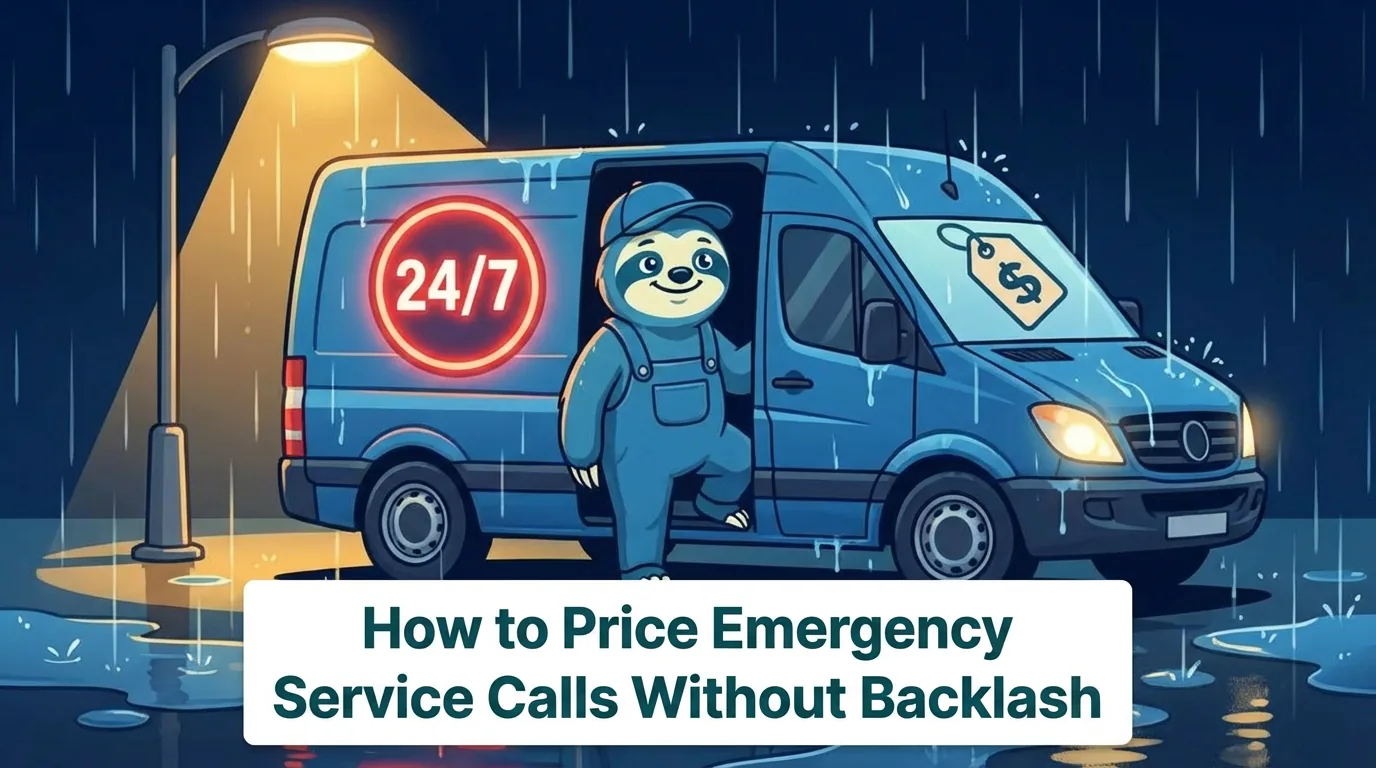
Every service business owner faces the same tension with emergency calls. The phone rings at 9 PM on a Saturday, and a homeowner has water pouring through their ceiling. They need help now, and they are willing to pay for it. But how much? Charge too little and you are subsidizing after-hours work with your regular margins, burning out your team, and training clients to expect cheap emergency service. Charge too much and you get angry reviews, lost clients, and a reputation as the company that gouges people when they are desperate.
The answer is not to pick a number that feels fair and hope for the best. It is to calculate the true cost of emergency response, build a pricing structure that covers that cost with a reasonable margin, communicate the rates clearly before the work begins, and let the client make an informed decision. Pricing backlash almost never comes from the rate itself. It comes from surprise - the client who expected a normal bill and got something dramatically higher. Transparent, consistent emergency pricing actually builds trust because it treats clients like adults who can evaluate a fair deal. 🚨
The True Cost of Rolling a Truck at 10 PM
Emergency service costs more to deliver than standard service. This is not a philosophical position - it is an accounting fact. The expenses are higher in every category, and pretending otherwise means you are subsidizing emergency work with the margins from your regular jobs.
Labor is the most obvious cost increase. If your technician earns $32 per hour during regular hours, overtime pushes that to $48 per hour. But the real labor cost goes beyond the overtime rate. A tech who works an emergency call from 9 PM to midnight has a disrupted evening, worse sleep, and reduced productivity the next day. If they are on a regular schedule the following morning, either their quality suffers from fatigue or you need to adjust their start time, which reduces your available labor hours. The opportunity cost of a tech's evening and next-day productivity is real even if it does not show up on a single job's cost sheet.
Vehicle costs are also higher for emergency work. Night driving carries higher accident risk, which is reflected in your insurance costs even if you do not calculate it per-trip. Fuel costs are the same per mile, but emergency calls often involve longer drives because you are dispatching from the tech's home location to wherever the emergency is, not from a planned route that minimizes drive distances. A tech who normally drives 15 minutes between calls on their daytime route might drive 35 minutes to reach an emergency caller across town.
There is also the cost of maintaining emergency availability itself. Having a technician on call means either paying an on-call stipend or rotating the duty in a way that is fair to your team. If you answer your own phone as an owner-operator, the cost is your personal time and the accumulated fatigue that comes from never being fully off. These costs are real, they are ongoing, and they should be reflected in your emergency pricing. 💡
Building a Tiered Pricing Structure
Flat emergency pricing - one surcharge for all after-hours calls - is simple but crude. A call at 6 PM on a Tuesday and a call at 2 AM on Christmas morning are dramatically different in terms of cost and disruption. Tiered pricing reflects this reality and feels fairer to clients because the premium scales with the actual inconvenience.
A practical three-tier structure works for most service businesses. Tier one covers after-hours weekday calls - typically 6 PM to 10 PM Monday through Friday. These calls disrupt an evening but do not require middle-of-the-night response. A surcharge of 1.5 times your standard labor rate is reasonable for this tier. A tech earning $32 per hour bills at their standard rate during the day, so the after-hours billable rate might be $120 to $150 per hour instead of the daytime $85 to $100.
Tier two covers weekends and late-night calls - Saturday, Sunday, and weekday calls between 10 PM and 6 AM. These are more disruptive, harder to staff, and genuinely interrupt the tech's personal time. A multiplier of 1.75 to 2 times the standard rate is appropriate. Tier three covers statutory holidays - Christmas, Thanksgiving, New Year's, and other major holidays where your tech is giving up family time to respond. A 2 to 2.5 times multiplier is standard and expected by most clients who call on these days.
| Tier | When | Rate Multiplier | Example Billable Rate* |
|---|---|---|---|
| Tier 1 - After Hours (Weekday) | Mon-Fri, 6 PM to 10 PM | 1.5x | $120 - $150/hr |
| Tier 2 - Late Night / Weekend | Sat, Sun, or weekdays 10 PM to 6 AM | 1.75x - 2x | $140 - $180/hr |
| Tier 3 - Statutory Holidays | Christmas, Thanksgiving, New Year's, etc. | 2x - 2.5x | $160 - $220/hr |
*Based on a standard daytime rate of $85 - $100/hr.
Present the tiers clearly on your website, in your phone greeting, and in any service agreement documentation. When a client understands the pricing structure before they call, the conversation shifts from "why is this so expensive" to "which tier does my call fall under." That shift eliminates most pricing objections before they start. 📊
Dispatch Fee vs Diagnostic Fee vs Repair Pricing
Emergency call pricing has three potential components, and clarity about each one prevents confusion and disputes. The dispatch fee covers the cost of rolling the truck - getting a technician from wherever they are to the client's location. The diagnostic fee covers the time and expertise required to identify the problem. The repair price covers parts and labor to fix it. Some companies combine these. Others break them out. The structure you choose matters less than the consistency and transparency with which you communicate it.
A standalone dispatch fee is the safest approach for emergency calls. This fee is charged regardless of whether the client proceeds with the repair. It covers your guaranteed costs - the tech's drive time, fuel, overtime base pay, and vehicle wear. For after-hours calls, a dispatch fee of $125 to $200 is common depending on your market and typical drive distances. The client pays this fee just for the tech to show up, diagnose the issue, and present repair options.
| Fee Component | What It Covers | Charged If Repair Declined? |
|---|---|---|
| Dispatch fee | Drive time, fuel, overtime base pay, vehicle wear | Yes - always |
| Diagnostic fee | Time and expertise to identify the problem | Yes - if separate from dispatch |
| Repair labor | Overtime labor rate for the actual repair | No - only if repair approved |
| Materials | Parts at standard markup | No - only if repair approved |
If the client approves the repair, many companies credit the dispatch fee toward the total invoice. This gives the client an incentive to proceed with the work and makes the dispatch fee feel like a deposit rather than an additional charge. If the client declines the repair - maybe the estimate is higher than they want to pay, or the issue turns out to be less urgent than they thought - you still collect the dispatch fee, which covers your hard costs for the trip.
Repair pricing on emergency calls should reflect the overtime labor rate plus standard material markup. Do not inflate material costs for emergency calls - clients will notice if a $15 part suddenly costs $40 because it was installed at night. The labor premium handles the cost difference. Keep material pricing consistent and let the labor rate multiplier do the work.
How to Communicate Emergency Rates Without Losing the Client
The moment of pricing communication matters more than the number itself. A client who hears the emergency rate before the tech leaves the shop has time to process it, ask questions, and make a decision. A client who hears it for the first time when the tech is standing in their flooded kitchen feels trapped and resentful. Same rate, completely different emotional response.
Train your dispatch staff or answering service to state the pricing clearly during the initial call. The script should sound something like: "We can have a technician to your home within 90 minutes. Our after-hours dispatch fee is $165, which covers the trip and diagnosis. If you approve the repair, that fee gets credited toward your total. Labor for after-hours work is billed at $145 per hour, and materials are at standard pricing. Would you like us to send someone out?" This gives the client all the information they need to make a decision without pressure.
Some clients will decline and try to wait until morning for a standard-rate appointment. That is fine - let them. Pressuring a client into accepting emergency pricing creates resentment even if they agree in the moment. Offer them the first available morning appointment and make a note in the system. Clients who choose to wait are making a rational decision, and respecting that decision builds long-term trust. Many of them will call back at 11 PM when the problem gets worse, and this time they will not hesitate on the pricing because they already know the rates and have already tried the alternative. 🎯
When to Waive or Discount Emergency Fees
Consistency in pricing builds trust. Every exception you make undermines the structure and teaches clients that your rates are negotiable. That said, there are specific situations where waiving or discounting the emergency surcharge is strategically smart.
Service agreement clients should receive preferential emergency treatment. If a client pays you $200 per year for a maintenance agreement, building in priority emergency dispatch with a reduced surcharge - say tier-one rates regardless of timing - is a powerful retention incentive. The client feels the value of their agreement precisely when they need it most, and the annual agreement revenue offsets the occasional discounted emergency call. This structure also helps sell maintenance agreements because "priority emergency service at reduced rates" is one of the most compelling benefits you can offer.
High-value repeat clients who generate significant annual revenue may justify a goodwill discount on the rare emergency call. A property management company that sends you 40 jobs per year has earned some pricing flexibility. A homeowner who calls you once every two years has not. Be strategic about who gets exceptions and document the reason in your system so the decision is transparent, not arbitrary.
Always cover emergency service at no additional charge when the emergency was caused by your prior work. If a pipe joint your tech repaired last week starts leaking at midnight, that is a callback, not an emergency call. Charging a surcharge in this scenario is a guaranteed way to lose the client and earn a one-star review. Handle it immediately, at your cost, and use it as a learning opportunity to prevent the same failure on future jobs.
Setting Up Your On-Call Rotation
Emergency service availability requires a sustainable staffing model. A single owner-operator who answers every after-hours call will burn out within months. A team with no structured rotation will have availability gaps and resentment among techs who feel they carry more than their share.
For teams of two to four technicians, a weekly rotation works well. One tech is on call for the full week, then passes the duty to the next person. On-call techs should receive a stipend - typically $50 to $150 per week depending on call volume - plus the overtime pay for any calls they respond to. The stipend compensates for the restriction on their personal time even if no calls come in. Without it, on-call duty feels like unpaid work, and techs will resist it.
For solo operators, the decision is binary: either you offer emergency service and price it high enough to make it genuinely worth your time, or you do not offer it at all. There is no shame in the second option. Many successful single-operator businesses close at 5 PM and let an answering service take messages for next-day callbacks. If you choose to offer emergency service, set a rate that makes you happy when the phone rings at midnight. If the rate required to make you happy is so high that nobody would pay it, that is the market telling you that emergency service is not the right offering for your business at its current size.
Competitor Benchmarking Without a Race to the Bottom
Knowing what your competitors charge for emergency service is useful context, but it should not be the primary driver of your pricing. Your costs are your costs. If a competitor charges $100 for an after-hours dispatch and your real cost to roll a truck at night is $130, matching their rate means you lose money on every emergency call. They are either subsidizing emergency service, cutting corners on technician pay, or they have a cost structure you do not share.
Research three to five direct competitors in your service area. Check their websites, call their after-hours lines, and ask about rates. Many businesses are surprisingly transparent about emergency pricing because they want to filter out price shoppers before dispatching a tech. Compile the data and identify where your rates sit relative to the market. Being in the middle of the pack is comfortable but not required. Being at the top is fine if your brand, response time, and service quality justify the premium.
The goal of competitor benchmarking is to make sure you are not dramatically out of range in either direction. If every competitor charges $125 to $175 for an after-hours dispatch and you are at $275, you will get very few calls regardless of your quality. If everyone else is at $150 to $200 and you are at $75, you are leaving money on the table and attracting price-sensitive clients who are unlikely to become loyal repeat business. Price within the range, compete on speed and quality, and let your reviews do the selling.
The Revenue Opportunity Most Owners Miss
Emergency calls are not just a cost center to manage - they are a revenue opportunity that most service businesses undermonetize. A client calling at 9 PM with a flooded basement is not shopping for the cheapest plumber. They are shopping for the fastest, most reliable plumber who can solve their problem tonight. Price sensitivity drops dramatically in genuine emergencies, and willingness to pay a premium is at its highest.
Well-priced emergency service at sustainable rates can represent 15 to 25 percent of a service business's annual revenue with significantly higher margins than standard work. The labor premium means each emergency hour billed generates more gross profit than a daytime hour. The urgency means less comparison shopping and faster approval of repair estimates. The gratitude factor - you helped them when they were in crisis - creates loyalty that generates referrals and repeat business for years.
The key is sustainability. Emergency revenue only works if you can deliver it without destroying your team's quality of life, without sacrificing next-day performance, and without burning through technicians who quit because on-call duty is uncompensated misery. Price it right, staff it fairly, communicate it clearly, and emergency service becomes one of the most profitable segments of your business instead of a dreaded obligation that eats into your evenings. 📈
Frequently Asked Questions
Ready to transform your field service business?
Start using WorkZen today. It's free to get started!