How to Ask for Payment Before Leaving the Job Site
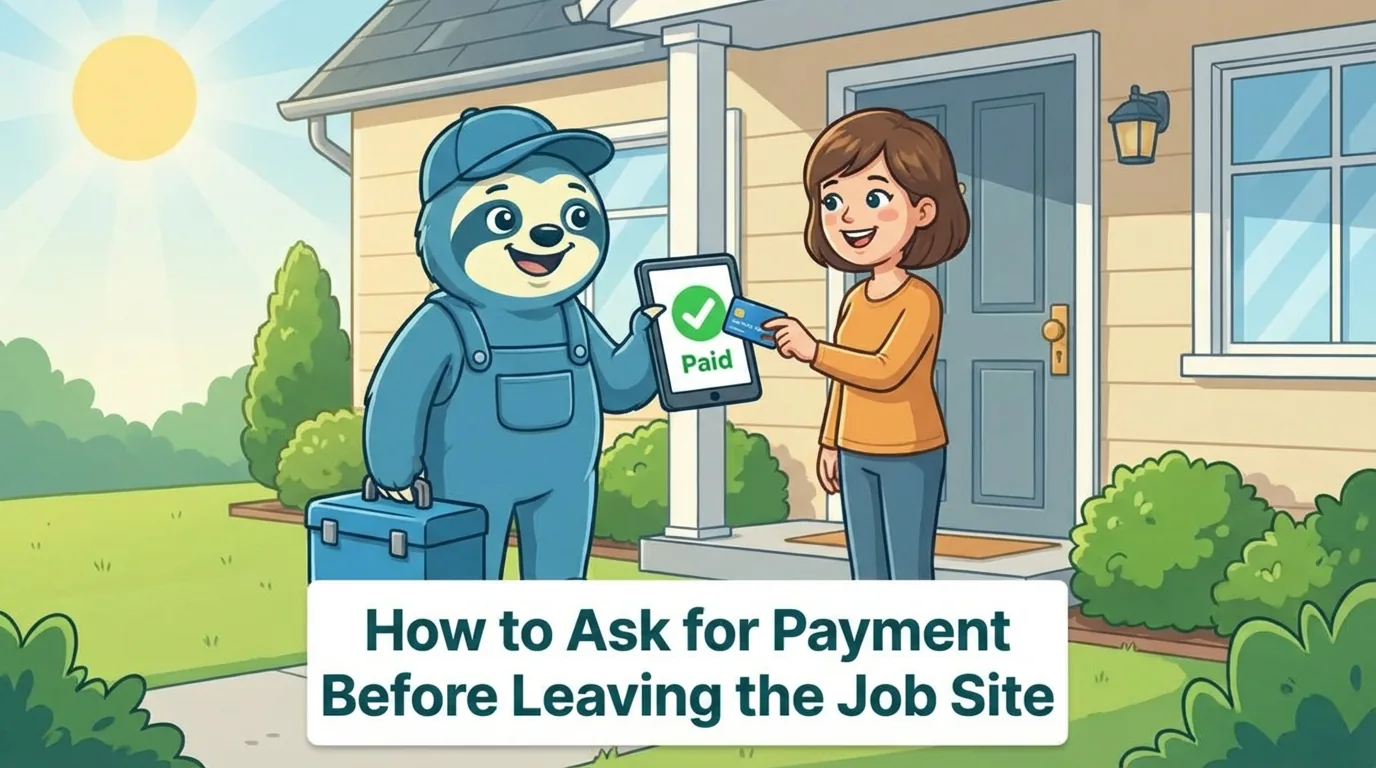
The work is done. The client is happy. The technician packs up the truck, says thanks, and drives to the next job. Three days later, an invoice goes out. A week after that, a reminder. Two weeks later, another reminder. A month later, the owner is chasing a $400 payment that should have been collected before the technician left the driveway. This cycle repeats across thousands of service businesses every single day, and it is one of the most preventable cash flow problems in the trades.
Collecting payment at job completion is not aggressive, awkward, or unprofessional. It is how most service transactions work outside of contracting. Your mechanic does not send you a net-30 invoice after an oil change. Your dentist does not email a payment request two weeks after a cleaning. They collect at the point of service because that is when the value is most tangible and the client is most willing to pay. Service contractors deserve the same standard, and the ones who adopt it see dramatic improvements in cash flow, collection rates, and administrative workload. 💰
The shift from invoicing later to collecting now does not require new technology or a personality transplant. It requires clear expectations set before the job starts, a simple process at the job site, and a team that has practiced the conversation enough to feel natural delivering it.
Why Collect-on-Completion Beats Net-30
Every day between job completion and payment collection represents risk. The client's enthusiasm fades. Other bills arrive. The work becomes part of the background rather than something they just watched happen. By the time a net-30 invoice is due, the client is mentally disconnected from the value you delivered, and the payment feels like an obligation rather than a fair exchange.
The numbers tell the story clearly. Industry data consistently shows that the longer you wait to collect, the harder collection becomes:
| Time to Collection | Collection Rate | What You Risk |
|---|---|---|
| Same day (on site) | 95%+ | Almost nothing |
| Within 7 days | ~85% | Minor follow-up effort |
| Within 30 days | 70-75% | Reminders, aging receivables |
| 60+ days | 50% or less | Write-offs, collections, lost trust |
Every week of delay costs you real money - not just in uncollected invoices, but in the time your office spends sending reminders, making follow-up calls, and managing aging receivables. 📈
There is a compounding effect too. When you collect on site, that cash is available immediately for payroll, materials, and fuel. When you invoice on net-30, you are effectively financing the client's project with your own operating capital for a month. For a small crew running tight margins, that float can be the difference between making payroll comfortably and sweating through the end of the month.
Set the Expectation During Booking
The payment conversation at the job site should never be the first time a client hears about your collection policy. If it is, you are starting from a position of surprise, and surprise makes people defensive. Instead, weave the expectation into your booking process so it feels like standard procedure by the time the work is complete.
When your office books the appointment, the confirmation message should include a line about payment. "Payment is due at the time of service. We accept all major credit cards, tap-to-pay, and e-transfer." That one sentence does more for your collection rate than any follow-up sequence ever will because it frames on-site payment as the default, not as a special request. 💡
Your estimate or quote should also reference payment terms. "Total: $850. Payment due upon completion." When the client approves the estimate, they are implicitly agreeing to the payment terms. That agreement gives your technician a natural foundation for the collection conversation later. They are not springing something new on the client - they are following through on what was already communicated and accepted.
Scripting the Payment Conversation
Most technicians who struggle with collecting payment on site do not have a philosophical objection to it - they just do not know what to say. The moment feels awkward because they have never been given language that feels natural. A simple script removes that awkwardness entirely.
After completing the work and walking the client through what was done, the technician transitions with something like: "Everything looks good. I am going to send the invoice to your email right now - you should see it in about 30 seconds. We can take care of payment by card or e-transfer, whichever is easier for you." That phrasing is confident, assumes the payment is happening, and offers choice rather than asking permission.
The key is the assumption. "We can take care of payment" is fundamentally different from "Would you like to pay now?" The first frames payment as the natural next step. The second frames it as optional. Technicians who use assumptive language collect at dramatically higher rates than those who ask open-ended questions. Practice this language in team meetings until everyone can deliver it without hesitation. 🎯
Offering Multiple Payment Methods
Friction kills collection rates. If the only way to pay is by check, you are going to leave a lot of money on the table because many clients do not carry a checkbook anymore. The more payment methods you offer at the job site, the fewer excuses exist for delaying payment.
| Payment Method | Speed | Client Familiarity | Best For |
|---|---|---|---|
| Tap-to-pay (card/phone) | Seconds | Very high | All jobs |
| Chip/swipe card | Under a minute | High | All jobs |
| Interac e-transfer | 1-5 minutes | High (Canada) | Larger amounts |
| Check | Immediate handoff | Low (declining) | Older clients |
| Cash | Immediate | Medium | Small jobs |
At minimum, your technicians should carry a mobile card reader that accepts chip, tap, and swipe payments. Square, Stripe, and most FSM platforms offer card readers that sync directly with your invoicing system. Tap-to-pay is increasingly the preferred method because it is fast and feels effortless - the client taps their phone or card, the payment processes in seconds, and the receipt arrives by email before the technician reaches the truck.
E-transfer is another strong option, especially in Canada where Interac e-transfer is nearly universal. Provide clear instructions and your payment email address on the invoice. For larger jobs, offering to split the payment across two cards or arranging a partial deposit with the balance on completion gives clients flexibility without letting the full amount drift into accounts receivable.
Handling Objections Without Losing the Job
Even with clear expectations and good scripting, some clients will push back at the moment of payment. The most common objections are "I need to talk to my spouse," "I was not expecting to pay today," and "Can you just send me an invoice?" Each of these requires a calm, professional response that maintains the expectation without creating conflict.
For the spouse objection, the best response is patience paired with proximity. "No problem at all - take a few minutes. I will finish loading the truck. If it helps, I can send the invoice to both of you right now so you can review it together." Then stay nearby and let the conversation happen. Most of the time, the client returns within 10 minutes with payment. The key is not leaving the site - once you drive away, collection rates drop sharply.
For "I was not expecting to pay today," reference the booking confirmation or estimate that included payment terms. "I understand - our payment terms are listed on the estimate you approved, and we mentioned it when we scheduled the appointment. We accept card, tap, or e-transfer if that makes it easier." This is not confrontational - it is factual. You are reminding the client of something they already agreed to, not introducing a new demand.
When to Make Exceptions
A rigid collect-on-completion policy works for 90 percent of situations, but there are legitimate exceptions. Property management companies and commercial clients often have internal approval processes that genuinely require invoicing. Long-time clients with perfect payment history may occasionally need a few days for a larger bill. Insurance-related work often involves third-party payment timelines you cannot control.
The key is treating exceptions as exceptions, not as the default. When you make an exception, do it deliberately and communicate the adjusted terms clearly. "For this project, I will send the invoice with net-15 terms since your property management company processes payments through their AP system. We will follow up at the 10-day mark to make sure everything is on track." That language shows flexibility while maintaining structure.
Track which clients and situations generate exceptions so you can identify patterns. If a particular client always needs "a few extra days," that is not an exception - that is a payment behavior you need to address directly. Over time, your exception rate should stay below 10 percent. If it is higher, your booking process is not setting expectations firmly enough.
Training Technicians to Collect Confidently
The biggest obstacle to on-site collection is not client resistance - it is technician discomfort. Many techs see themselves as skilled tradespeople, not salespeople, and anything that feels like "selling" makes them uncomfortable. Reframing the collection conversation as a professional completion step rather than a sales moment changes how technicians approach it.
Start by explaining the business impact. Technicians who understand that delayed payments mean tighter payroll, slower tool purchases, and more office overhead tend to take collection more seriously. When the team understands that their on-site behavior directly affects the company's financial health, the motivation shifts from compliance to ownership.
Role-playing is the most effective training method. During a team meeting, pair technicians up and have them practice the payment script in both directions - one plays the tech, the other plays the client. Run through the common objections. Let them stumble, correct, and try again. By the time they do it for real on a job site, the words feel practiced and natural rather than forced and awkward.
The Ripple Effects on Your Business
Shifting to collect-on-completion changes more than your cash flow. It reduces your accounts receivable balance, which means less time spent on follow-up calls and reminder emails. It eliminates the emotional weight of chasing money, which is one of the most draining parts of running a service business. And it creates a cleaner financial picture because revenue is recognized and collected on the same day.
Your administrative costs drop because fewer invoices age past 30 days. Your bookkeeping gets simpler because payments match jobs in real time instead of arriving weeks later as disconnected deposits. Your technicians feel more professional because every job has a clean beginning, middle, and end - including the financial close.
The clients who adjust to on-site payment do not resent it. In most cases, they prefer it. Paying immediately means they do not have an outstanding bill hanging over them. They do not have to remember to pay next week. The transaction is complete, and they can move on. Making payment easy and expected is a service to both sides of the relationship. ✅
Frequently Asked Questions
Ready to transform your field service business?
Start using WorkZen today. It's free to get started!