When a Tech Damages Property: A Response Plan
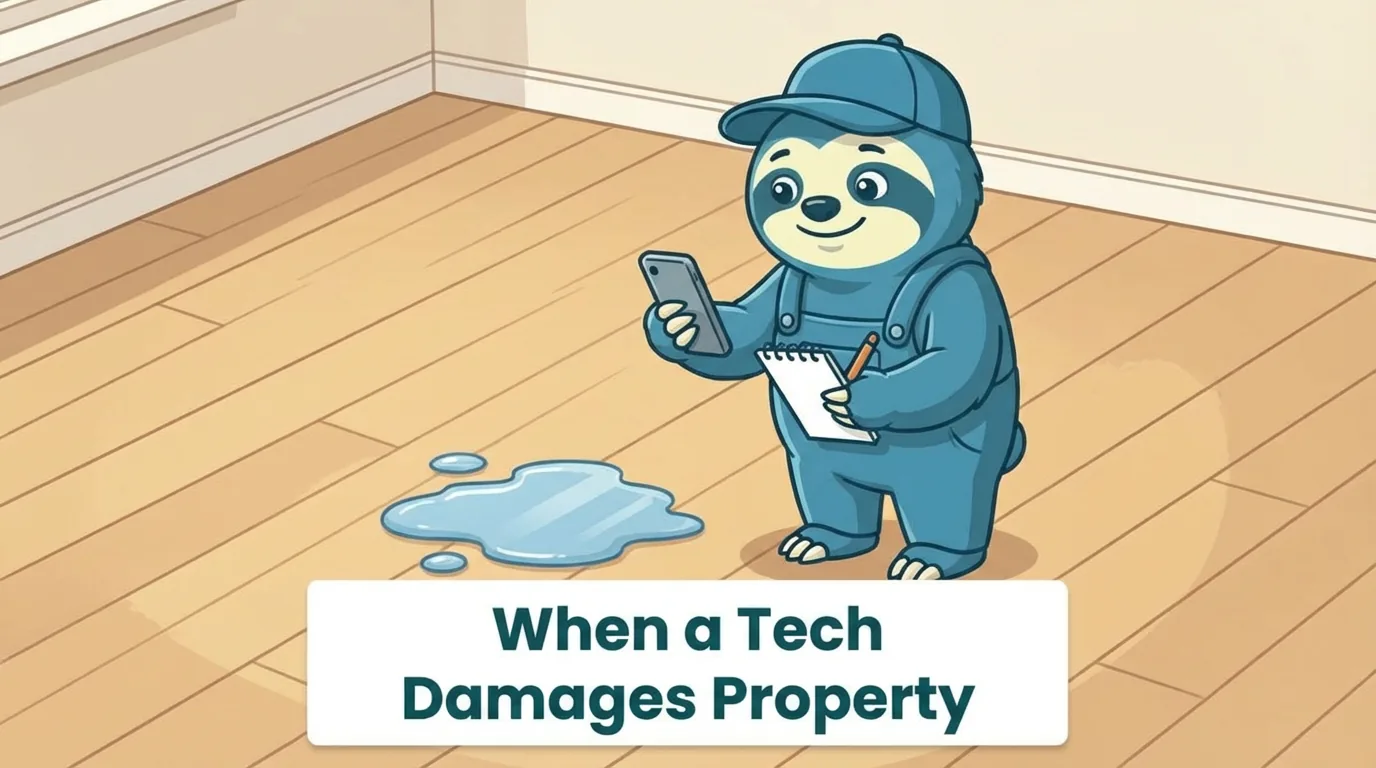
Property damage during service work is one of those operational realities that owners hope to avoid and almost never can across enough volume. A truck backs into a fence post. A wrench slips and chips a granite countertop. A water connection fails and floods a finished basement. A torch sets off a smoke detector and ruins a Saturday morning for a family. Across thousands of service calls per year, mathematics catches up with even the most careful contractor, and damage incidents become a regular operational scenario rather than a rare emergency. 🛠️
How a shop responds in the first 60 minutes after damage occurs determines almost everything that follows. Done well, the response can preserve the client relationship, keep insurance claims manageable, prevent litigation, and even produce a stronger client relationship than existed before the incident. Done badly, the response can lose the client, escalate into a legal claim, damage the company's reputation in the neighborhood, and produce financial costs many times the actual damage value. The difference between these outcomes is almost entirely process - and process is something that can be built deliberately rather than improvised in the moment.
The First Hour: What Has to Happen Immediately
The first hour after damage occurs is when the situation is most dynamic and most controllable. Fast, calm, structured action in this window prevents the cascading consequences that make damage incidents expensive. Owners and techs without a clear process default to either panicking or pretending nothing happened, both of which produce bad outcomes.
The immediate response has five components, in order. First, stop the damage. If water is leaking, shut off the water. If smoke is filling a room, ventilate. If something is unstable, stabilize it. The priority is preventing further loss before doing anything else, including talking to the client extensively. Second, ensure safety. Make sure no one is at risk - the client, the tech, anyone else in the home. Third, make initial contact with the client. Acknowledge what has happened factually and explain what is being done immediately to address it.
Fourth, contact the office or owner. Damage incidents need to be reported to leadership immediately, not at the end of the day. The owner or service manager needs to know within 30 minutes so they can decide whether to come to the site, deploy mitigation resources, or coordinate communications. Fifth, document the scene before any cleanup or repair work begins. Photos from multiple angles, close-ups of damage, wide shots showing the context, video if appropriate. Documentation cannot be added later - it has to happen now or it does not exist. ⏱️
| Time | Action | Who Owns It |
|---|---|---|
| 0-5 min | Stop the damage, ensure safety | Tech on site |
| 5-15 min | Initial honest conversation with client | Tech on site |
| 15-30 min | Notify office/owner, document scene | Tech + dispatcher |
| 30-60 min | Owner/manager response, mitigation plan | Owner or service manager |
| 1-4 hours | Mitigation begins, formal incident report | Dedicated response |
The biggest mistake in the first hour is silence. Techs who do not know how to handle the situation sometimes try to fix it without telling anyone, hoping it goes away. It never does. The client always notices, the damage usually gets worse, and the company finds out about the incident days later when the client calls to complain - by which time the response window has closed and most of the leverage to handle the situation well is gone.
The Conversation With the Client: What to Say and Not Say
The conversation with the client immediately after damage occurs is one of the highest-stakes interactions in service business operations. Done well, it preserves the relationship and sets up a positive resolution. Done badly, it creates legal exposure, alienates the client, and turns a manageable situation into a crisis.
The framing that works is honest acknowledgment of facts plus clear commitment to make things right, without specific premature promises. "Mr. Jones, while I was working on the water heater connection, the fitting failed and caused this leak. I have shut off the water and stopped the immediate damage. I am calling our office now so we can get the right people here to help fix this. We are going to make this right, and I want to make sure we do it correctly - I will get someone with more authority on the phone with you in the next few minutes."
The principles behind this script. Acknowledge the facts of what happened - hiding the cause produces worse outcomes than transparency. Stop the immediate damage - action signals competence. Escalate to higher authority - the tech is not the right person to negotiate the resolution and should not try. Commit to making it right - vague but real commitment is the right level. Avoid specific dollar promises - those come later, when the actual scope is known.
Things to never say during this conversation:
- "Don't worry, our insurance will cover everything." (May not be true, depending on policy)
- "I'll pay for it personally." (Creates legal complications, may exceed actual damages)
- "This was probably already going to fail anyway." (Defensive, alienating, may not be true)
- "It's not really that bad." (Minimizing creates immediate distrust)
- "I'm not really sure what happened." (Unless genuinely uncertain - then explain what is unclear)
- "Just don't tell anyone about this." (Catastrophic for credibility, may suggest hiding)
The owner or service manager taking over the conversation should be in contact with the client within 30-45 minutes. The escalated conversation can address resolution path more concretely - what happens next, who handles the repair, what the timeline looks like, who pays for what. The client should leave that conversation knowing the company has a process for this and is taking it seriously, even if specific numbers are not yet final.
Documentation: Building the Record That Protects Everyone
Documentation done in the first hour after an incident protects the company, the client, and the insurance process. Documentation done later - or not at all - creates ambiguity that almost always favors whoever is more aggressive in the post-incident negotiation, which is rarely the contractor.
The documentation package needs five elements. Photos: comprehensive coverage from multiple angles and distances, including damage close-ups, room context, and any equipment involved. Written incident report: factual account of what was being done when damage occurred, what specifically happened, what immediate response was taken, who was contacted. Timeline: precise times of when work started, when damage occurred, when client was notified, when office was notified. Witnesses: names of anyone present who observed the incident or its immediate aftermath. Existing condition notes: documentation of any pre-existing damage that was visible before work began.
| Documentation Element | What to Capture |
|---|---|
| Photos - damage | Close-ups, multiple angles, with reference for scale |
| Photos - context | Wide shots showing surrounding area, conditions |
| Written report | Factual sequence: what, when, where, who, immediate response |
| Timeline | Precise times, ideally from text/dispatch records |
| Witness statements | Names and contact info for anyone who observed |
| Pre-existing damage | Photos and notes documenting condition before work |
The written incident report should be completed by the tech the same day, before they go home. Memory degrades quickly, and a report written 36 hours later often contains errors and omissions that cause problems later in claims or legal proceedings. The report does not need to be elaborate - one page covering the essential facts is usually sufficient - but it does need to exist while the events are fresh.
Store all documentation in a single, organized location accessible to whoever handles claims. Cloud-based field service management systems make this straightforward; companies relying on email and paper notes often find documentation scattered across formats and locations when they need it most. The discipline of complete documentation costs almost nothing and pays back significantly when something escalates beyond the routine. ✅
The Insurance Decision: When to File and When to Absorb
Not every damage incident should be filed as an insurance claim. Filing claims for small damages drives up future premiums, may affect carrier willingness to renew, and can cost more in the long term than simply paying the damage out of operating cash. The decision needs to be made deliberately based on damage value, deductible, and policy implications.
The general rule: damages clearly below the policy deductible come out of operating cash. Damages clearly above the deductible go through insurance. Damages near the deductible require judgment based on specific circumstances - claims history, current premiums, severity, and risk of escalation.
| Damage Value | Typical Approach |
|---|---|
| Under $1,000 | Pay out of operating cash, do not file |
| $1,000 - $3,000 | Usually pay out of cash unless policy deductible is lower |
| $3,000 - $10,000 | Filing decision based on deductible and claim history |
| $10,000 - $50,000 | Almost always file - exceeds reasonable absorption |
| $50,000+ | Always file, also notify legal counsel preemptively |
When filing a claim, do it quickly. Most policies require notification within specific timeframes (often 24-72 hours for liability claims), and missed notification deadlines can affect coverage. The agent or carrier handles the heavy lifting after notification, but the trigger has to come from the contractor promptly.
When paying out of pocket, document the resolution as carefully as if it had been a claim. Get a written acknowledgment from the client that the damage has been resolved to their satisfaction once payment is made and any repair is complete. Without this acknowledgment, situations sometimes resurface months later with claims that were supposedly settled, which can be very difficult to refute without documentation.
The Repair Decision: Your Crew, Outside Vendor, or Insurance Network
Once the damage scope is understood, someone has to actually fix it. The decision of who does that repair affects cost, timeline, quality, and client relationship. The wrong choice can take a recoverable situation and make it worse.
For damage in your own trade scope - a plumber repairing damage from their own water leak, an electrician fixing damage from their own electrical issue - the company should usually do the repair work itself. Self-repair is faster, cheaper, and demonstrates accountability. The client sees the company taking ownership rather than passing the problem along.
For damage outside your trade scope - water damage from a plumbing leak that affects drywall and flooring - outside vendors handle the work. The choice is between picking your own preferred vendor (usually best for small to moderate damage) and using the insurance carrier's preferred vendor network (usually appropriate for major claims).
| Damage Scope | Who Does the Repair |
|---|---|
| Within your trade | Your own crew, immediately |
| Adjacent trade, small scope | Your preferred sub or trusted local |
| Adjacent trade, moderate scope | Carrier's network or your trusted vendor |
| Major damage requiring multiple trades | Carrier's project management network |
| Specialty restoration (mold, smoke) | Always specialists, never DIY |
The insurance carrier's preferred network exists for good reasons - vetted vendors, established processes, claims efficiency - but the network is optimized for the carrier's interests, not the contractor's. For major claims, network use is often unavoidable. For moderate claims where the contractor has good local vendor relationships, using your own network can be faster and produce better client outcomes even if the carrier prefers their network.
Preventing the Next Incident: Learning From Each Event
Every damage incident contains information that can prevent future incidents if it is captured and used. The shops that learn from incidents trend toward steadily lower damage rates over time. The shops that handle each incident as an isolated event continue having the same incidents repeat across years.
The post-incident review should happen within two weeks of the event, separate from the immediate response. The review covers what happened, what specifically caused it, whether the cause was unique to this situation or represents a systemic issue, and what changes (if any) should be made to prevent recurrence. The review is not about assigning blame - blame conversations interfere with honest assessment - but about extracting lessons from the event.
| Review Question | What It Surfaces |
|---|---|
| What was the proximate cause? | Specific failure point in equipment, process, or judgment |
| Was this a unique situation or systemic? | Whether a process change is warranted |
| Could training have prevented it? | Skill or knowledge gap to address |
| Could equipment have prevented it? | Tool, supply, or PPE gap |
| Could process have prevented it? | Workflow or checklist change |
| Was the response effective? | Lessons for future response |
Patterns worth tracking across multiple incidents: trade type, job category, tech tenure, time of day, season, equipment involved. Over time these patterns reveal where damage incidents cluster and where intervention has the highest leverage. A shop that discovers most of its damage incidents happen on jobs over a certain dollar value, performed by techs in their first 18 months, can address that specific risk through training or process changes. 📊
Pulling It All Together
Property damage on service calls is not a question of if but when, and how often. The shops that handle it well treat the response as an operational discipline rather than an emergency improvisation. They have a written process. They have trained their techs on how to respond and what to say. They have insurance policies that match their actual exposure. They have documentation systems that capture what happens immediately. And they review incidents to keep getting better at preventing the next one.
This level of operational maturity is unusual in small service businesses, which is why most owners feel exposed when a damage incident occurs. The fix is not complicated - it is mostly a matter of writing down what good looks like, training the team to execute it consistently, and reviewing periodically to keep improving. The investment to build the discipline is small. The protection it provides, across the long arc of operating a service business, is enormous - and the calm professionalism it produces during crisis moments is its own kind of competitive advantage. Clients remember who handled their bad day well, and they tell their neighbors.
Frequently Asked Questions
Ready to transform your field service business?
Start using WorkZen today. It's free to get started!