How to Start a Landscaping Business in 2026
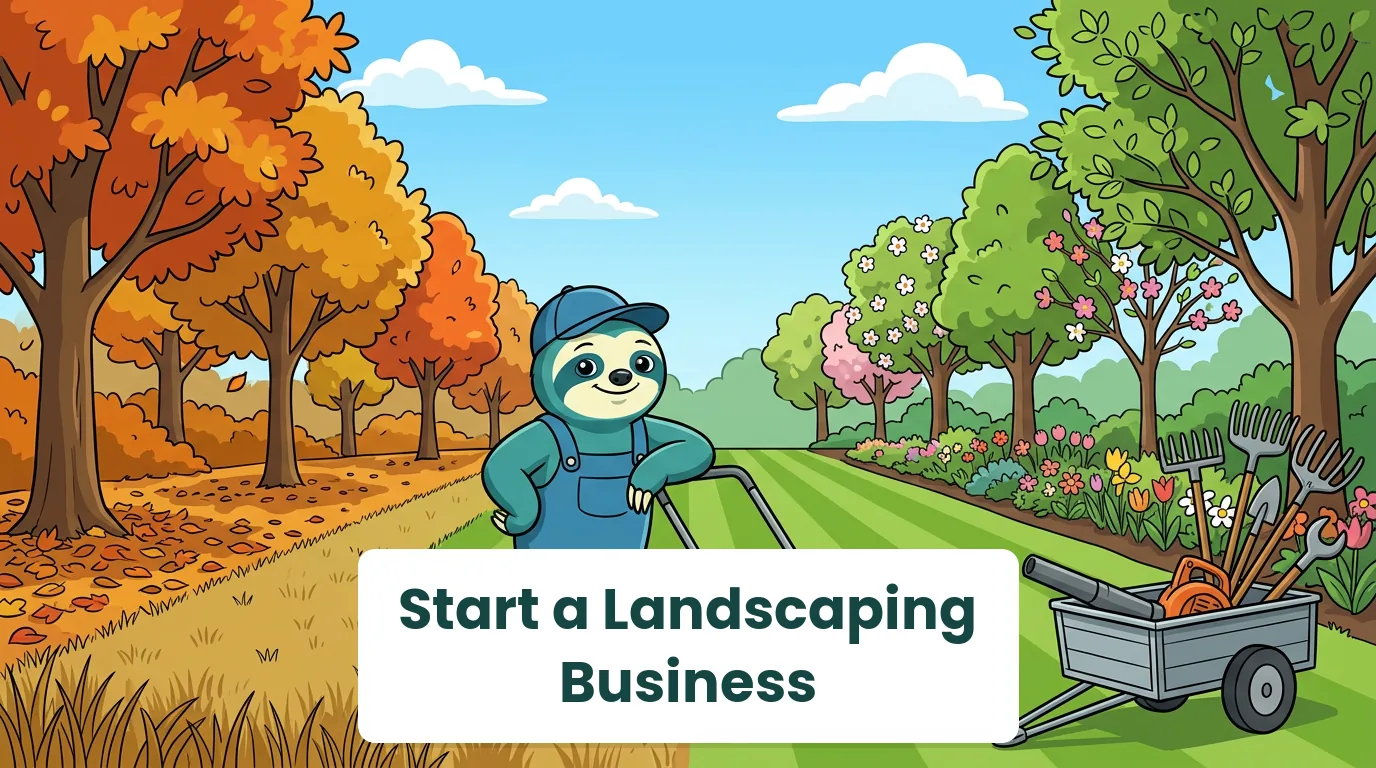
Landscaping is one of the few service businesses where the calendar decides almost everything. You cannot mow in February in Minnesota or Manitoba, the phones ring hardest in April, and the owners who win spring are the ones who did their homework in November. So this guide is not a generic "Step 1 to Step 9" list. It is built around the season you are actually in.
If you are reading this in October, your timing is perfect. You have six months to set up, price, market and pre-sell, and a lot of that work is cheaper and calmer in the off-season. Plant in the fall, harvest in the spring. It works for tulips and it works for landscaping companies.
How to Start a Landscaping Business: The Short Version
To start a landscaping business, pick a lane (lawn care, landscaping or hardscaping), register and insure the business, buy only the equipment your first 20 clients need, and price by the visit or project with a seasonal contract. Use the winter to build your pipeline, then launch routes in April, clustered in a few neighbourhoods.
The whole plan in six lines:
- Pick your lane before you buy anything. It decides your costs, licences and margins.
- Budget honestly: equipment, insurance and three months of running costs.
- Get legal: business registration, insurance, and a pesticide licence only if you will spray.
- Use October to April to build a brand, a price list and a list of pre-booked clients.
- Stay dense: fewer neighbourhoods, more lawns per street.
- Sell contracts, not visits, and plan winter income before the snow does it for you.
Lawn Care, Landscaping or Hardscaping: Pick Your Lane
"Landscaping business" covers three quite different companies. Most owners start in the first one and grow into the second.
| Lawn care | Landscaping (soft) | Hardscaping | |
|---|---|---|---|
| What you sell | Mowing, edging, cleanups, aeration, seasonal care | Planting, beds, mulch, sod, small designs | Patios, walls, walkways, steps |
| Startup cost | Lowest | Medium | Highest (compact equipment, materials) |
| Licensing | Usually basic business licence | Some states and cities license landscape contractors | Often contractor licence and permits for larger builds |
| Ticket size | Small, frequent | Medium | Large, occasional |
| Recurring revenue | Very high (weekly or biweekly) | Medium (seasonal refresh) | Low (one-time projects) |
| Seasonality | Strong | Strong | Strong, plus weather delays |
| Skill barrier | Low | Medium | High |
Our take: start with lawn care for cash flow and a client list, then add planting and bed work for those same clients. Hardscaping is a great upsell once you have the skills or a partner who does, but it is a hard first business because one bad wall can wipe out a season of mowing profit.
How Much Does It Cost to Start a Landscaping Business?
It depends on the lane and on whether you already own a truck. Here are three realistic starting points, using equipment prices from dealer and retailer listings (AllMachines, MachineFinder and major retailers) in September 2026. Prices are USD and vary by region.
| Setup | What you buy | Rough budget (excluding truck) |
|---|---|---|
| Lean lawn care start | Commercial walk-behind mower, string trimmer, blower, edger, hand tools, small used trailer | ~$3,000 to $5,000 |
| Solo pro | Commercial zero-turn (commercial listings on AllMachines average about $11,000; used units often sell for around half), trailer, trimmer, blower, edger, spreader, hand tools | ~$10,000 to $20,000 |
| Small crew | Second mower, second truck or larger trailer, crew gear, more backup equipment | $40,000 and up |
Equipment ranges from dealer and retailer listings, September 2026. A used truck, if you need one, is a separate and bigger line.
What tools do you need to start a landscaping business?
For lawn care, the must-haves are:
- A commercial mower (walk-behind to start, zero-turn when routes justify it)
- String trimmer, edger and backpack blower
- Rakes, shovels, a spreader and a sprayer
- A trailer if your truck bed cannot carry everything safely
- Safety gear: eye and ear protection, boots, gloves
Buy commercial-grade where it matters (the mower and trimmer run every day) and cheap where it does not (rakes do not care about your brand). Our startup cost breakdown for 17 trades covers the non-equipment lines like registration, software and marketing.
Insurance: budget it from day one
Insureon's landscaping data (updated February 2026, small landscaping businesses that bought policies through Insureon) puts median premiums at:
| Policy | Median monthly | Median annual |
|---|---|---|
| General liability | $51 | $610 |
| Business owner's policy (BOP) | $94 | $1,130 |
| Tools and equipment | $38 | $450 |
| Commercial auto | $204 | $2,452 |
| Workers' compensation (once you hire) | $169 | $2,029 |
USD, from insureon.com, February 2026.
Licenses, Insurance and the Pesticide Trap
The basics are the same as any service business:
- Register the business (sole proprietor, LLC or corporation in the US; sole proprietorship or incorporation in Canada) and get a local business licence where required.
- General liability protects you when a rock from your mower goes through a window. Many clients and property managers ask for a certificate before you start.
- Commercial auto covers the truck you use for work. Your personal policy usually will not.
- Workers' compensation once you hire, as your state or province requires.
Now the trap. Spraying is licensed separately. Mowing needs no special licence in most places, but the moment you apply weed killer, insecticide or other pesticides on someone else's property for pay, you are a commercial applicator.
- In the US, states run pesticide applicator certification under federal standards set by the EPA under FIFRA. The certified person passes a core exam and a category exam (usually ornamental and turf), and most states require continuing education to renew. Some states also regulate fertilizer application. See the EPA's certification overview and your state department of agriculture.
- In Ontario, the person applying needs an exterminator licence (the landscape category covers ornamental plantings) and the business needs an operator licence, which requires liability insurance of at least $2 million per incident plus pollution coverage, according to the Ontario pesticide licensing guide. Ontario also restricts cosmetic pesticide use on lawns under Ontario Regulation 63/09, which limits what you can sell in the first place.
- Other provinces have their own rules, so check with your provincial environment ministry before offering weed control.
The simple path: start with mowing, cleanups and organic or mechanical weed control, and add chemical programs only once someone on the team is certified.
Your Off-Season Launch Calendar (October to April)
This is where landscaping differs from every other trade startup. You have a built-in six-month runway. Use it.
| Month | Focus | What to finish |
|---|---|---|
| October | Decide and name | Pick your lane and service area, choose a name (our business name generator helps), check the domain |
| November | Get legal | Register the business, open a business bank account, get insurance quotes, check pesticide rules if relevant |
| December | Buy smart | Shop used equipment while dealers clear inventory and other owners sell off-season |
| January | Build your presence | Website, Google Business Profile with service area, simple branding for the truck and door hangers |
| February | Price the season | Per-visit prices, season packages, a written service agreement, your software set up with recurring visits |
| March | Pre-sell | Door hangers in your target neighbourhoods, referral offers, early-bird season packages, spring cleanup bookings |
| April | Launch | Spring cleanups first, then weekly and biweekly routes start |
If you only do one thing in winter, make it March pre-selling. A season package sold in March is a client who will not call a competitor in May when the grass is knee-high.
How to Price Landscaping Work
Different lanes, different pricing models.
- Mowing and lawn care: price per visit, based on lawn size and complexity. LawnStarter's 2026 data puts typical mowing at $43 to $70 per visit, averaging $56, and professional rates at $32 to $68 per hour (updated September 2026). Treat those as a market check, not your price.
- Landscaping installs: price per man-hour plus materials, or per project with a clear scope.
- Hardscaping: always per project, with materials, equipment rental, disposal and a contingency built in.
Is $100 an hour too much? For a skilled crew with equipment doing installs, no. For one person mowing, it probably is in most markets. The number that matters is your own: labour, fuel, equipment wear, insurance, overhead and profit. Our markup calculator helps with the materials side.
One more pricing rule: set a minimum visit price. A tiny lawn across town costs you the same drive time as a big one.
Route Density: The Math That Makes or Breaks You
Most new landscapers take every lawn they can get. It feels like growth. It is often the opposite.
Here is an illustrative 8-hour day with 30 minutes of mowing per lawn and $56 per visit:
- Scattered route: 20 minutes of driving between stops, so each stop takes about 50 minutes. That is about 9 lawns a day, or roughly $504.
- Clustered route: 4 minutes between stops, so each stop takes about 34 minutes. That is about 14 lawns a day, or roughly $784.
Same truck, same mower, same owner, about 55% more revenue, and less fuel on top. Twenty lawns on four streets beat forty lawns across the city.
How to build density on purpose:
- Choose two or three neighbourhoods and say no (politely) to one-off requests far outside them.
- Market street by street: once you mow one lawn, door-hang the five houses on either side.
- Plan routes on a map, not a list. Our guides to choosing service area boundaries and route optimization go deeper.
In WorkZen, weekly and biweekly visits are set up once as recurring jobs, and the scheduling map shows each day's visits as pins so you can see at a glance which client is breaking your route.
How to Get Your First Landscaping Clients
The best marketing for a landscaper is a good-looking lawn on a busy street. Beyond that:
- Door hangers in your target neighbourhoods, timed for March and again after your first cuts.
- Google Business Profile with your service area, real photos and a steady trickle of reviews. See our guide to turning your Google Business Profile into a lead machine.
- Referrals from neighbours: a small credit for every neighbour who signs a season contract.
- Local Facebook groups and community boards in the neighbourhoods you serve, not the whole city.
- Google Local Services Ads once you are established and verified. We covered how they work in our Local Services Ads guide.
Capture every inquiry in one place. A simple web form feeding your client list beats a pile of texts, DMs and sticky notes when April hits.
Maintenance Contracts: The Real Business Model
The single biggest difference between landscaping companies that last and those that do not: the ones that last sell seasons, not visits.
A seasonal maintenance agreement typically includes:
- Weekly or biweekly mowing, edging and blowing from spring to fall
- Spring and fall cleanups
- Optional add-ons: aeration, overseeding, mulch, hedge trimming
- A clear price, either per visit or as a flat monthly amount spread over the season
- Weather and skip rules (what happens in a drought, a heat wave, a rain week)
- Renewal terms for next year
Flat monthly billing smooths your cash flow and your client's budget. Prepaid season packages, often with a small discount, fund your spring equipment and fuel before the first cut. And renewals in the fall mean next season starts half-sold. Our fall maintenance upsell playbook covers how to turn September visits into next year's contracts.
What to Do in Winter: Snow, Lights and Planning
Winter is where many new landscaping businesses quietly die. The fix is to decide in October what your winter looks like.
- Snow removal: in Canada and the northern US, the natural pair to lawn care. Same clients, same neighbourhoods, same truck. Price per push, per event or per season, and get the contract signed before the first storm, not during it.
- Holiday lighting: installation, takedown and storage for your summer clients.
- Winter work that keeps routes warm: gutter and leaf cleanups into December, tree and shrub pruning where the climate allows.
- Planning and selling: the off-season calendar above is also your winter job. Owners who treat January as a sales month start April with full routes.

For more on keeping revenue steady through the slow months, read how to stay profitable in the off-season without layoffs and our seasonal slowdown survival guide.
Is Starting a Landscaping Business Worth It?
The market is big and steady. IBISWorld puts the US landscaping services industry at about $176.7 billion in 2026 across roughly 556,000 businesses, and the BLS projects grounds maintenance employment to grow 5% from 2025 to 2035, faster than the average for all occupations. There is room for one more well-run local company.
"Well-run" is doing a lot of work in that sentence, though. The owners who make it tend to:
- Start in one lane and grow into the next
- Keep their routes dense
- Sell contracts in winter
- Plan the off-season before it arrives
Lawn care is also one of the easiest trades to start without a licence, which means competition is real. Professional pricing, reliable scheduling and good communication are how you stand out.
The Bottom Line
Start in October, launch in April. Pick your lane, budget realistically, stay out of pesticides until you are certified, and build your whole business around dense routes and seasonal contracts. The mower is the easy part. The calendar is the business.
If you want to see how recurring visits and route maps work for a lawn care company, have a look at WorkZen for landscaping businesses.
WorkZen is field service management software with a free-forever plan for up to 3 users, recurring scheduling, route maps and built-in lead collection. Start free, upgrade when the routes fill up.
Frequently Asked Questions
Ready to transform your field service business?
Start using WorkZen today. It's free to get started!