Why Your Best Tech Quits in Year 2
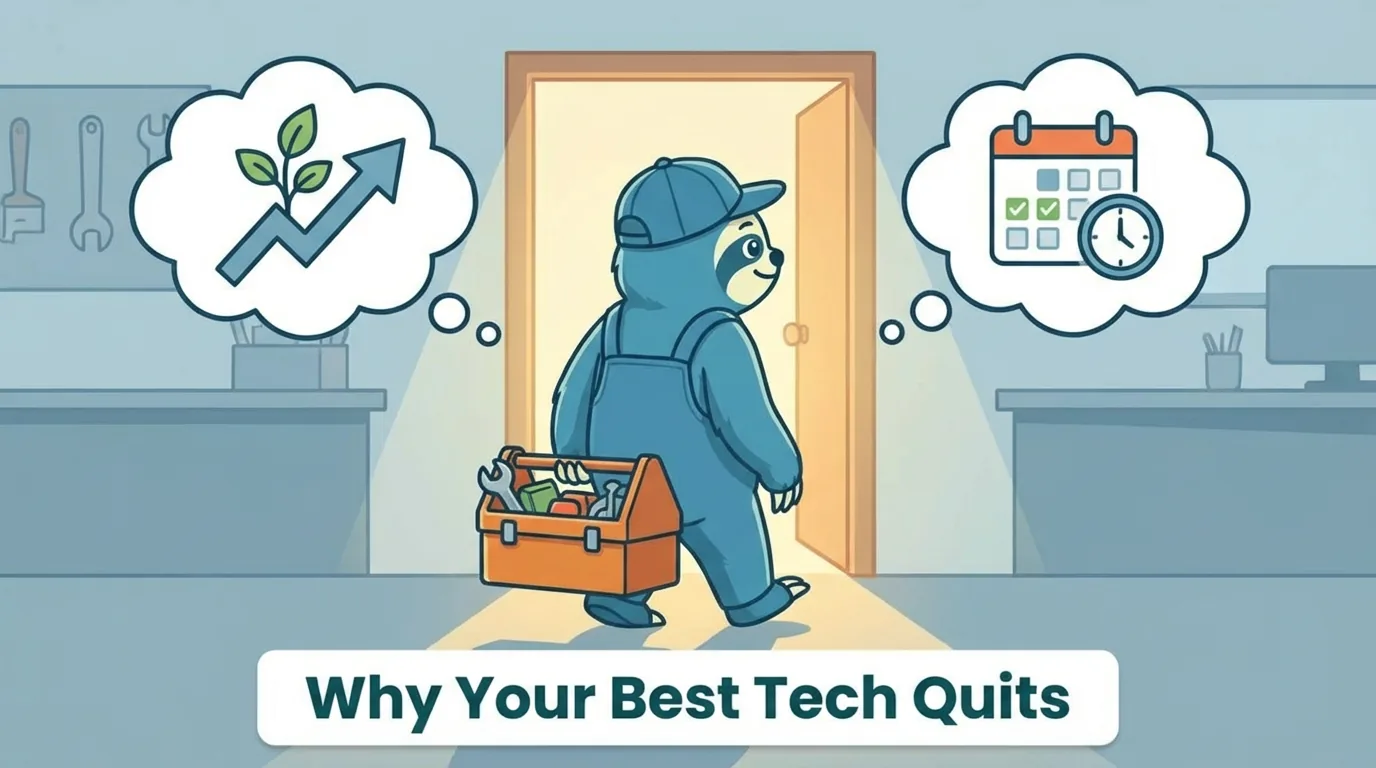
The pattern shows up in nearly every service trade. A tech is hired, trained, and integrated through year one. By month 12 they are productive, valued, and starting to feel like a real contributor. Somewhere between month 14 and month 22, something shifts. The energy drops. The engagement softens. They start showing up on time but not five minutes early. They stop volunteering for the harder jobs. And then, eight to ten months after the shift, they give two weeks notice. The owner is shocked. The tech is not - they have been thinking about it for the better part of a year. 🚪
The reason this hurts so much is that month 14-22 is exactly when the company has finished investing and is just starting to get returns. The first year of any tech's tenure is mostly cost - training, supervision, mistakes. Year two should be when the investment pays off through independent productivity and senior-level work. When the tech leaves at month 22, the company has paid for the training and gotten almost none of the productive years that were supposed to follow. And the replacement starts the cycle over from zero.
The Disengagement Curve: What Actually Happens in Months 14-22
The shift in year two is not random. Senior techs who leave between month 14 and month 22 follow a recognizable pattern that starts months before the resignation decision. Understanding the pattern is what makes intervention possible, because by the time someone gives notice the work is essentially done - they have already mentally moved on, and pay raises and promises at that stage almost never reverse the decision.
The curve has three phases. Phase one is plateau recognition, usually months 12-15. The tech notices that the rapid learning of year one has flattened out. The job that felt new and challenging six months ago feels routine. They start asking, internally, "is this it?" - sometimes consciously, often just as a vague dissatisfaction that is hard to name.
Phase two is opportunity testing, usually months 15-18. The tech starts quietly evaluating the market. They take a recruiter call. They check what other shops in the area pay. They notice when their friend at a competitor mentions a benefit their company does not offer. None of this is a decision to leave - it is information gathering, often unconscious - but it builds a sense of what alternatives exist.
Phase three is decision and exit, usually months 18-22. Something specific triggers the move. A pay disparity becomes too large to ignore. A particularly bad week with leadership pushes them past a threshold. An unexpected job offer arrives at the right moment. The tech accepts an offer, gives two weeks, and the exit is brief and businesslike. By the time the conversation happens, the decision has been made for months and is essentially irreversible. 📉
| Phase | Months | Key Behaviors |
|---|---|---|
| Plateau recognition | 12-15 | Reduced enthusiasm, "is this it?" questioning |
| Opportunity testing | 15-18 | Quiet market checking, recruiter responsiveness |
| Decision and exit | 18-22 | Specific trigger, resignation, brief notice |
Reason 1: They Have Stopped Growing
The single most common driver of year-two departures is the perception that growth has stalled. The first 12 months of any service trade tenure involve massive learning - new equipment, new procedures, new client types, new code requirements. By month 14, that learning has plateaued for most techs. They know the work. They know the systems. The novelty has worn off.
If nothing replaces the year-one learning curve, disengagement starts. The tech is still doing useful work but they are not getting better at anything specific. The job is no longer building them. For ambitious techs - which is exactly the kind you most want to retain - this stagnation is intolerable, and they will leave for a role that offers a new climb.
The fix is structured continued development. Not vague "professional development opportunities" but specific, scheduled progression through identifiable skills and certifications. A senior HVAC tech might progress through commercial systems, then variable-refrigerant-flow, then geothermal, then load calculations. A senior plumber might progress through service plumbing, then commercial, then medical gas, then design-build. The path needs to be visible, the milestones need to be defined, and the company needs to actually fund the training when the tech is ready for the next step.
| Year of Tenure | Development Focus |
|---|---|
| Year 1 | Core trade skills, company processes, client communication |
| Year 2 | Specialty area selection, advanced certifications, mentoring junior techs |
| Year 3 | Specialty mastery, complex job leadership, design or estimating skills |
| Year 4+ | Trade leadership, training role, possible path to lead/foreman |
The investment in continued learning typically runs 1,500-3,500 dollars per senior tech annually plus the working hours dedicated to training. The return is measured in retention - keeping a senior tech for an additional three years instead of losing them at month 22 is worth dramatically more than the training cost.
Reason 2: The Schedule Has Become Punishing
Year one of a tech's tenure usually has reasonable schedule expectations because they are still learning. Year two is when the schedule starts grinding them down - more emergency calls because they are now competent enough to handle them, more on-call rotations because seniority creates obligation, more weekend coverage because junior techs have less experience.
This pattern is especially brutal for techs in their late 20s and 30s, the exact demographic most service businesses depend on. These are people with young families, mortgages, and lives outside work. A schedule that ate their life entirely in their early career stops being acceptable when they have a partner, kids, or other commitments. They will leave for a shop with better schedule control even at lower pay.
The fix is treating schedule as a benefit and managing it actively. Track on-call rotations and ensure equity. Cap consecutive on-call weeks. Provide real time off after major emergency periods. Build the workforce with enough depth that no single tech becomes irreplaceable on weekends. Pay overtime fairly and avoid the temptation to load it on the most productive techs (who are the ones most likely to leave).
The often-missed leverage is predictability rather than less work. A senior tech who knows exactly when their on-call weeks are scheduled six months in advance can plan around them. A senior tech who finds out Friday evening that they are on-call this weekend is the one who starts checking the job market.
Reason 3: The Equipment Is Embarrassing or Frustrating
This sounds trivial but is one of the largest under-discussed factors in tech retention. Service techs work with their tools and trucks every day, all day. Working with bad equipment - vehicles that break down, tools that do not work, technology that loses information - creates daily friction that compounds over months into a deep negative perception of the company.
A senior tech driving a truck with 240,000 miles, broken AC, and bald tires is being told something every morning when they get in the cab: "your time is not important enough for us to fix this." A senior tech using a clipboard and paper invoices while their friend at another shop has tablet-based job management is being told: "we will not invest in the tools you need to do your job better." A senior tech whose tool budget was cut to save money is being told: "your productivity matters less than our short-term margin."
These messages are absorbed daily, and they accumulate. The tech often cannot articulate why they are unhappy because no individual incident is dramatic - but the cumulative friction wears down even high-performers. When a competitor offers them a clean truck, modern tools, and decent technology, the choice feels obvious.
The fix is treating equipment as a retention investment, not just an operational expense. Senior techs should drive vehicles in good condition. Tool budgets should be funded annually with clear approval processes for replacement. Technology - field service management software, communication tools, payment processing - should be modern and actually work in the field. Equipment quality is one of the cheapest signals a company can send about how they value their people, and senior techs receive that signal loud and clear. ⚡
Reason 4: The Relationship With Leadership Has Cooled
The last factor is the most interpersonal and the hardest to fix once it has decayed. Year one of any tech's tenure usually involves significant interaction with the owner or service manager - training, oversight, frequent course correction. By year two, the tech is operating independently and the daily contact has dropped to almost nothing. Many owners stop investing time in the relationship the moment the tech becomes self-sufficient.
The unintended message is "I cared about you when I had to manage you - now that you are competent, I do not need to interact with you." The tech notices. They feel like a cog rather than a teammate. They start to wonder why they are loyal to people who do not seem to care about them as individuals.
Senior techs typically need 30-60 minutes of meaningful 1-on-1 contact with leadership per month. Not status updates about jobs - real conversations about how they are doing, what they are working on professionally, what is frustrating them, what they want next. Done consistently, this prevents the relationship erosion that makes departure feel easy. Skipped routinely, it accelerates the disengagement curve.
The other dimension is recognition. Senior techs who consistently produce strong results stop hearing about it after year one. The praise that flowed during onboarding dries up because the tech is "supposed to" be performing at this level now. Continued specific recognition - "I noticed you handled that difficult client really well" or "the way you trained the new tech yesterday was exactly right" - costs nothing and signals that the work is seen. Owners who cannot find time to do this routinely struggle with year-two retention. ✅
The Stay Interview: Catching Disengagement Early
The exit interview is structurally too late. By the time a tech is leaving, the relevant decisions are already made and the conversation is largely a postmortem. The intervention point that actually changes outcomes is months earlier, before the disengagement curve completes - which means asking the right questions of senior techs while they are still engaged enough to answer honestly.
The stay interview is a structured conversation, ideally every 90-120 days for senior techs, that asks three things: what is working well in your role, what is not working, and what would you change if you could. Twenty to thirty minutes, casual setting, no laptop or notes during the conversation. The owner or service manager listens more than they talk and writes down the substance afterward.
| Question Theme | Sample Question |
|---|---|
| What is working | "What is the part of this job that you would not want to lose?" |
| Growth | "What do you want to be learning that you are not currently learning?" |
| Frustrations | "If you could change one thing about how this place runs, what would it be?" |
| Schedule | "Are you happy with your hours and on-call schedule?" |
| Future | "Where do you see yourself in two years if everything went well?" |
The stay interview only works if the manager actually does something about what they hear. A pattern of techs raising the same issue - say, that the truck condition is becoming a problem - that gets nodded at and never addressed produces worse outcomes than not asking at all. The act of asking creates an obligation to respond, and breaking that obligation deepens disengagement faster than ignorance would.
Pulling It All Together
Year-two departures are not random and they are largely preventable. The same four factors show up again and again in service trade exits: stalled growth, punishing schedule, frustrating equipment, and cold leadership relationship. Owners who actively manage all four for their senior techs retain people for years longer than owners who treat retention as something that happens by itself.
The math always favors retention. Even an aggressive program of professional development, equipment upgrades, schedule investment, and structured leadership engagement costs a fraction of what replacing senior techs costs. The companies that figure this out build deep benches of experienced talent that compound over years - and become very difficult for competitors to compete against, because the institutional knowledge in those teams is essentially uncopyable.
The companies that do not figure this out keep paying recruiting fees, keep onboarding replacements, and keep wondering why their margins are tighter than they should be. The cost is hidden in plain sight, distributed across line items that look like normal business expenses, and the pattern only becomes visible when someone actually adds it up. By then, the next senior tech is already in month 16, evaluating their options.
Frequently Asked Questions
Ready to transform your field service business?
Start using WorkZen today. It's free to get started!